

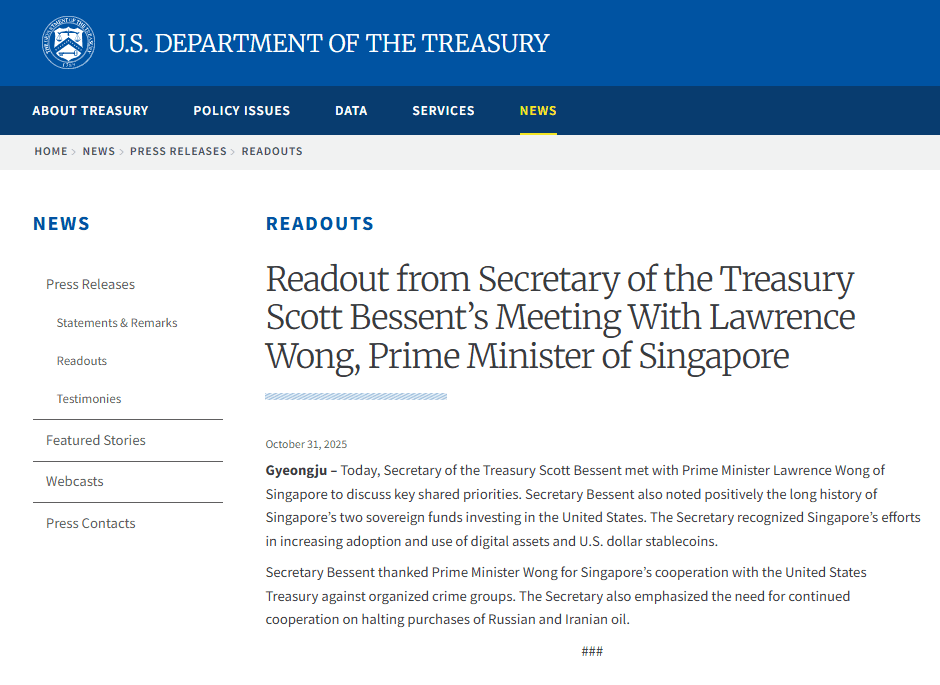
US Treasury Secretary Scott Bessent told the 2025 APEC leaders in Gyeongju, South Korea that Singapore is making progress in digital asset adoption and stablecoin regulation. He said this in a meeting with Prime Minister Lawrence Wong, according to a statement from the U.S. Treasury Department. The discussion comes as APEC countries focus on global growth, energy security and technology.
Mr. Bessent also said during the Economic Leaders’ Informal Dialogue that the United States, through its cooperation with APEC countries, “is investing record levels of capital in advanced manufacturing and technology sectors.” This comment placed digital assets, stablecoins, and regulated cross-border finance on the same economic agenda as trade and manufacturing.
The Treasury Department noted that Bessent had traveled throughout Asia with US President Donald Trump, including stops in Malaysia, Japan and South Korea. The visit signaled that the US wants to remain active in digital finance talks in the Asia-Pacific region, where Singapore has already set the rules.
Singapore’s digital asset adoption outpaces scale
Singapore, with a population of 5.9 million, operates as a regional hub for digital assets, tokenized finance, and licensed cryptocurrency exchanges. According to the December 2024 ApeX Protocol Report, Singapore granted twice as many crypto licenses in 2024 as it did in 2023. This shows that digital asset companies continue to enter the market under the current regime.
The same ApeX Protocol report cited Singapore as a leader in Web3 employment, registered cryptocurrency exchanges, and blockchain-related patent filings. This means the country is open not only to the storage and trading of digital assets, but also to on-chain business models and crypto-related intellectual property.
For this reason, Singapore is often cited at APEC and G20 talks as an example of digital asset adoption that maintains stablecoin regulations. That was the reason for Bessent’s praise.
Stablecoin regulation will remain central to Singapore
On May 30, the Monetary Authority of Singapore (MAS) issued a directive. Cryptocurrency companies that provide services to overseas users are required to obtain a license in Singapore or exit. This move coupled the introduction of digital assets with clear licensing rules. It also linked the sector to AML requirements and cross-border supervision.
In September 2025, the ApeX Protocol report called Singapore the most “crypto-obsessed” country. Approximately 25% of people own digital assets. He also said that Singapore is leading in crypto-related searches. This level of retail usage will help states regulate stablecoins, payment tokens, and digital asset service providers.
In October, Singapore hosted Token2049, one of the largest cryptocurrency and digital asset events. The event confirmed that while MAS keeps its licensing framework in effect, the country still allows the sector to operate openly.
APEC 2025 Framework on Digital Assets
Founded in 1989 and comprised of 21 member countries, APEC continues to aim for sustainable growth and economic cooperation in the Asia-Pacific region. However, the 2025 agenda includes technology, energy security and digital finance, with stablecoin regulation and the introduction of digital assets forming part of formal talks.
When the US Treasury links record capital inflows into the technology sector to APEC cooperation, it suggests that regulated digital assets, stablecoins, and licensed cross-border platforms should be aligned with existing financial rules rather than operated separately.
This comes as global bodies, including the Basel Committee on Banking Supervision, consider how banks should treat crypto asset exposure and stablecoins due to the rise in regulated asset-backed tokens. Singapore’s model — license first, expand later — fits in that direction.