

Uniswap founder Hayden Adams has submitted the protocol’s first-ever governance proposal, titled “UNIfication.” The plan aims to enable protocol fees, introduce a UNI burn mechanism, and realign incentives across the ecosystem.
This announcement boosted investor confidence. Following Adams’ announcement, Uniswap’s native token, UNI, soared to a two-month high.
sponsored
Explanation of the unified proposal
The UNIfication proposal, proposed by Adams on behalf of Uniswap Labs and the Uniswap Foundation, aims to turn Uniswap into a leading decentralized exchange. This plan will enable protocol fees used to burn UNI tokens, making them a deflationary asset.
At launch, fees will apply to Uniswap v2 and major v3 pools on Ethereum. For v2, liquidity providers (LPs) earn 0.25% per trade and 0.05% is allocated to the protocol. For v3, Governance collects either a quarter or a sixth of the liquidity provider fee based on the fee level.
The proposal calls for a retrospective burn of UNI 100 million from the Uniswap treasury. This represents the amount that could have been spent if the fee had been active since the inception of the protocol.
“Unichain was launched just nine months ago and already processes approximately $100 billion in annualized DEX volume and approximately $7.5 million in annualized sequencer fees. This proposal directs all Unichain sequencer fees to the write mechanism, except for L1 data costs and 15% towards Optimism,” the proposal reads.
The introduction of protocol fee discount auctions will allow users and liquidity providers to bid during fee-free trading periods. This innovation aims to benefit liquidity providers and maximize the value of the protocol. Aggregator hooks allow Uniswap v4 to act as an on-chain aggregator and collect protocol fees from external liquidity sources.
sponsored
Governance and structural change
In addition to fee-based activation and burn, the UNifation proposal would overhaul Uniswap’s structure. Uniswap Labs will discontinue collecting fees on its apps, wallets, and APIs and will instead use funds to drive growth and adoption of the protocol.
The plan also transfers Foundation staff to institutes under the Treasury-backed Growth Fund. This move is aimed at unifying the ecosystem and accelerating the expansion of the protocol. Unisocks liquidity owned by Governance will be migrated to v4 on Unichain, and the liquidity position will then be burned.
This proposal requires approval from the Uniswap community before the changes take effect. The governance process will take approximately 22 days, including a 7-day comment period, 5-day snapshot voting, and 10-day on-chain execution period.
Adams emphasized the importance of the proposal in his announcement on X, highlighting the regulatory hurdles facing Uniswap Labs and noting that it would incur significant legal costs. Recent evolutions in the regulatory environment support this change in governance.
sponsored
“UNI was launched in 2020, but for the past five years, Labs has been unable to meaningfully participate in Uniswap governance, severely limiting how we can build value into the Uniswap community. That ends today!” he said.
Market reaction and UNI price trend
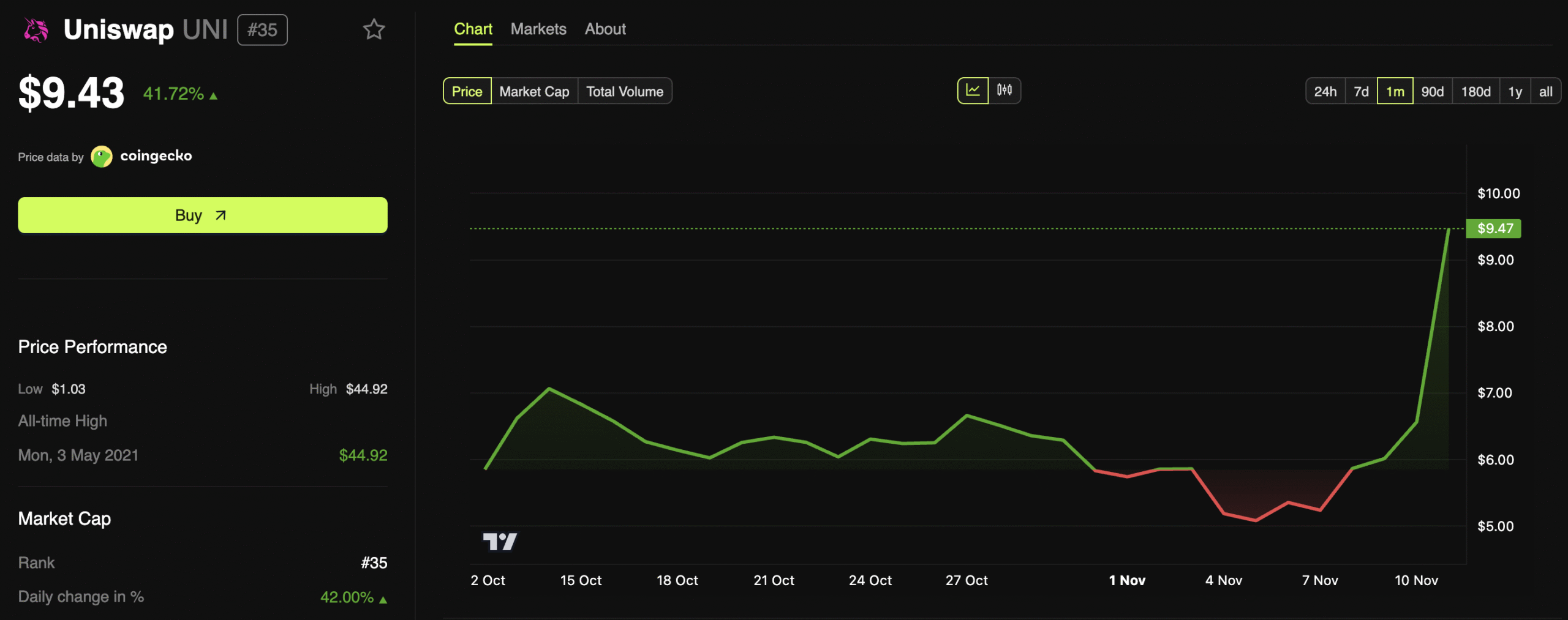
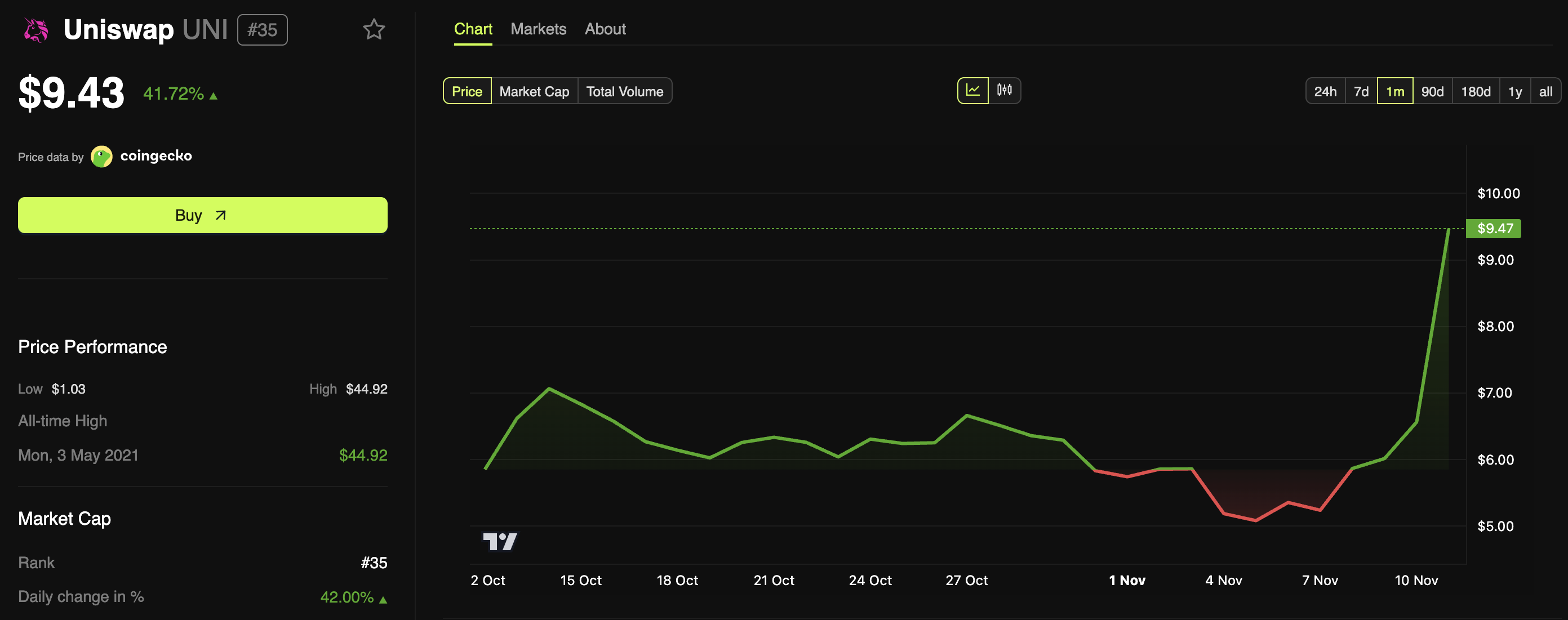
After Adams’ announcement, UNI’s price skyrocketed. It reached a high of $10 in early Asian trading. This level was last seen in September.
At the time of writing, the altcoin was trading at $9.43. This represents an increase of 41.7% over the past day.
sponsored
This reaction highlights investors’ confidence in Uniswap’s new direction. Token burn plays an important role in forming the long-term value of cryptocurrencies.
The permanent removal of tokens from circulation could reduce supply and increase scarcity. If demand is stable or increasing, as often happens with successful ecosystem expansion, this scarcity can put upward pressure on prices.
“Uniswap could go parabolic if the fee switch goes into effect. With $1 trillion in year-to-date trading volume just counting v2 and v3, that would be about $500 million in annual burn if volume holds up. The exchange holds $830 million, so even with the unlock, a supply shock seems inevitable. Please correct me if I’m wrong,” said Ki Young, CEO of CryptoQuant. Ju said.
However, some community members have expressed concerns about insider interests and potential conflicts of interest. Critics questioned whether early investors were able to position themselves ahead of the announcement and what impact the proposal could have on existing stockholders.