

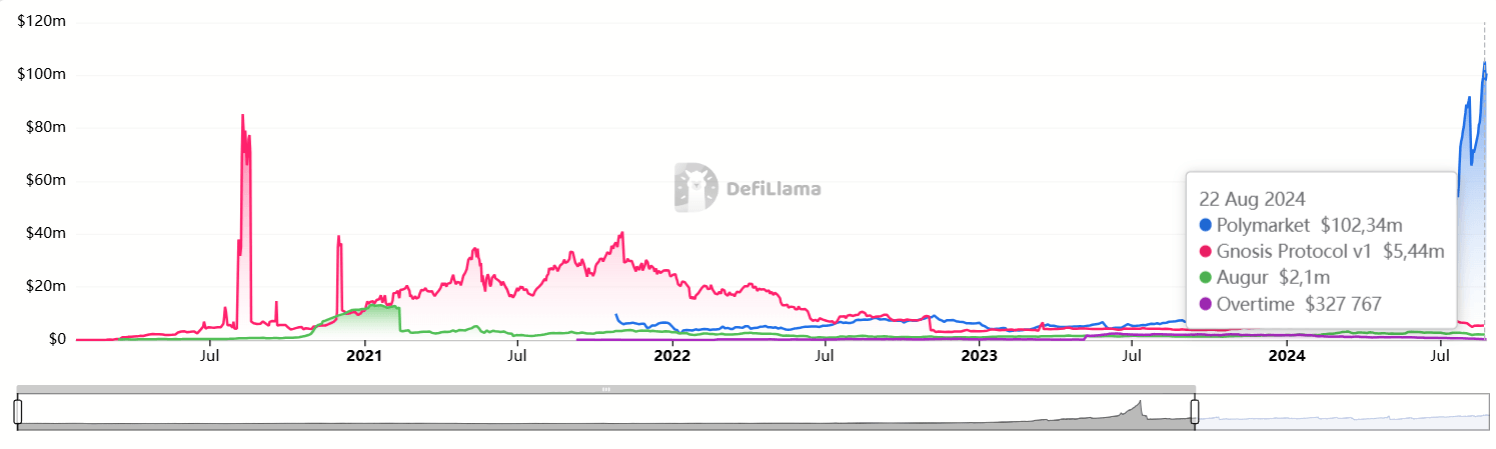
While Polymarket and Kalshi are currently considered the leaders of the crypto prediction market, this space was once led by other players with very different approaches.
Intercontinental Exchange’s move to invest up to $2 billion in Polymarket and Kalsi’s $300 million funding turn a once-niche corner of cryptocurrencies into a mainstream trading category.
“The real benefit for ICE is not just to clear contracts, but to monetize the data and sell odds as a sentiment factor alongside interest rates and credit, and every rumor pays a fee,” Michael Ashley Shulman, partner and chief information officer at Running Point Capital Advisors, told Reuters.
But the prediction market boom is the culmination of years of technological experimentation, regulatory battles, and product rethinking, not a passing trend.
Where are Augur and Gnosis?
Long before Polymarket and Kalshi came onto the scene, the decentralized prediction markets sector was already crowded with Gnosis, with a total of over $85 million locked at its peak in August 2020, followed by Augur with over $13 million, according to data from DefiLlama.

Announced during the ICO era, Augur was founded in 2014 by Joey Krug, Jack Peterson, and Jeremy Gardner and went live in 2018, promising a decentralized prediction market with a native reputation token (REP) and an oracle system for reporting results.

Although the idea was sound on paper, early users quickly encountered practical problems. Third-party node services were inconsistent, blockchain synchronization issues and high Ethereum gas fees at the time slowed the market.
As Alchemy, a blockchain infrastructure company that also provided services to Augur, explained in a blog post, the project took months to recover because Augur initially offered a “free third-party node service that was slow, unreliable, and frequently provided incorrect blockchain data.”
Mike Garland, head of product at Alchemy, explained to The Defiant that Augur and Gnosis were “pioneers in launching prediction markets built on crypto rails, testing the limits of what decentralized applications could do at a time when blockchain was still in its infancy.”
“Many of the technical hurdles they faced, such as scalability, transaction costs, and wallet UX, reflected the broader landscape of Ethereum at the time,” he added.
Garland noted that Polymarket is also currently using Alchemy’s products.
Some suggested that Augur jumped on the token, gathered hype and money before the platform had any real users or liquidity, and then struggled for years just to get a basic app working on Ethereum. Zane Haufman, CEO of Odyssey Finance, said in a post on
“It was a full Ethereum node that required downloading a desktop app and maintaining it to use it. It took several hours just to connect. Gnosis v1 (Omen) was at least usable,” Hauffman wrote.
As DefilLlama founder @0xngmi pointed out in an X post, “The craziest thing is that Augur was #1 at one point. Had they continued, they could have gotten a 9 billion valuation from Polymarket.”
Krug, one of Augur’s co-founders, did not respond to multiple requests for comment from The Defiant.
Foundation for new rivals
Gnosis, which was the largest forecasting platform before Polymarket came on board, took a completely different path.
Unlike Augur, which rushed to issue tokens and struggled to acquire users, Gnosis, founded in 2015, focused on building tools first. Its conditional token framework allows anyone to create markets and turn the outcome of events into tradable tokens.

By July 2020, Gnosis stopped operating its consumer prediction site and focused on its core technology. Meanwhile, community-run collective DXdao used its technology to build Omen, a decentralized platform for trading event outcomes.
Ironically, Gnosis’ technology became a key element for later winners like Polymarket, which runs its outcome token as ERC-1155 on Polygon. Meanwhile, Gnosis itself has shifted focus to other projects such as Safe, CoW Exchange, and Gnosis Chain, and has stepped back on its consumer prediction market efforts.
Gnosis did not respond to The Defiant’s request for comment.
Difference between polymarket and calci
Polymarket and Kalshi sought to solve two fundamental questions: “Where does liquidity come from?” “Is the product legal and reliable for the customers I care about?”
Polymarket’s advantage comes from its low betting threshold, clean UI, low-cost rails, and strong on-chain ethos. Leverage Gnosis’ conditional token primitives to mint the resulting positions as ERC-1155 tokens on Polygon, minimizing fees per trade. A hybrid off-chain/on-chain order book enables near-instant execution and familiar order types for retail users.
However, despite these benefits, polymarkets still struggle with the reliability of their resolution mechanisms, as the oracle of universal market access is frequently controversial and often favors whales over average traders.
Rather than building a market that runs natively on blockchain, Kalsi has chosen a different path, prioritizing legal certainty and institutional distribution with off-chain order matching, storage, and clearing.
This model keeps payments, customer custody, and compliance within traditional financial rails and regulatory oversight. And it worked: in November 2020, Calsi won approval from the Commodity Futures Trading Commission, making it the first federally regulated prediction market of its kind in the United States.
In an effort to deepen its connection with the crypto community, Karsi has hired crypto influencer John Wang to fill the gap.
In contrast, Polymarket operates offshore. However, recent developments indicate that the company also plans to enter the US market, with the company acquiring QCEX, a regulated derivatives exchange and clearing house, for $112 million in July, giving Polymarket the necessary regulatory approvals.
The company is also said to be planning to launch its native token POLY, but details and timing have not yet been disclosed.