

Implementation will depend on foreign partners willing to issue tokenized versions of Russian companies’ shares despite sanctions from the EU and the US.
Russia’s central bank said in a recent statement that it would consider allowing the tokenization of domestic company shares to be made available to foreign investors, a move that could open up new channels for capital inflows without relying on sanctioned infrastructure.
As local news media TASS reported on Thursday, October 9, Bank of Russia First Deputy Governor Vladimir Chistyukhin told reporters at the Finopolis 2025 forum that tokenizing Russian stocks for overseas trading is a “possible option.” But he added that this effort will primarily depend on foreign partners willing to create and operate tokenized versions of Russian assets abroad.
“Yes, this is a possible option. But in this matter, a key role is assigned precisely to foreign partners, i.e. foreigners who are willing to tokenize Russian assets in order to carry out buying and selling abroad,” Tistyukhin said, according to the English translation of the original text by TASS news agency.
Tystyukhin’s comments about foreign partners “willing to tokenize Russian assets” reflect the reality that the U.S. and European regulations that currently impose sanctions on the Russian Federation largely prohibit people from those regions from purchasing Russian stocks and bonds.
For example, the U.S. Treasury Department’s Office of Foreign Assets Control (OFAC), under several executive orders, prohibits U.S. persons from purchasing both new and existing debt and equity securities issued by entities within the Russian Federation.
Similarly, the Council of the European Union has prohibited trading in transferable securities issued by Russian publicly managed entities after April 12, 2022.
Moscow Exchange adds crypto index
The tokenization plan builds on an earlier proposal by Sergei Shvetsov, chairman of Russia’s largest stock exchange, the Moscow Exchange, which said the exchange could give global investors exposure to Russian assets while bypassing intermediaries and systems subject to Western sanctions, local business media RBC reported on September 29.

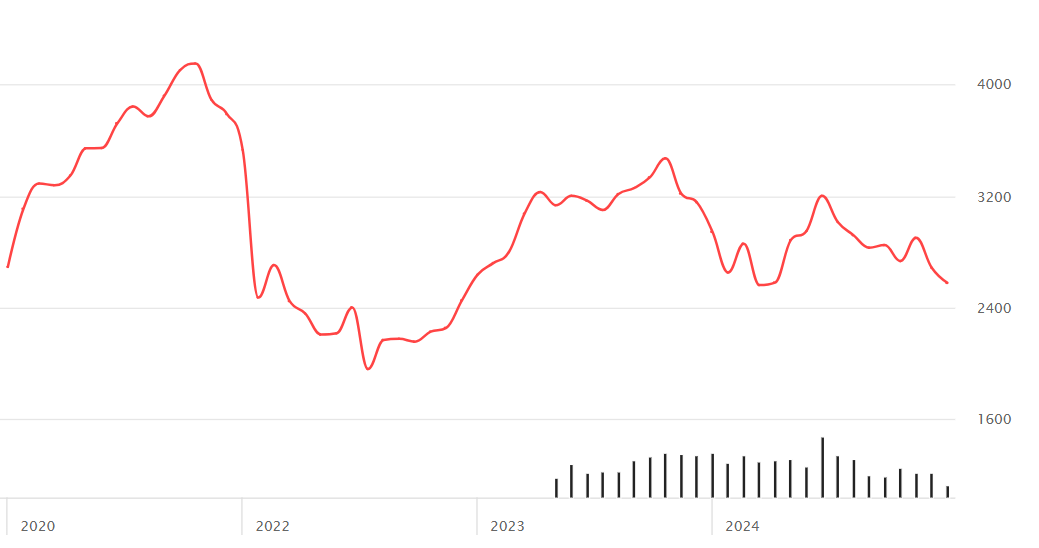
At the time of writing, Russia’s IMOEX index, which tracks the 50 most liquid Russian stocks on the Moscow Exchange, is down about 34% since the beginning of 2022, hovering around levels last seen in April 2022.
In parallel with the tokenization push, the Moscow Exchange is deepening its involvement in cryptocurrencies and plans to expand its offering of cryptocurrency indexes. Bitcoin’s existing index (calculated once daily using BTC/USDT perpetual futures and swap data from Binance, Bybit, OKX, and Bitget) will be joined by 10 new indices tracking crypto assets, including spot Bitcoin and Ethereum (ETH) indices, RBC reported on October 8, citing Moscow Exchange Director Viktor Zhidkov.
He also added that, pending regulatory approval, the exchange plans to launch quarterly and perpetual futures and options based on 10 new cryptocurrency indices.
In early October, Mike Novogratz’s cryptocurrency firm Galaxy Digital predicted that based on its baseline scenario, tokenized assets could reach a market capitalization of $1.9 trillion by 2030, of which tokenized stocks would represent a small portion.
Last month, Nasdaq applied to launch tokenized versions of its listed stocks and products.