

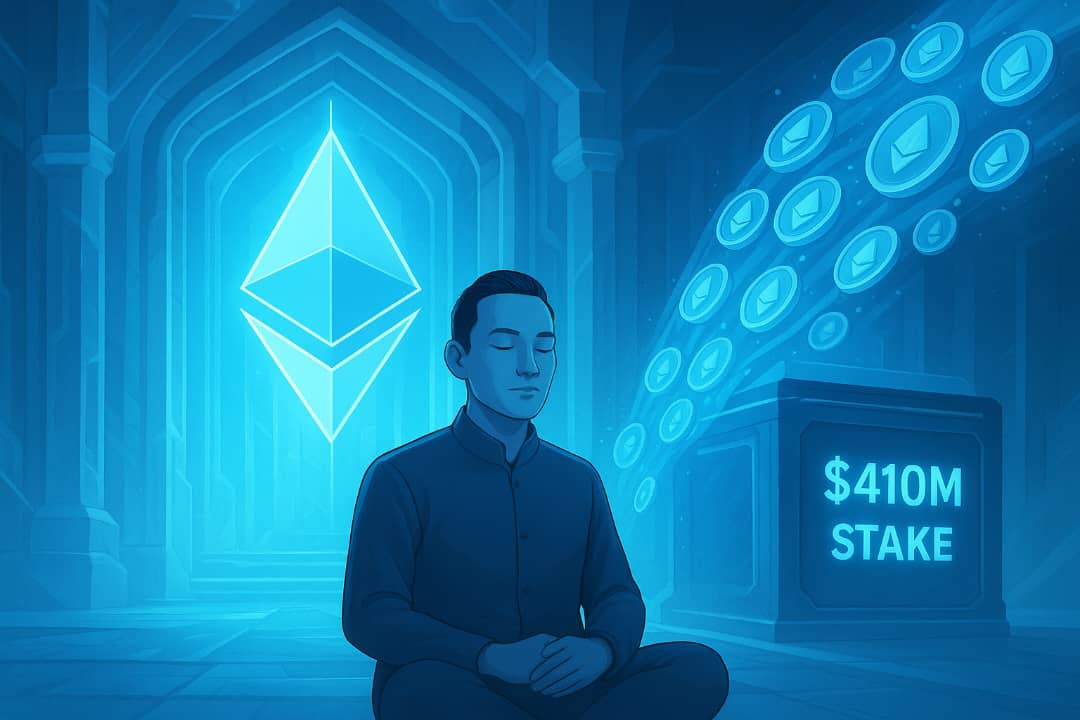
Ethereum whales are back in accumulation mode again, but this time it’s not just retail panic buying. Big names are on the move.
TRON founder Justin Sun just staked 45,000 ETH worth $154.5 million through Lido, Ethereum’s largest liquid staking platform.
This deposit came shortly after he withdrew the same amount from AAVE, suggesting a calculated transition from loan yield to staking rewards.
Sun currently holds approximately $534 million in Ethereum, slightly more than his TRX holdings of approximately $519 million. For someone who built an empire on TRON, this is a loud statement, but Ethereum remains the king of smart contracts, and Sun knows it.
Data from Arkham Intelligence confirms this move with on-chain records showing that it was performed in a single transaction, causing a slight increase in the total value of locked lidos.
Billion dollar ETH whale accumulation
Justin Sun isn’t the only one playing aggressively. Over the past three days, whales have purchased 394,682 ETH, worth approximately $1.37 billion, according to on-chain data.
In a market where most traders are still waiting for a Bitcoin breakout, smart money is quietly building exposure to Ethereum. These are not retail-level purchases, but inflows of millions of dollars from the wallets of institutional investors and wealthy individuals.
On-chain researcher 0xNonceSense noted that the pattern of accumulation is consistent with ETH’s recent decline, suggesting that whales are focusing on dollar-cost averaging rather than following price movements.
🚨 Breaking news
In the last 3 days, many whales bought a total of 394,682 pieces $ETHworth $1.37 billion.
TOM LEE’s Bitmin made a big move today by buying 40,718 pieces $ETH $137 million.
Whales continue to accumulate Ethereum. Stop selling to them! pic.twitter.com/U8mKvsbr6i
— NonceSense (@0xNonceSense) November 6, 2025
Tom Lee’s Bitmine is here in a big way
Adding fuel to the bullish narrative, Tom Lee’s Bitmine just bought 40,718 ETH, worth $137 million.
This purchase alone represents over 10% of this week’s total whale accumulation.
This move shows confidence from institutional investors even though Ethereum is hovering around consolidation levels. Bitmine’s aggressive positioning suggests that they are betting on the next breakout rather than waiting for it.
Market players see this as a strong vote of confidence in Ethereum’s fundamentals. If financial institutions increase exposure while the broader market hesitates, it could signal the early stages of a new accumulation phase.
Ethereum records 24,192 TPS, a new era of scaling
While the whales were accumulating, Ethereum itself just hit an all-time high throughput record of 24,192 transactions per second (TPS).
This spike in network performance is largely thanks to our Layer 2 solutions, especially Lighter, which has consistently handled around 4,000 TPS on its own since its release.
This milestone marks the beginning of an era of scaling for Ethereum, where L2 takes over the execution layer and turns Ethereum into the backbone of payments and security for the entire ecosystem.
This improvement isn’t just a technical milestone, it’s a narrative shift. For years, Ethereum’s critics have pointed to slow transaction speeds and high gas fees as evidence of Ethereum’s inability to scale. But now the data shows that’s not the case.
Developers and analysts see this as proof that Ethereum’s roadmap is working. L2 is no longer experimental. These are production-ready and encourage real-world use.
$ETH Leveraging Layer 2 Lighter, we achieved a record 24,192 TPS. It has been consistently around 4,000 TPS since launch.
This is a real network run.
Throughput is higher, fees are lower, and efficiency is higher.@Ethereum @VitalikButerin pic.twitter.com/qC0AA4auvc— Crypto Patel (@CryptoPatel) November 6, 2025
The big picture: smart money accumulation
When Ethereum whales buy when the market is quiet, it often signals the start of a new accumulation cycle.
Smart money tends to act before the story changes, before the headlines change, and long before retail buyers notice.
That’s exactly what’s happening right now.
- Purchased 394,682 ETH in just 3 days
- $1.37 billion inflow
- 45,000 ETH staked by Justin Sun
- 40,718 ETH was purchased by Bitmine
These are not random moves, but strategic moves by companies that understand where the market is heading.
Ethereum’s fundamentals are stronger than ever, including record throughput, strong validator yields, and a deepening ecosystem of L2 projects.
And while prices have stabilized, on-chain data has shown consistent outflows from exchanges, indicating investors are moving ETH from trading platforms into long-term storage or staking.
Why the market should pay attention
The combination of whale accumulation and record network performance paints a bullish medium-term picture for Ethereum.
Historically, similar on-chain activity preceded large gatherings. The 2021 bull market began with a similar wave of whale buying, especially through staking and long-term holding.
The difference this time is scale and infrastructure. Ethereum’s L2 landscape, which includes Arbitrum, Optimism, and now Lighter, can process thousands of transactions per second and supports a global ecosystem of decentralized apps and finance.
Meanwhile, the liquidity staking economy (led by Lido, Rocket Pool, and EigenLayer) offers new revenue opportunities and incentivizes whales to hold for the long term rather than trade for the short term.
The current Ethereum story is not just about price, but also belief.
While traders panic over short-term volatility, billionaires and institutional investors are building long-term exposure.
Justin Sun’s $150 million staking and Bitmine’s $137 million purchase are obvious. The people with the most information and resources are betting on the future of Ethereum.
With record network speeds, a surge in whale activity, and a maturing ecosystem, Ethereum appears to be entering a new phase where fundamentals, rather than hype, are in charge.
So when you see the next dip, remember who is buying it.
Disclosure: This is not trading or investment advice. Always do your research before purchasing any cryptocurrency or investing in any service.
Follow us on Twitter @themerklehash Stay up to date with the latest crypto, NFT, AI, cybersecurity, and metaverse news.