

As Ethereum enters the TradFi spotlight with increasing inflows into ETFs and DATs, experts are considering the question: “Is it a good thing for DeFi’s biggest chain?”
Ethereum’s biggest threat may actually be what many see as Ethereum’s next milestone: institutional adoption. At least that’s what pcaversaccio, a pseudonymous analyst at blockchain security firm Seal911, recently suggested on X, warning that traditional finance could tame the network’s open, cypherpunk ethos.
In a late September post, pcaversaccio argued that the more large financial institutions enter the ecosystem, the more they want to “have greater influence over future hard fork decisions,” and treat compliance as a feature rather than a constraint.
“Look, we can go all mainstream, but we should actually celebrate it when Ethereum isn’t picked by trade clowns. It means we’re doing something right. I won’t allow Ethereum to be tamed, castrated, or turned into just a corporate playground. Never,” writes pcaversaccio.
Institutional Capital: The Rise of DAT, ETP
The post landed just months after Ethereum began a strong recovery from a network that some saw as being at the center of a new wave of hype. The resurgence of the ecosystem was driven in part by new features in the Pectra upgrade, such as account abstraction and sponsored transactions, new Ethereum Foundation leadership and roadmap, and the resulting spike in ETH prices, which returned capital and attention to staking and Layer 2.
Spot Ethereum exchange-traded products (ETPs) in the United States have also gained significant momentum this summer, one year after their debut. The total net assets of the entire ETH ETF have doubled since January to $26.5 billion, according to data from SoSoValue, showing increased interest among institutional investors.
In July, net inflows into the ETH ETF exceeded $5.4 billion, making it the largest month since its inception. In August, these products set a single-day record, with net inflows exceeding $1 billion on August 11th.
A surge in demand from crypto asset treasury companies, also known as digital asset treasury (DAT), further fueled the hype.

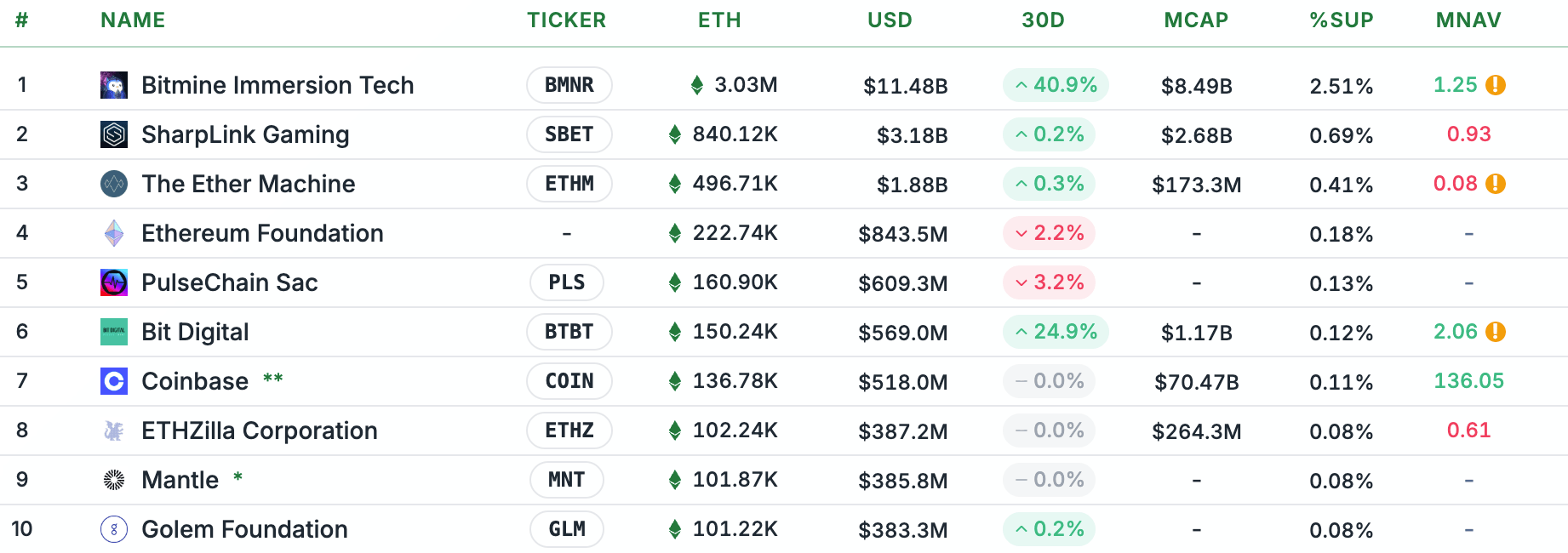
Bitmine Immersion, backed by Tom Lee, currently holds over 3 million ETH in its treasury, while Sharplink’s ETH DAT, chaired by Joseph Rubin, has the second-largest stockpile with over 840,000 ETH. According to Strategic ETH Reserve data, the total amount of ETH held on the company’s balance sheet is over 5.9 million.
ETH staking
Meanwhile, staking on the Ethereum network also continues to set new all-time highs, with over 35.7 million ETH, worth over $138 billion at current prices, locked in staking contracts. Additionally, the emergence of liquid staking, institutional custody products, and structured yield products has made it easier for companies to earn rewards from idle ETH.

As the hype grows, not everyone sees institutional adoption as a threat. Cyprian Grau, leader of the zkEVM Rollup Status Network, told The Defiant that the institutional adoption of Ethereum is a “net positive” as it brings the value of Ethereum “from the crypto-native bubble into the real economy.”
As Grau explained, what institutions actually want is “aligned with Ethereum’s ultimate objectives of faster payments, lower fees, scale, decentralization, trusted neutrality, and ultimately privacy.” Grau added:
“They don’t want to settle for each other’s private ledgers. They want a trusted, neutral platform where everyone can trade under the same rules. Any attempt to move the governance of core protocols will put those assets at risk, so the dominant strategy is cooperation rather than capture.”
Layer 2 as a midpoint
According to Grau, if an institution wants more control and customization, it will build on L2, which is where TradFi Pilot comes in. As Status Network leaders pointed out, L2 inherits the security and liquidity of Ethereum and retains the configuration capabilities and tools of the Ethereum Virtual Machine (EVM), allowing enterprises to design their own execution and policy rules.
For example, Deutsche Bank began testing a layer 2 blockchain called “Project Dama 2” based on ZKsync in late 2024 to help tokenize real-world assets while addressing regulatory and compliance concerns, The Defiant reported at the time.
“There is no real threat.”
Jérôme de Tichey, president of Ethereum France and CEO of the Ethereum infrastructure project Cometh, told The Defiant that Ethereum is “clearly the biggest economic playground of our lives, but there is no need to worry about different institutions joining in on the fun.”
Even if TradFi doesn’t choose Ethereum directly, “they are largely choosing EVM and delaying the inevitable: their Alt-L1 becomes L2. They will do so with a focus on deep network neutrality and censorship resistance,” he said. Ethereum French President added:
“In my opinion, arguments about the potential legal jeopardy of validators forced to include sanctioned transactions are overstated. There are many other venues for enforcing OFAC or general AML compliance. Ethereum has consistently made a ‘neutral transport’ claim. Validators operate as if they operate on TCP/IP; they transfer any valid payload that the protocol allows.”
Alon Murach, CEO and co-founder of SSV Labs and a core contributor to the decentralized staking protocol SSV Network, says concerns that institutions could threaten Ethereum are “mostly unfounded.” “Even the largest consortium will not be able to do anything about the future of Ethereum,” Mulock explained in commentary for The Defiant, adding that institutions “are not a real threat to Ethereum or its decentralization mission.”
“L2 big names like Robinhood will continue to be built on Ethereum and stick around, and the amount of activity these names bring to the ecosystem is ultimately a good thing,” Murok said. The SSV Labs co-founder added that while there are still “legitimate concerns” that institutions staking large ETH holdings could lead to increased centralization of validators, “there are a wealth of industry-ready solutions to this, including decentralized validator technology.”
Earlier this year, Robinhood announced tokenized stocks on Arbitrum, a Layer 2 network built on Ethereum, for customers in the European Union. Eventually, the fintech brokerage giant plans to move the tokenized shares to its own Arbitrum-based L2, Robinhood Chain, which the company plans to launch in 2026.