

important notes
- Based on recent advances from IBM and Google, experts estimate that a quantum computer capable of cracking Bitcoin encryption could arrive within five to 10 years.
- Dormant Satoshi-era coins totaling 1.72 million BTC in old address formats face the greatest risk from quantum algorithm attacks.
- The Bitcoin community remains divided on whether to burn or migrate vulnerable coins, and proposed quantum-resistant solutions pose major problems with scaling.
The Human Rights Foundation released a report on October 31, 2025, warning that quantum computers related to cryptography pose a significant threat to Bitcoin.
BTC
109 556 dollars
24 hour volatility:
1.6%
Market capitalization:
$2.18 trillion
Vol. 24 hours:
6.096 billion dollars
safety. The report states that 6.51 million BTC will be vulnerable to quantum attacks within the next five years.
According to the report, the vulnerable supply includes 1.72 million BTC in initial public key payment addresses. These coins are worth approximately $188 billion, are considered dormant, and contain an estimated 1.1 million BTC belonging to Satoshi Nakamoto. An additional 4.49 million BTC remains vulnerable, but active holders can migrate these funds to a quantum-secure address type.
Timeline and technological threats
Eighty experts who attended the Presidio Bitcoin Quantum Summit in July 2025 estimated that a quantum computer capable of decrypting Bitcoin could emerge within five to 10 years. Market analyst Charles Edwards’ warning of a quantum threat in 2026 echoes the urgency expressed at the summit. Recent hardware advances from IBM, such as the 120-qubit system and Google’s 105-qubit Willow chip, make threat assessment even more urgent.
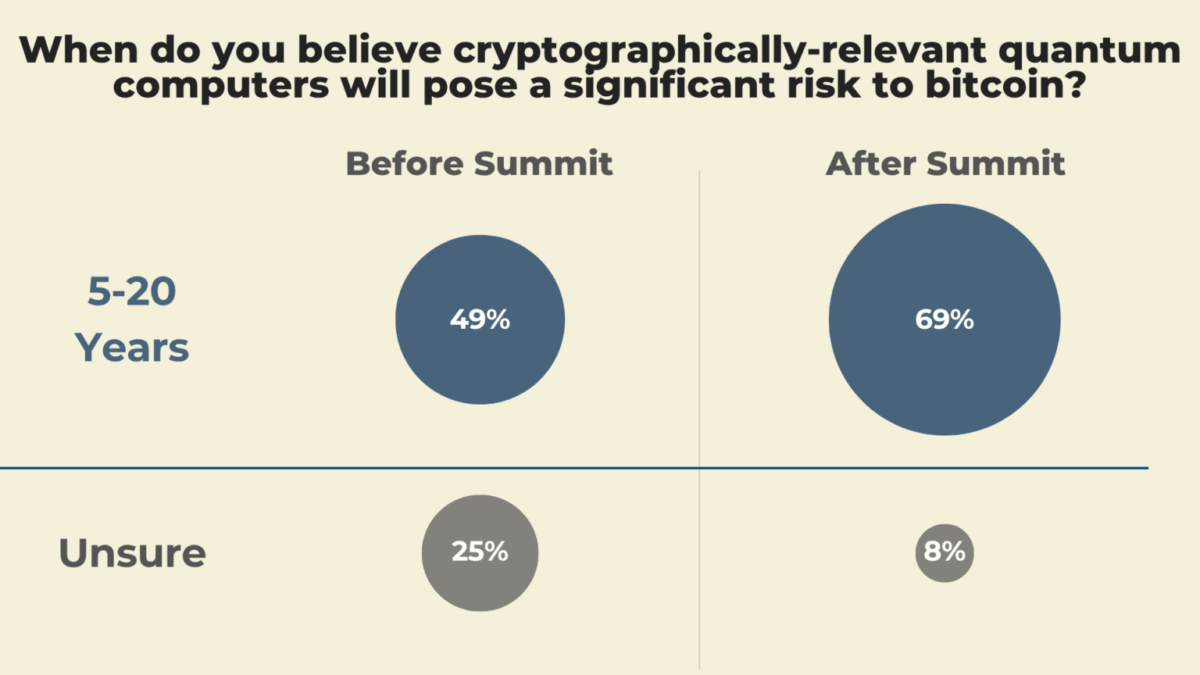
Presidio Bitcoin Survey | Source: Presidio Bitcoin
A quantum computer running Scholl’s algorithm could perform long-range attacks against addresses where public keys have been exposed, such as in P2PK format or reused addresses. Short-range attacks that target new transactions over a short period of time also pose a risk to Bitcoin’s security model.
Community discussion surrounding dormant coins
The report highlights the burn-or-steal dilemma that has divided the Bitcoin community over what to do with vulnerable Satoshi-era funds and other dormant coins in P2PK addresses. The Presidio Summit confirmed that there is no consensus on whether these coins should be destroyed or left vulnerable to possible theft by quantum attackers.
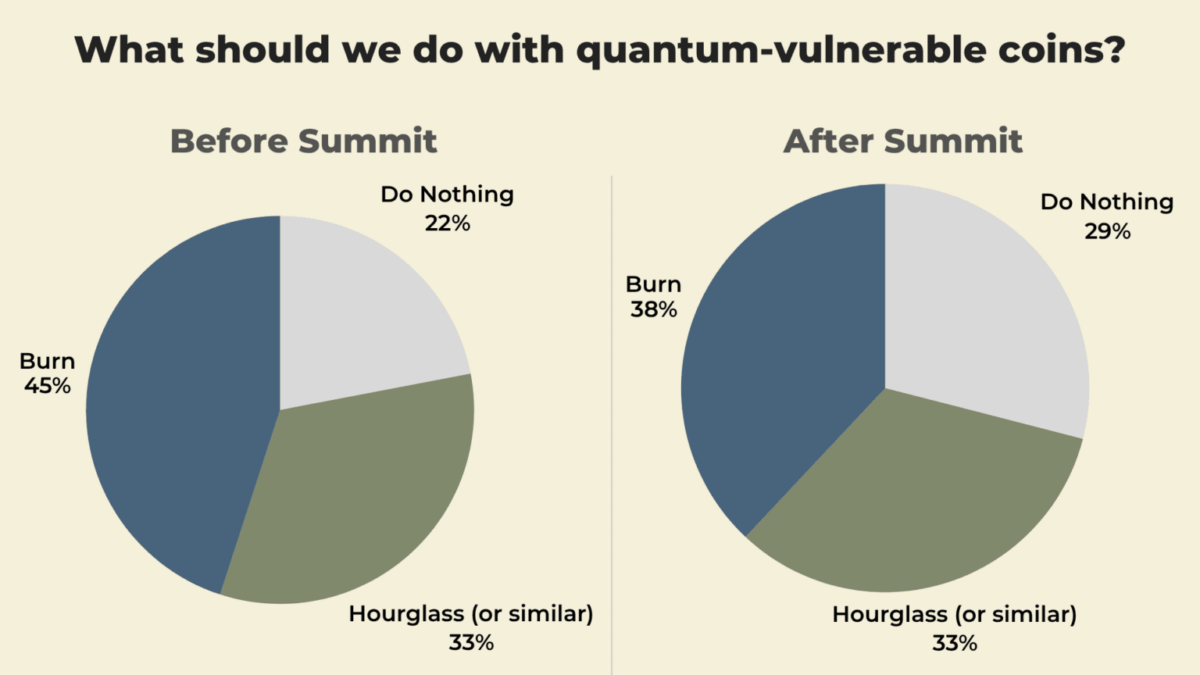
Presidio Bitcoin Survey | Source: Presidio Bitcoin
Multiple quantum-resistant signature schemes have been proposed, including lattice-based and hash-based approaches. However, these solutions are 10 to 38 times larger than current signatures, posing significant challenges to blockchain scaling. Competing approaches surfaced at the summit, including SPHINCS+, Lifeboat, and BIP360 proposals, but participants did not converge on a single roadmap.
Experts reached agreement on immediate action items, particularly eliminating address reuse by exchanges and custodians. The summit emphasized that institutional storage solutions must adopt better operational practices to reduce vulnerabilities before quantum computers arrive.
Next
Disclaimer: Coinspeaker is committed to providing fair and transparent reporting. This article is intended to provide accurate and timely information but should not be taken as financial or investment advice. Market conditions can change rapidly, so we recommend that you verify the information yourself and consult a professional before making any decisions based on this content.

Zoran Spirkovski, Web3 Marketing Strategist and former CMO of DuckDAO, transforms complex cryptographic concepts into compelling stories that drive growth. With a background in cryptocurrency journalism, he excels in developing go-to-market strategies for DeFi, L2, and GameFi projects.
Zoran Spielkovskiy of X