

Important points
-
SWIFT supports most of the world’s bank transfers through its messaging network, and Ripple uses XRP to make cross-border payments faster and cheaper.
-
In addition to payments, XRP is also used for remittances, with institutions like SBI Holdings testing integration and applications in tokenized royalties and DeFi applications also being considered.
-
SWIFT is developing a blockchain-based ledger for real-time payments that is interoperable with major networks and supports tokenized assets.
-
SWIFT still faces challenges including outdated systems, regulatory hurdles, organizational inertia and competition from Ripple’s growing network.
Trillions of dollars move in cross-border payments every year, and two names dominate: the well-established SWIFT (Society for World Interbank Financial Telecommunication) and Ripple, a startup built around blockchain technology. SWIFT operates a large global network but still has slow speeds, while Ripple uses the XRP (XRP) token for near-instant payments. Over time, Ripple has built its technology and reputation as a faster and more efficient alternative to SWIFT’s older and more expensive systems.
But SWIFT is no longer playing defense. It is developing a shared ledger with ConsenSys, aiming to compete directly with Ripple. In this article, we explore how SWIFT’s system works, its blockchain plans, and the challenges that still need to be overcome.
About SWIFT: The messaging system behind international money transfers
SWIFT is at the heart of global banking communications. Although the funds themselves do not move, they provide a secure, standardized messaging network that allows banks and payment providers to exchange instructions for cross-border transactions.
When a customer sends money abroad, the bank uses the SWIFT network to send a secure payment message to the recipient’s bank. This message includes details such as account number, amount, and reference code. Each bank has a unique SWIFT/Bank Identification Code (BIC) that ensures messages reach the correct destination.
SWIFT acts as a trusted intermediary in global finance, providing encrypted, authenticated and reliable messaging to more than 200 countries. Standardize communications to reduce errors, speed payments, and support compliance. This has been the backbone of international remittances for decades.
Did you know? SWIFT was founded in Belgium in 1973 by 239 banks from 15 countries to replace the slow and error-prone Telex system with faster, more secure financial communications.
The multiple impacts of XRP: Faster payments, stronger loyalty, and enabling DeFi
International payments via XRP allow for the reduction or elimination of upfront funds, faster settlement, and lower costs. Japan’s SBI Remit uses XRP for remittances to the Philippines, Vietnam, and Indonesia. Similarly, Pyypl has integrated XRP via Ripple’s on-demand liquidity (ODL) for remittances between parts of Africa and Asia, targeting unbanked users.
Beyond payments, XRP is also integrated into travel and loyalty services. For example, Webus/Wetour plans to use XRP (backed by a proposed $300 million in reserves) to support blockchain-based vouchers and loyalty points for Air China’s PhoenixMiles members. In the future, these members will be able to use XRP for overseas services such as airport transfers and premium rides.
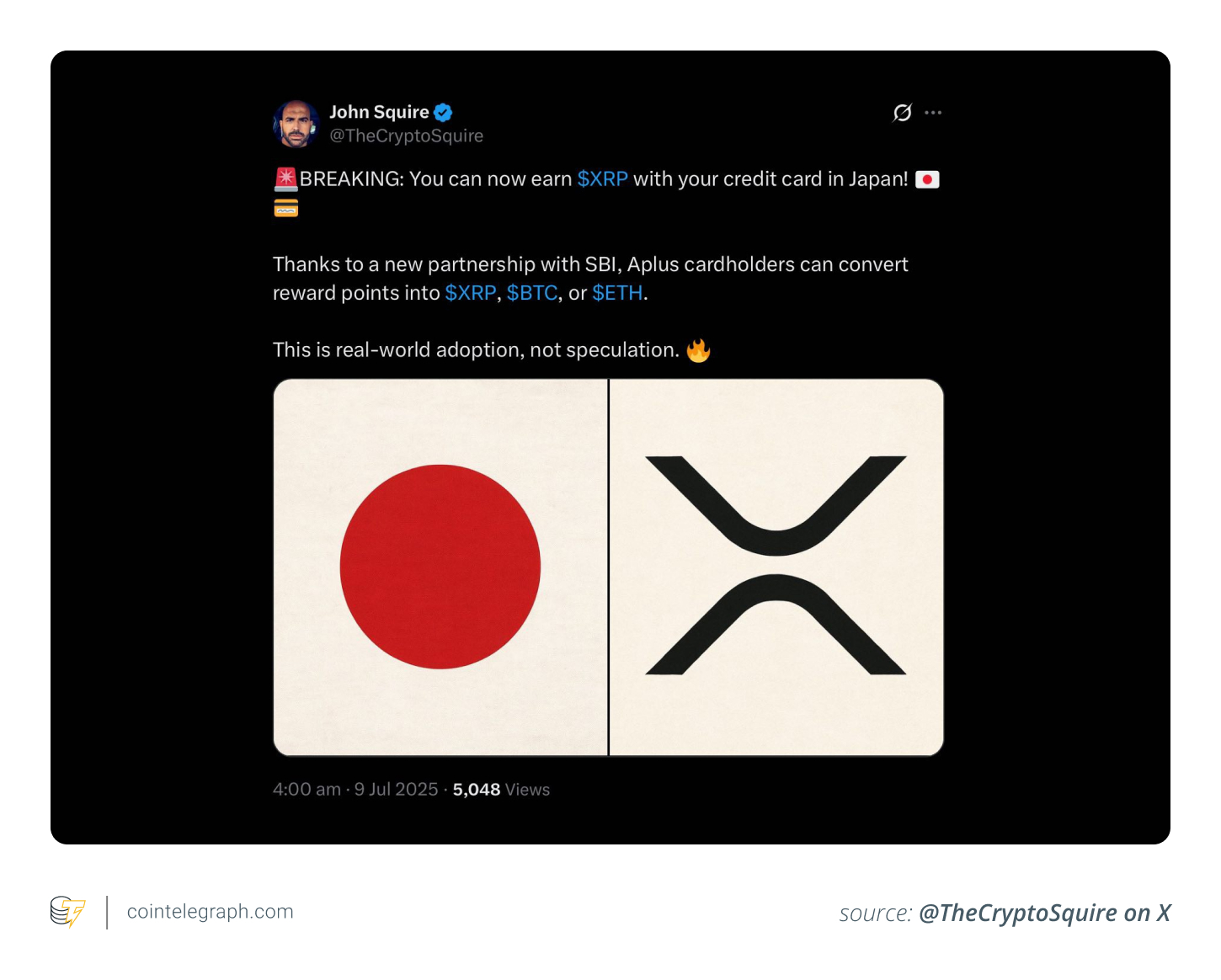
Institutions are now considering XRP as a significant operational and financial asset. For example, SBI Holdings not only invests in Ripple, but also integrates XRP into its subsidiaries (SBI Remit, SBI VC Trade) and maintains large XRP reserves.

XRP Ledger is a fast and low-cost blockchain used for cross-border payments, tokenized assets, and decentralized finance (DeFi) projects. Relying on consensus protocols rather than mining reduces energy usage and operational costs compared to Proof-of-Work networks.
SWIFT’s blockchain project: architecture and ambitions
SWIFT’s blockchain initiative is designed for interoperability between public and private chains, and for processing regulated stablecoins and tokenized assets, and is positioned as the versatile infrastructure of the future.
A key feature of SWIFT’s blockchain project is real-time cross-border payments. The system is designed to enhance, rather than completely replace, existing digital infrastructure. This approach allows financial institutions to more easily integrate it with their current systems, reducing one of the biggest barriers to adoption.
By embracing blockchain, SWIFT aims to maintain its central role in global payments as networks such as stablecoins and XRP gain traction. The project aims to keep the bank within the SWIFT ecosystem by modernizing its infrastructure and strengthening its position as a core of international finance.
Did you know? While Ripple’s technology can settle in 3-5 seconds on the XRP Ledger, SWIFT-based cross-border transfers often take 1-5 business days.
How SWIFT’s blockchain will undermine Ripple’s advantage
SWIFT’s blockchain project builds on its long-standing advantages in global banking and payments. Its network already connects thousands of banks and financial institutions around the world, giving it a scale that Ripple will find difficult to match. Ripple’s ODL system, which uses XRP tokens as a bridge currency, still provides faster and cheaper cross-border payments. The main challenge for SWIFT is to improve liquidity to achieve the same level of efficiency as Ripple’s ODL model.
Network effects also play a big role. Since most institutions are already linked to SWIFT, banks may find it easier to adopt SWIFT’s new shared ledger than migrate to Ripple’s system. Convincing financial institutions to switch networks remains a big challenge for Ripple. SWIFT’s neutral stance on tokens and payment methods could also help maintain its edge over Ripple.
While Ripple’s model relies on XRP as a bridge asset, SWIFT’s upcoming ledger is designed to support a wider range of regulated tokens, including stablecoins and tokenized assets. This flexibility could weaken XRP’s dominance in cross-border payments, especially if banks move to multi-asset payment systems.
Did you know? Ripple’s on-demand liquidity (ODL) is used by Japan’s SBI Remit to send money to countries such as the Philippines and Vietnam.
Challenges facing SWIFT
SWIFT’s blockchain project still faces hurdles that could slow its rollout. One of the biggest challenges is connecting the new system to the existing banking infrastructure while maintaining all technical compatibility. SWIFT operates a long-established global messaging network, so making it work smoothly with distributed ledgers without disrupting current services is a complex task.
Another key challenge is regulatory compliance across jurisdictions. Different rules regarding digital assets, stablecoins, and tokenization can complicate cross-border deployments. Additionally, many financial institutions are cautious. They may be reluctant to implement new infrastructure unless the benefits are clear and the risks are mitigated.
SWIFT also faces stiff competition from Ripple’s long-standing partnership focused on real-time payments. Unless SWIFT can demonstrate clear and measurable benefits, its blockchain project may be seen as an ancillary effort rather than a primary solution.
Will SWIFT’s blockchain compete with or complement Ripple?
Looking forward, SWIFT’s blockchain ledger has the potential to reshape global payments in two ways. It could coexist with Ripple while maintaining its dominant position in the regulated banking industry. Meanwhile, Ripple may continue to focus on liquidity and payment efficiency in emerging markets. Another possibility is that SWIFT could use its large network to gradually overtake Ripple and reduce the industry’s dependence on proprietary tokens.
The outcome of this conflict will shape the future of cross-border payments. Ripple’s response will be important. Competition between the two could lead to faster innovation and more real-world applications through partnerships with fintechs and local banks.
In the end, it is not just the improvement of technology that is the deciding factor. Other factors will also play a role, including network momentum, institutional trust, and alignment with the broader goals of global finance.
This article does not contain investment advice or recommendations. All investment and trading moves involve risk and readers should conduct their own research when making decisions.