

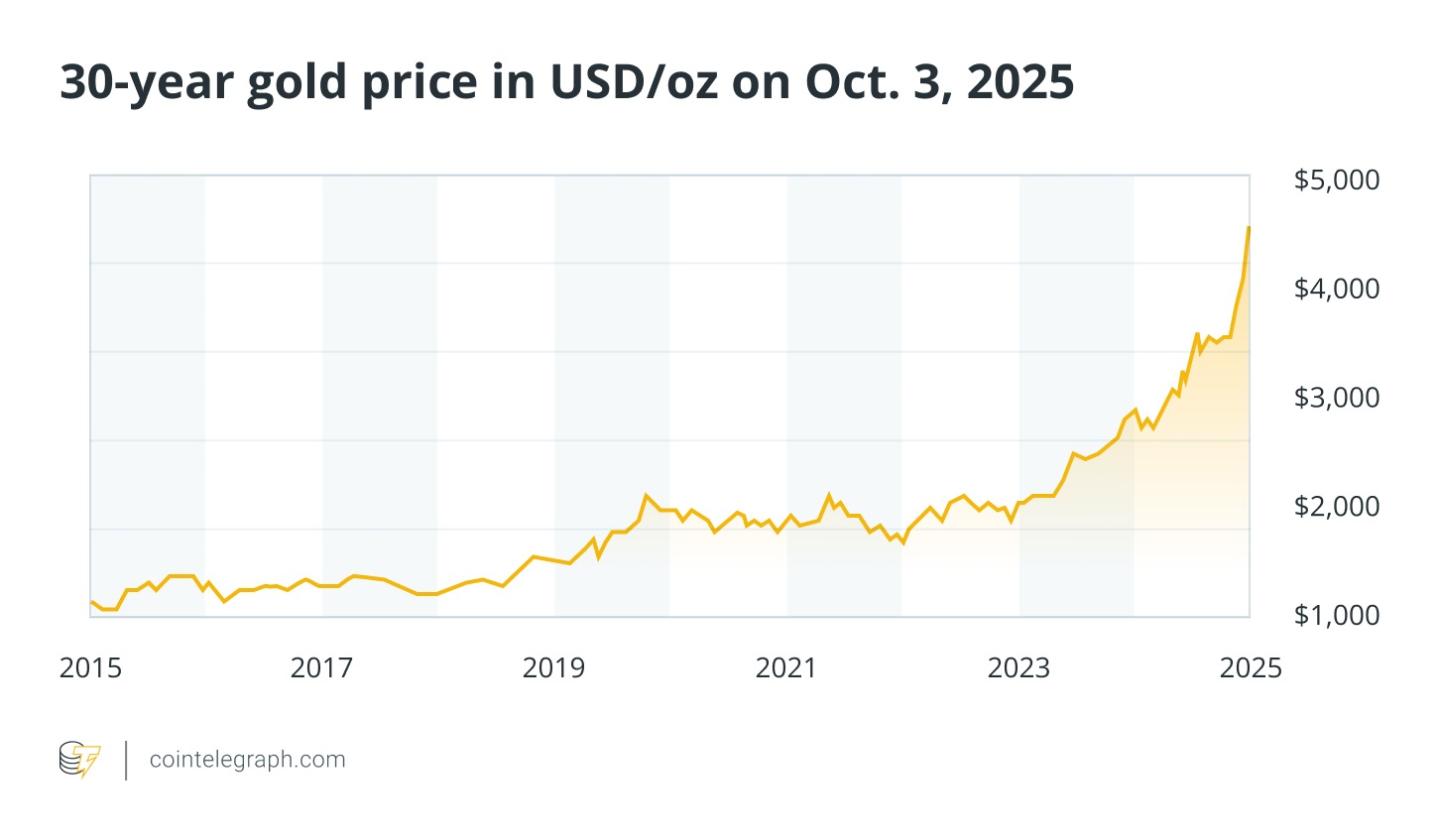
How the gold rush ended in October 2025
The historic milestone was reached after gold prices rose significantly above $4,300 per ounce, driven by strong demand as a safe-haven asset. By October 2025, the market began to take profits.
Gold prices fell by more than 2% on October 17, 2025, shortly after reaching the milestone. At the time of writing, spot gold was trading at around $4,023 per ounce, down 8.1% from its all-time high of $4,378.69.
The main driver of the decline was the easing of trade tensions between the US and China after President Donald Trump said that keeping tariffs on China across the board was unsustainable. Additionally, a stronger U.S. dollar and renewed investor interest in high-yield assets such as Bitcoin (BTC) also contributed to the decline.
Did you know? The term “digital gold” gained popularity as Bitcoin’s scarcity and independence began to reflect gold’s role as a hedge against inflation.
History of gold: crash and peak
Gold’s history has been marked by dramatic rises and falls caused by inflation, interest rates, and geopolitical events. The gold market has experienced several ups and downs, from its peak in the early 1980s, to a sharp correction since 2013, to a strong rally in the 2020s before a recession in October 2025.
-
Decrease from 1980 to 1999: Gold peaked at about $850 an ounce in January 1980, after high inflation and geopolitical tensions caused prices to soar. This rally ended with the “Volcker Shock,” when Federal Reserve Chairman Paul Volcker aggressively raised interest rates. From 1980 to 1982, the Federal Reserve raised the federal funds rate to over 20% in an effort to control inflation, causing a sharp recession. This led to a massive decline, with gold prices falling more than 60% by 1982, entering an extended bear market. The price of gold, which was about $850 per ounce in 1980, had fallen to about $278 per ounce by 1999.
-
Crashes from 2012 to 2018: After peaking in 2011, gold entered a long decline as the global economy stabilized and stock prices outperformed, making gold less attractive as an investment. In 2013, the US Federal Reserve began tapering its quantitative easing program, strengthening the US dollar and moving capital into higher-yielding assets, further putting pressure on gold prices. SPDR Gold Trust, a major gold-backed exchange-traded fund (ETF), has shed more than 30% of its holdings, signaling a decline in investor interest. From 2014 to 2018, gold traded in a range of $1,200 to $1,400 per ounce, down from about $1,680 in 2012.
-
2020s: The 2020s saw gold regain its status as a safe-haven asset during a time of global uncertainty. When the coronavirus disease (COVID-19) stalled economies, governments around the world rolled out more than $10 trillion in stimulus packages, raising concerns about inflation. By 2022, US inflation will exceed 9%, reinforcing gold’s status as a financial safety net. The central bank also increased its purchases, adding about 1,000 tonnes of gold each year from 2022 to 2024. Despite rising interest rates, gold prices rose from around $1,785 in 2020 to more than $3,200 by early 2025.
However, the October 2025 gold crash led investors to seek alternatives like Bitcoin (BTC), which are relatively independent of government and central bank policies.

How funds started flowing into Bitcoin
The digital gold narrative has strengthened significantly, with younger investors increasingly seeing Bitcoin as a modern-day hedge against inflation and currency devaluation. Bitcoin is now considered by many to be more accessible and innovative than physical bullion, with Bitcoin’s market capitalization rising from $134 billion in 2019 to more than $2.4 trillion by the first half of 2025.
Spot Bitcoin ETFs and exchange-traded products (ETPs) offer institutional-level access and attract billions of dollars in regulated inflows. In early October 2025, U.S. Spot Bitcoin ETFs, led by BlackRock’s iShares Bitcoin Trust (IBIT), recorded record weekly inflows of $3.55 billion, pushing the Bitcoin price above $126,000. Meanwhile, gold ETFs have faced more than $2.8 billion in outflows in recent weeks, highlighting the contrast with Bitcoin’s momentum.
Gold outflows and Bitcoin inflows have historically been inversely correlated, with the correlation between Bitcoin and gold dropping to -0.3 during periods of risk-on sentiment. The exchange balance has decreased to 2.83 million BTC, the lowest level in six years, indicating a decline in selling pressure.
$200,000 Bitcoin: Is the goal realistic?
Bitcoin’s path to $200,000 appears to be supported by strong market and macroeconomic factors. April 2024 Block reward halvedAs demand increases, supply is tight. Several indicators continue to suggest steady growth for cryptocurrencies.
As global debt steadily increases, the appeal of Bitcoin as a decentralized investment asset continues to grow. By the first half of 2025, global debt will reach nearly $338 trillion, equivalent to about 235% of global GDP.
Institutional drivers for Bitcoin adoption are gaining momentum. As of October 24, 2025, Strategy (MSTR) holds 640,418 BTC, followed by Marathon Digital Holdings (MARA) and Celsius (CEP) with 53,250 and 43,514 BTC, respectively.
Monetary easing efforts by the US Federal Reserve (Fed) may provide further tailwinds. The $200,000 level serves as a strong psychological benchmark and is likely to prompt investors to shift away from assets such as gold, with $2.8 billion already exited from ETFs.
Did you know? Gold has been a store of value for over 5,000 years, and Bitcoin has achieved a similar reputation in just over a decade.
How capital is moving from gold to Bitcoin
The movement of capital from gold to Bitcoin often defines major market cycles and highlights how investor preferences change over time. The major cycles include:
-
2013 to 2017: From 2013 to 2017, the price of gold remained relatively flat between $1,200 and $1,400 per ounce following its peak in 2011, while Bitcoin soared from $100 to $20,000. The rally was fueled by retail investors seeking a decentralized alternative to fiat currencies.
-
2020-2021: In 2020-2021, institutional adoption drove Bitcoin to $69,000 as pandemic-era stimulus and inflation concerns led companies like MicroStrategy to favor BTC over gold. Historically, gold attracts cautious investors during periods of stability, but during risk-on phases, Bitcoin tends to capitalize on its scarcity and growth potential to attract capital.
Recent trends are reinforcing this change. Bitcoin ETFs recorded weekly inflows of $3.55 billion in October 2025, while gold ETFs recorded outflows of $2.8 billion. These trends highlight a generational shift toward digital assets amid continued global uncertainty.
Did you know? While gold’s supply grows by about 1% every year, Bitcoin’s supply growth halves every four years, increasing scarcity and reinforcing its long-term value story.
Obstacles blocking Bitcoin’s path to $200,000
Cryptocurrency enthusiasts expect Bitcoin to reach $200,000, but the path will not be without obstacles. These include volatility, regulatory uncertainty, a potential gold comeback, and competition from other assets.
-
Bitcoin volatility: Like all cryptocurrencies, Bitcoin is highly volatile and is subject to sudden spikes and corrections. Institutional purchases can cause prices to rise, while large holders (“whales”) selling Bitcoin can lead to sudden declines.
-
Regulatory uncertainty: Bitcoin regulations are still taking shape in many parts of the world. Continued ambiguity surrounding taxation and compliance may hinder institutional participation.
-
Possible return of gold: In October 2025, some investors who had made large profits began withdrawing money from gold mining ETFs. Meanwhile, according to Reuters, crypto ETFs recorded record inflows of $5.95 billion globally in the third week of October 2025. Strong demand for crypto assets has pushed Bitcoin to an all-time high. But gold as a safe-haven asset could still make a comeback.
-
competition: Stocks have an average annual return of around 10% and are competitive with digital assets. Tokenized government bonds and central bank digital currencies (CBDCs) are also stable alternatives. These options may divert funds from Bitcoin.
Generational change of value-stored assets
A generational shift is redefining the way people view store-of-value assets. Young investors, shaped by the digital age, are increasingly attracted to Bitcoin due to its decentralized and borderless nature and the potential for high returns.
On the contrary, older generations continue to prefer gold because of its tangible form and proven stability. The growing digitalization of finance is accelerating this change as blockchain technology replaces time-consuming paper-based systems with more transparent and efficient alternatives.
However, gold and Bitcoin may coexist over time within a two-layer hedge model. While gold provides reliability through physical scarcity and historical track record, Bitcoin provides growth through limited supply and digital adaptability. Together, they strike a balance between tradition and innovation and reflect how investors are adapting to an increasingly complex financial world.