

The recent crash that occurred on October 10th was the largest liquidation event in the history of the crypto market. More than $19 billion was liquidated and open interest decreased by $65 billion, according to CoinGlass data. This number far exceeds other memorable liquidation cascades, such as the COVID-19 crash with $1.2 billion in liquidations and the FTX collapse with $1.6 billion in liquidations.
There has since emerged a consensus among researchers that the incident was at least partially caused by weak pricing oracles on the Binance exchange. The collateral value of the three fixed crypto tokens USDE, bnSOL, and wBETH was determined from Binance’s internal order book data rather than external oracles. This puts users of the “integrated account” feature at risk of liquidation during market abnormalities.
This vulnerability may have been exploited in a coordinated attack on October 10th, but the evidence is not yet conclusive. In particular, USDE contributed approximately $346 million in chain liquidations. In comparison, wBETH had $169 million and bnSOL had $77 million. Large withdrawals of buy-side liquidity in stablecoin pairs should be considered particularly suspicious.
Using detailed data obtained exclusively from our partners at AI-driven market analysis firm Rena Labs, Cointelegraph Research analyzes anomalous activity in the USDE/USDT trading pair in this article.
Massive liquidity meltdown
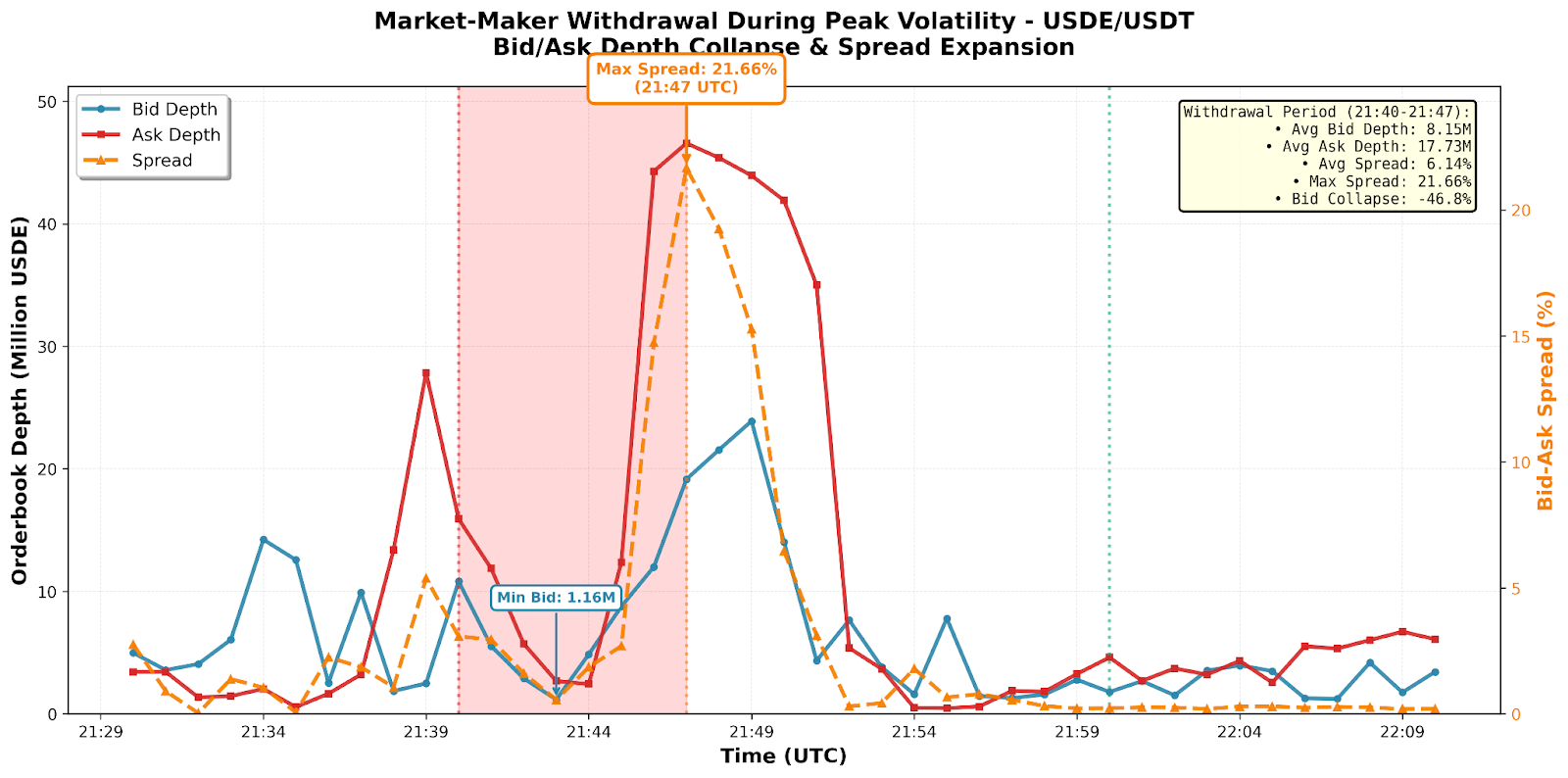
Rena’s anomaly detection engine recorded one of the sharpest and most complex market disruptions ever seen in stablecoin trading. This is surprising given that unlike previous UST and USDC depegs, there were no concerns about the health of USDE’s collateral. USDE minting and redemption continued to occur as usual. Nevertheless, professional market makers extracted liquidity from currency pairs on a large scale. Some of this can be attributed to automated risk scoring systems that have initiated defensive market withdrawals to limit exposure.
Before the collapse, USDE’s average total liquidity was $89 million with a balanced structure of buy and sell orders. Between 21:40 and 21:55 UTC, the pair’s liquidity on Binance collapsed by nearly 74%, dropping to about $23 million. By approximately 9:54 p.m., market depth had almost completely disappeared. Total liquidity decreased to just $2 million, and market-making activity virtually disappeared. As a side effect, the bid/ask spread widened by up to 22%.

The market lost its structural integrity in the crash. Trading volume surged 896x as ask-side depth collapsed by 99%. This imbalance caused the price of USDE to drop to $0.68 on Binance’s spot market, while it remained close to its peg on other exchanges.
During the 10-minute crisis period, trading density increased nearly 16 times compared to the normal 108 trades per minute. At its peak, there were approximately 3,000 trades per minute, of which 92% were sell orders. Many of the orders are likely due to panic selling, stop loss triggers, and forced liquidations.

Evidence of abnormal market activity
However, the anomalous activity was discovered by Rena’s anomaly engine well before the USDE liquidity crisis occurred. Around 21:00 UTC, 28 anomalies were reported, a rate four times higher than the previous hour. Anomalies recorded by this engine include unusual spikes in volume, price, or trade strength, and suspicious patterns, especially bursts, clusters, and series of trades. This also includes fingerprinting activities that are characteristic of various forms of order spoofing.

The size profile of the order book shows three different large orders immediately before the crisis. These orders were placed when BTC was already starting to decline on major exchanges, but before USDE ran into a liquidity crunch.
The event highlights the vulnerabilities and leverage that still exist in the cryptocurrency market, with chain liquidations potentially erasing seemingly safe trades. Similar to the 99% drawdown of some altcoins during the crash, USDE depegging indicates that there is little intrinsic demand in the market for many tokens to support it. In the absence of large-scale market makers like Wintermute, order books for many crypto assets have shown little resilience.
This article does not contain investment advice or recommendations. All investment and trading moves involve risk and readers should conduct their own research when making decisions.
This article is for general informational purposes only and is not intended to be, and should not be taken as, legal or investment advice. The views, ideas, and opinions expressed herein are those of the author alone and do not necessarily reflect or represent the views and opinions of Cointelegraph.
Cointelegraph does not endorse the content of this article or the products mentioned here. Readers should do their own research before taking any action related to the products or companies mentioned and are solely responsible for their decisions.