

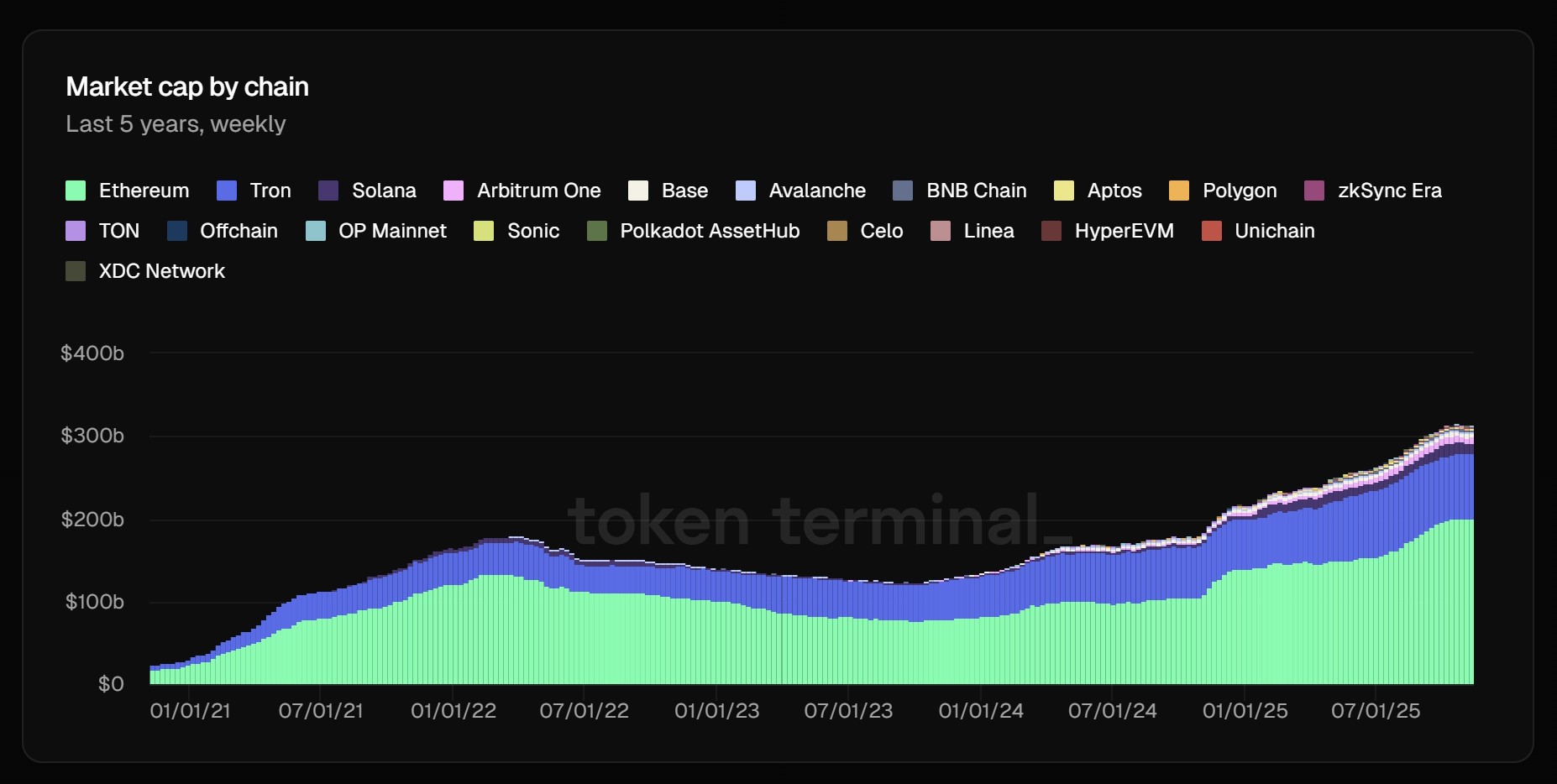
Important points:
-
Ethereum currently holds $201 billion in tokenized assets, nearly two-thirds of the global total of $314 billion.
-
On-chain fund assets under management have increased by 2,000% since 2024, driven by institutional growth led by BlackRock and Fidelity.
-
Supply on ETH exchanges has hit a yearly low, suggesting investor accumulation and market resilience.
Ethereum’s growing dominance in the tokenized asset landscape is changing the way investors value the network’s fundamentals and its native token, Ether (ETH). As of November 11, tokenized assets across all blockchains amounted to approximately $314 billion, of which Ethereum accounted for nearly two-thirds of the market at $201 billion. This highlighted its key role as the most used payment layer for cryptocurrencies in 2025.

Stablecoins continue to form the backbone of Ethereum’s network economy and account for the majority of trading activity. The combined issuance of USDT and USDC on Ethereum maintains a rich pool of liquidity across DeFi, cross-border payments, and exchanges, helping the network maintain one of the highest transaction throughputs in the industry.
This expansion extends beyond stablecoins. Tokenized fund assets under management (AUM) on Ethereum have surged nearly 2,000% since January 2024 as institutional investors such as BlackRock and Fidelity bring traditional investment products on-chain.

Fidelity Digital Assets noted that “beyond Bitcoin and Ethereum, some of the most notable developments in digital assets are occurring in stablecoins and tokenized real-world assets (RWA).”
The company highlighted that stablecoins have become a global medium of exchange, processing $18 trillion in transaction volume in the past 12 months, even exceeding Visa’s annual processing volume of $15.4 trillion.
Meanwhile, RWA has emerged as the fastest growing category on Ethereum. Government bonds, funds, and credit products tokenized on Ethereum currently total $12 billion, accounting for 34% of the $35.6 billion global RWA market. Protocols like Ondo, Centrifuge, and Maple are fueling the market surge by offering 4-6% yields on tokenized US Treasury exposure and collateralized lending products.
Analytics platform Token Terminal noted that this expansion effectively locks Ethereum’s $430 billion market cap into tangible on-chain utilities, noting that “the market cap of tokenized assets on Ethereum sets a floor for ETH’s market cap.”
Related: Bitmine increased ETH by 34% last week as price fell
ETH exchange supply points enter bullish setup
Binance, the largest Ether exchange by volume, noted that data from CryptoQuant shows that supply on the ETH exchange has declined sharply since mid-2025, reaching its lowest level since May 2024. After peaking in early summer, supply decreased continuously until November, reaching a level of approximately 0.0327.

This persistent outflow indicates coins moving to cold storage or long-term wallets, a behavior typically associated with the accumulation phase. Interestingly, this decline in exchange balances coincided with the price of Ether peaking around $4,500-$5,000 in August and September before falling back to around $3,500 today.
Analysts said reduced supply on exchanges tends to ease selling pressure, and an improvement in investors’ risk appetite could help stabilize prices and pave the way for new upside.
Related: Ethereum holders take back profits as ETH price prepares for $4,000 breakout
This article does not contain investment advice or recommendations. All investment and trading moves involve risk and readers should conduct their own research when making decisions.