

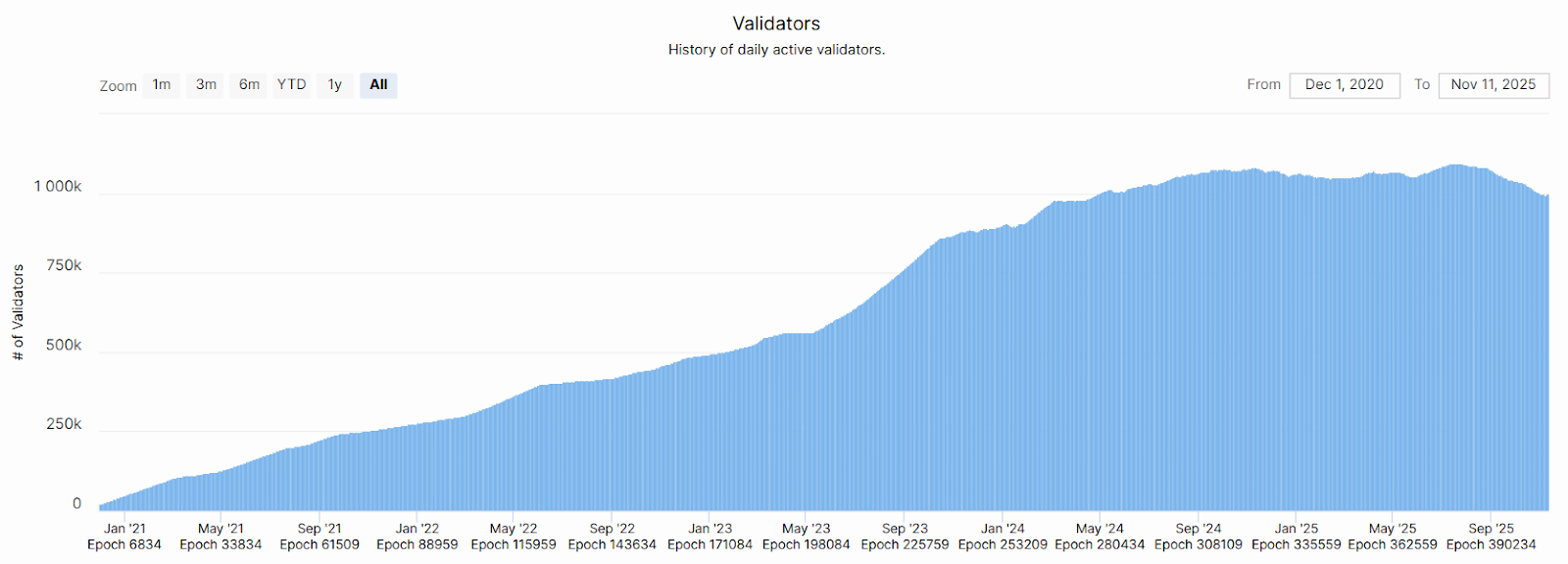
The number of Ethereum validators has returned to April 2024 levels, and exit queue wait times have hit an all-time high.
The number of daily active validators on Ethereum has fallen by about 10% since July, to the lowest level since April 2024, according to Beaconchain data. After a steady rise to new highs, the recent decline marks the first decline of this magnitude since the network switched from proof-of-work to proof-of-stake consensus mechanisms in September 2022.

Recently, the number of daily active validators fell below the 1 million mark for the first time since April 28, 2024, standing at 999,203 as of today, November 11.
Validators are operators that run Ethereum’s software and stake ETH to process transactions and keep the network secure in exchange for rewards. If you decide to stop validating the network and fully withdraw your staked ETH, you will need to go through the exit queue. This is a built-in safety feature that limits the number of withdrawals you can make at once to avoid network interruptions. After withdrawal, your funds will be available for withdrawal and can be converted into cash.
Clemens Scarpatetti, CEO of Ethereum staking operator CryptoCrew Validators, spoke about the decline in active VA in a commentary for The Defiant:
The reduction reflects “a combination of cyclical and structural factors.” Scarpatetti further explained:
“Following ETH’s strong performance from Q2 to Q3, we are likely to see some profit-taking as long-term stakers exit their positions. We have also seen large withdrawals from liquidity staking providers like Lido, whose exit queue has reached fairly high levels recently.”

At the time of writing, ETH is trading at $3,470, down about 25% from late July to mid-August, when it briefly hit an all-time high of $4,946 and surpassed the November 2021 record. After an eventful year, ETH has only risen 4% since January.
While this summer’s rally brought relief to long-term holders, it also pushed validators’ exit queues to new unprecedented highs as staking operators rushed to unstake funds to sell their funds for a profit.

According to data from ValidatorQueue, which tracks ETH validator activity, it currently takes Ethereum validators approximately 37 days to withdraw staked ETH, an increase from just one day in May.
However, entry waiting times for validators have also increased rapidly in recent months, with approximately 1.2 million ETH currently waiting to be staked, with a waiting time of 22 days.
Validator integration
Among those paying attention to this change is Aron Murok, founder and CEO of SSV Labs, a crypto staking infrastructure provider. In an interview with The Defiant, Murok said that Ethereum’s long exit queues are “a predictable consequence of the way validator exits operate at scale.”
He noted that Kiln, a large institutional staking service with over $18 billion of tokens staked across various networks, began withdrawing nearly all validators on Ethereum in early September due to security concerns, as previously reported by The Defiant. This figure corresponds to about 4% of the total staked ETH, or about $7 billion.
According to Murach, large institutions often manage hundreds or thousands of validators. Once terminated or consolidated under Ethereum’s new MaxEB rules with the recent Pectra upgrade, up to 2,048 ETH will be able to be combined into one validator instead of running dozens of smaller validators, which could cause a chain reaction that backs up the queues of other validators.
Murach pointed out that the current integration could make future mass exits more efficient, as one large MaxEB validator is replaced by dozens of smaller MaxEB validators.
“True decentralization is not just about how many validators there are, it’s about truly independent operators,” Muroc added.
decrease in yield
Staking profitability also plays a role. Meir Rosenschein, Director of Blockchain and AI Products at DcentraLab, told The Defiant that another factor in the decline is that staking yields have fallen, raising borrowing costs and making leveraged staking unprofitable.
At the time of writing, Ethereum’s annual staking yield is approximately 2.9% per year, down from a record 8.6% in May 2023.
“Over the next period, validator participation is likely to continue to migrate to larger professional operators. Pectra’s 2,048 ETH integration will facilitate that. Withdrawals are completing while the queue for withdrawals is likely slow but steady,” Rosenschein explained.
Overall, he said, the validator landscape “looks like it’s trending toward larger, more optimized participants.”

At the time of writing, decentralized staking protocol Lido leads the market with over 8.4 million ETH staked across 265,000 validators, holding over 23% share, according to data from blockchain analytics platform Dune. Centralized exchanges Binance and Coinbase follow, accounting for approximately 9.2% and 6.5% of staked ETH, respectively.
Shor Rejwan, managing partner at Masterkey VC, sees the current decline as a “natural rotation of capital and computing” rather than a structural weakness. In a commentary for The Defiant, he added that the current situation represents “validator churn, not capitulation” and reflects “a mature market optimizing efficiency.”
As such, at this time, staking yields and participation may remain uneven while withdrawals are made through the system. But over time, consolidation and new decentralized validator technologies could make the network leaner and more efficient, even if there are fewer active operators.