

The Ethereum Foundation, which oversees the development of the Ethereum network, announced the Privacy Cluster, a team of 47 experts from across the blockchain industry tasked with introducing privacy features into the layer-1 smart contract network.
Ethereum’s Privacy Cluster will bring together researchers, engineers, and cryptographers to develop protocol-level privacy features, including private payments and private decentralized identity solutions, according to an announcement Wednesday.
The Foundation introduced Privacy Stewards for Ethereum (PSE), a privacy-focused research and development initiative, in September, and the Privacy Cluster will work closely with PSE to build enhanced privacy protections.
These privacy-preserving developments include the development of a zero-knowledge infrastructure, a way to verify information without revealing its specific content, confidential transmission over the PlasmaFold Layer 2 network, and preventing remote procedure call (RPC) nodes from relaying user metadata.
Privacy is central to the cypherpunk ethos behind cryptocurrencies and data encryption, and the increasing sophistication of digital surveillance technology and its impact on personal freedom has brought it into new focus in the cryptocurrency community.
Related: Vitalik slams EU chat regulations: ‘We all have the right to privacy and security’
Privacy will become even more important in 2025
The cryptocurrency industry is putting a new focus on privacy as governments around the world push for greater financial surveillance of their citizens and artificial intelligence creates new threat vectors to user privacy.
The European Union’s proposed Chat Control Act, which would give European governments unfettered access to all messaging traffic, could spur adoption of Web3 alternatives as users seek privacy and control over their data.
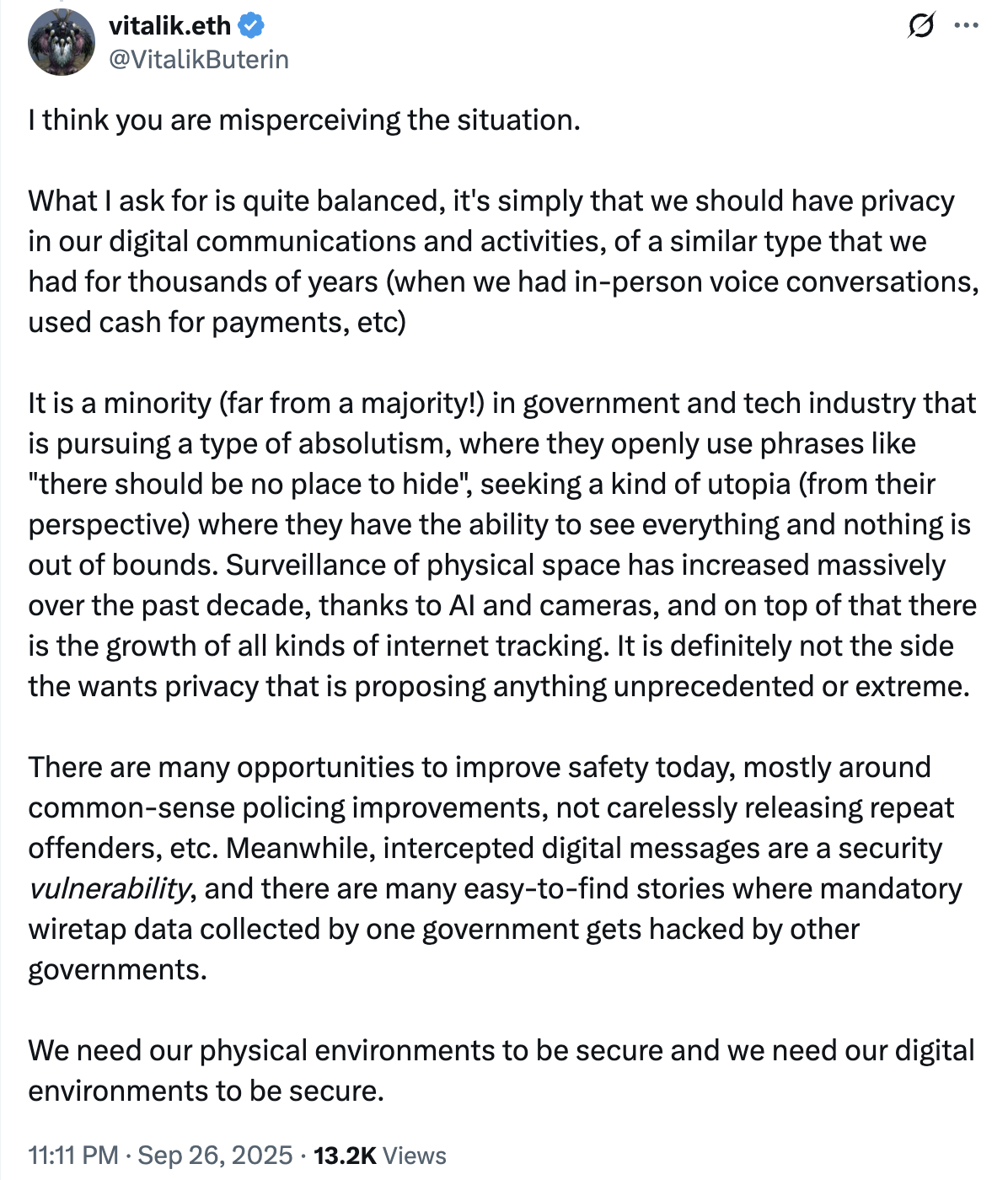
Ethereum co-founder Vitalik Buterin has urged the crypto community to “fight chat control” and warned of the potential for sensitive user information to be leaked through misuse or hacking of collected data.
“You cannot make society safe by making people anxious. We all have the right to privacy and security without backdoors that inevitably allow us to hack into our private communications,” Buterin said.

David Holtzman, a former military intelligence expert and chief strategy officer at Naori Decentralized Security Protocol, told Cointelegraph that information stored on centralized servers has become a honeypot for hackers and cybercriminals.
Online communications platform Discord was targeted on Wednesday by hackers who breached its database that stores age-verifying photos of users, including government-issued IDs and passports.
The hackers are trying to blackmail the platform, threatening to leak the information of an estimated 2.1 million users if ransom demands are not met.
magazine: EU’s privacy-destroying chat control bill postponed, but the fight isn’t over