

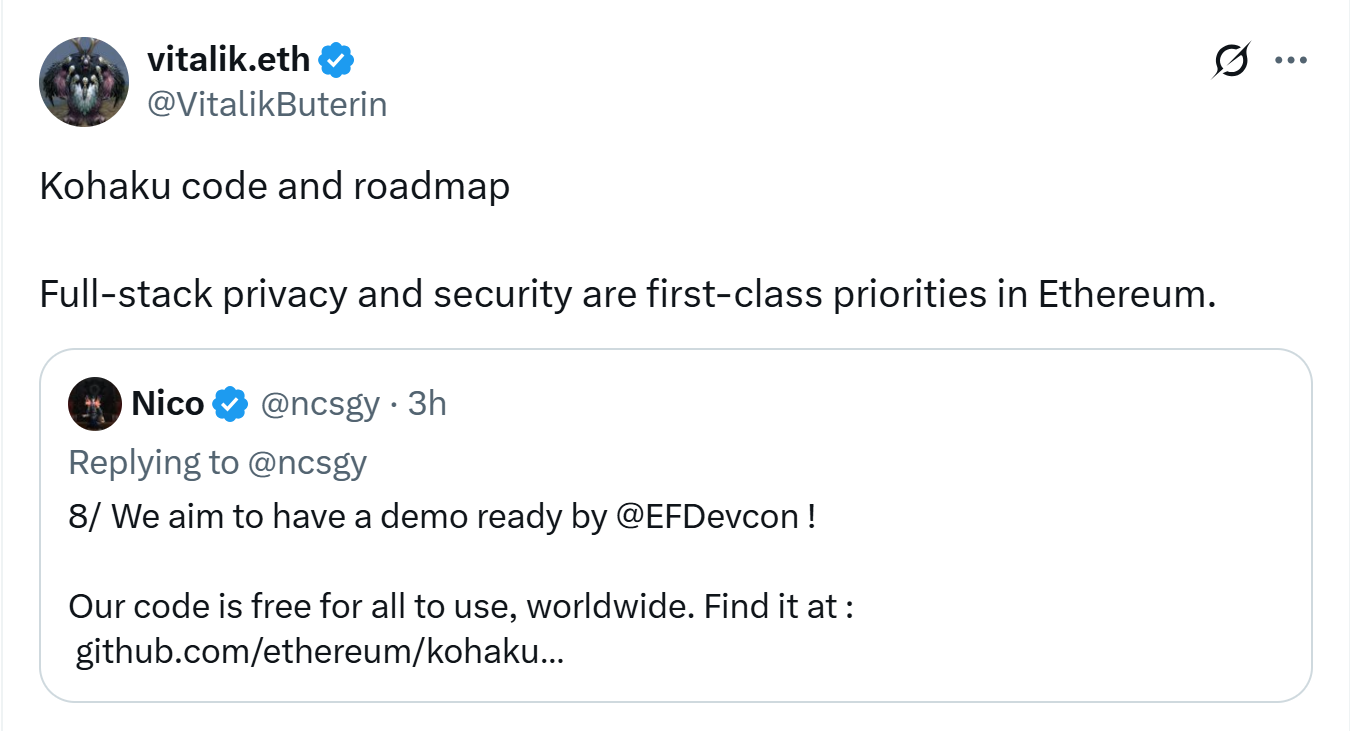
Ethereum developers have announced Kohaku, a new roadmap aimed at improving wallet privacy and security through a modular framework designed for both developers and advanced users.
The project, announced by Ethereum Foundation Coordinator Nicolas Consigny in a blog post on Thursday, outlines plans to build a set of privacy and security building blocks for the Ethereum ecosystem.
At the core of Kohaku is creating a software development kit (SDK) for building secure wallet functionality and a reference wallet that shows how these tools work in practice. The first version comes as a browser extension based on the Ambire wallet and is designed for advanced users who want more control and privacy.
Kohaku is developed in collaboration with well-known Ethereum ecosystem teams such as Ambire, Railgun, DeFi Wonderland, Helios, and Oblivious Labs. This project is open source and developers are encouraged to contribute through the GitHub repository.

Related: Privacy is a ‘constant battle’ between blockchain stakeholders and states
Kohaku aims to reduce reliance on centralized services for wallets
Kohaku’s main goal is to reduce wallets’ dependence on centralized services that can track transactions. The project includes features such as private send and receive, IP address hiding, separate accounts for each DApp, and P2P transaction broadcasting that bypasses regular remote procedure call (RPC) servers.
We also plan to add social recovery options with tools like ZK Email and Anon Aadhaar, making it easier to restore access without giving up your privacy. ZK Email enables anonymous verification of emails using zero-knowledge proofs, and Anon Aadhaar allows users to prove their identity in a privacy-protecting way.
In the long term, the team aims to bring wallet security even closer to the device level, which they call “getting as close to silicon as possible.” This means creating a native Ethereum browser that allows users to safely interact with DApps, IPFS content, and decentralized networks without data leakage.
Related: EU’s privacy-destroying chat control bill postponed, but the fight isn’t over
Ethereum Foundation establishes “Privacy Cluster”
On Wednesday, the Ethereum Foundation launched a new initiative called the Privacy Cluster, bringing together 47 leading researchers, engineers, and cryptographers to develop privacy features at the protocol level of the Ethereum network.
The group will work with the Privacy and Scaling Explorations (PSE) team to introduce tools such as private payments, confidential identity systems, and zero-knowledge infrastructure designed to protect user data directly on Ethereum’s Layer 1 blockchain.
The Privacy Cluster includes multiple Ethereum Foundation and PSE efforts, including Kohaku. Other notable projects include Private Reads & Writes, Private Proving, and Private Identities.
magazine: Meet the co-founders of Ethereum and Polkadot who aren’t featured in Time Magazine