

At Web3, there is growing momentum to transform Bitcoin, the world’s largest crypto asset, into the base layer of a programmable, yield-producing financial ecosystem.
While Ethereum has long been a center of DeFi activity, Bitcoin has historically been “idle” and non-yielding. However, Bitcoin DeFi has emerged as a rapidly emerging movement to increase Bitcoin productivity without sacrificing security, liquidity, and decentralization.
Illustrating this, Hunter Rogers, previously senior ecosystem leader at TRON DAO, is betting big on making assets programmable. For this reason, he joined Bitcoin-native yield protocol TeraHash as a co-founder and left his role at TRON.
This is a move that highlights the growing momentum around “BTC-native” DeFi products that convert mining hashrate into liquid on-chain yield.
Former TRON lead Hunter Rogers joins TeraHash as co-founder
We are pleased to welcome Hunter Rogers, former Senior Ecosystem Development Leader at TRON DAO, as a co-founder of TeraHash.
Hunter brings years of experience in interagency partnerships, ecosystem growth, and strategy. pic.twitter.com/O8RkNxQES4
— TeraHash (@TeraHash_xyz) November 6, 2025
Former TRON leader’s new project
Bitcoin was designed as a simple, secure payment and store of value network, not a smart contract platform. That’s why DeFi first exploded on Ethereum. Programmable by default.
But in recent years, new layers and protocols have made Bitcoin programmable, bridging liquidity to DeFi, and BTC-native financial primitives have begun to be introduced.
As Bitcoin Layer 2 and wrapped Bitcoin continue to power through, TerraHash is a Bitcoin native yield protocol.
Tokenize your Bitcoin mining hashrate into $THS (a token that generates BTC-based rewards). The company describes it as a bridge between physical Bitcoin mining and composable DeFi, issuing tokens that represent actual mining power and allowing holders to earn daily BTC rewards without interacting with miners.
“Bitcoin mining generates more than $20 billion in annual revenue, but that vast value stream is locked behind physical infrastructure, energy logistics, and operational overhead,” said Hunter, now co-founder of TerraHash.
Its pitch revolves around making Bitcoin mining yields “liquid, configurable, and accessible” through an on-chain financial product, essentially Bitcoin DeFi (BTCFi).
In his role, Mr. Rogers will lead ecosystem partnerships, institutional support, and community growth as TeraHash prepares for mainnet.
Also read: Charles Hoskinson wants to solve Cardano’s $5 billion DeFi problem
Is Bitcoin DeFi growing?
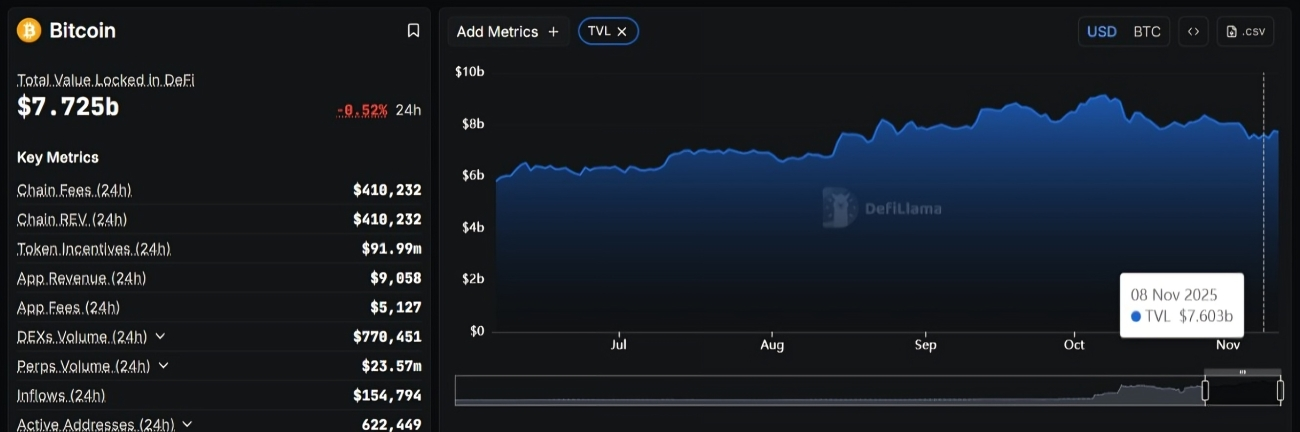
According to data from DeFi Llama, Bitcoin DeFi TVL is $7.7 billion, a historic high from less than $300 million in early 2024, a 25x increase in less than two years.
Despite this, it still represents less than 1% of the total BTC supply, suggesting a lot of room for growth.
This activity remains heavily concentrated in a small number of emerging protocols and L2 ecosystems, including Stack, RSK, BitVM test deployments, and mining yield tokenization projects such as TeraHash.
The $92 million daily token incentive shows that strong liquidity mining and staking programs are driving adoption.
More than 622,000 active addresses also highlights true user engagement across the Bitcoin DeFi stack. Charles Hoskinson warned in an interview that Ethereum is facing a “sleeping giant,” saying, “When Bitcoin wakes up in Bitcoin DeFi, its TVL will be hundreds of billions of dollars, bigger than Ethereum’s market cap. There will be even more liquidity, and Sovereign and BlackRock will be there.” . He launched the Cardano protocol, Race Wallet, and brought revenue to Bitcoin DeFi.
Also read: Western Union partners with crypto startup Rain
Investment Disclaimer: The content reflects the author’s personal views and current market conditions. Please do your own research before investing in cryptocurrencies as neither the author nor the publication will be held responsible for any financial losses.
Advertising disclosure: This site may contain sponsored content and affiliate links. All ads are clearly labeled and our advertising partners have no influence over our editorial content.
share