

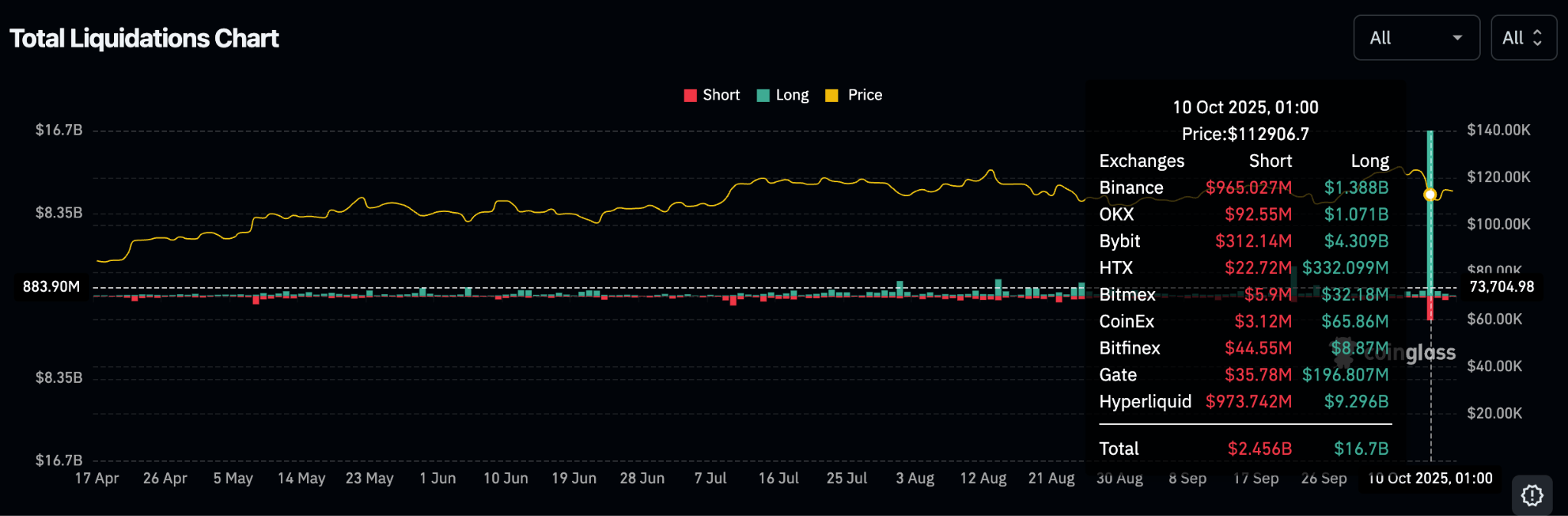
Top DeFi protocols such as Aave, Hyperliquid, and Morpho faced significant pressure and held on as crypto markets recorded record liquidations in Friday’s market selloff.
On Friday, October 10th, the crypto market once again demonstrated how quickly things can change, with crypto exchanges reporting that nearly $20 billion in leveraged positions were liquidated in just a few hours, making it the largest single-day liquidation event the industry has ever seen.
Amid the ensuing market-wide turmoil, decentralized finance (DeFi) protocols underwent a massive stress test but emerged largely unscathed. Most of the largest protocols had zero outages and very few issues reported by users, especially when compared to centralized protocols.
Bitcoin fell more than 10% from above $120,000 on Friday night following reports that US President Donald Trump had imposed 100% tariffs on imports from China, briefly falling below $103,000 on some exchanges before rebounding, while many altcoins plummeted further in a short squeeze, with most assets posting double-digit losses.
Ethereum (ETH) has fallen below $4,000 and XRP has hit its lowest price since November of last year. Its market capitalization fell more than 15% in a matter of hours, dropping from more than $4.2 trillion to about $3.5 trillion.
The market has since recovered much of its losses, and as of this writing, the market capitalization has recovered to $3.97 trillion, BTC to over $114,000, and ETH to around $4,100. But traders and other industry participants, especially those who trade with leverage (more than 1.6 million of them liquidated on Friday), continue to analyze and debate what happened, how the top platforms performed, and what will happen next to the market.

What happened with USDe on Binance and Ethena?
In the market crash and its aftermath, much of the drama centered around Binance, the largest centralized exchange (CEX), and Etena’s USDe, the USDe-linked token, which saw a staggering drop of $0.6567 on the exchange.

However, on other platforms, particularly the Curve Finance pool, USDe maintained a price peg near $1.00, and this discrepancy led some to attribute this decline to Binance’s own technical settings. Critics reported that pricing feeds were delayed and market makers were taken offline, which they said could cause CEX’s order book to become out of sync with the broader market.

However, in a blog post on Saturday, October 12, Binance distanced itself from these accusations, instead stating that the exchange’s core futures, spot matching engine, and API trading “remain operational.”
The exchange also added that the amount of forced liquidations processed by the platform “represented a relatively small proportion of the total trading volume, indicating that this fluctuation was primarily driven by market-wide conditions.”
Binance also announced that it compensated users a total of $283 million who were liquidated as a result of the depegging of USDe and two other assets on the exchange for holding these assets as collateral for leveraged trades and loans, although The Defiant could not independently verify that figure.
However, many remained unconvinced, pointing to inconsistencies in blog posts, unclear timelines, vague technical explanations, and missing data on clearing and compensation.
What happened to DeFi amidst the turmoil?
Meanwhile, DeFi protocols faced their own pressure tests as liquidity became diluted and collateral values fluctuated wildly. Aave, the largest lending protocol with more than $42 billion in total value locks (TVL) per DefiLlama, has experienced the “biggest stress test” of its lending infrastructure, Aave founder Stani Kulechov wrote in an X post on the evening of October 10th.
“The protocol worked flawlessly, automatically liquidating a record $180 million worth of collateral in just one hour without any human intervention,” Kulechov added.
HyperLiquid, the largest decentralized perpetual exchange by trading volume, also weathered the volatility with “zero bad debts and 100% occupancy,” according to founder and CEO Jeff Yang. He said in an X post on Saturday that the event marked the first cross-margin automatic deleveraging (ADL) in the DEX’s more than two years of operation, an automatic risk management mechanism for leveraged trading.
After describing HyperLiquid’s operations during the first 20 minutes of the crash, where billions of dollars in leveraged positions on DEXs were liquidated, Yang argued that “other exchanges may not be subject to the same stringent margin requirements as regular users because their liquidation engines are not transparent.”
But HyperLiquid’s rival lighter, which outperformed its rivals in daily trading volume last week, ran into trouble during the selloff. The team behind the DEX reported that its database struggled under heavy traffic, causing a 4.5-hour outage on Friday night.
After the market turmoil, the team admitted in the X thread that shortly after the exchange’s own mainnet debut on October 1st, the team realized that the database resources would “likely struggle with growth through launch” and had plans to upgrade the database resources, but the DEX also “held on through the worst of the market move and gave up after only 4-5 hours.”
The team also shared the number of users’ losses and promised compensation, reporting that 2,008 traders lost more than $1,000, 367 traders lost more than $10,000, and 38 traders lost more than $100,000.
Morpho, another major lending protocol with over $7 billion in TVL, reported no major issues, with co-founder Marlin Egarite calling the event “one of the biggest tests DeFi has experienced in recent memory” in an October 11 XPost, and saying the protocol “continues to work as designed.” However, some users reported difficulty accessing their orders due to what Egalite described as a “wallet RPC” issue.
Sam McPherson, a core contributor to Spark, a DeFi protocol in the Sky ecosystem with over $9.6 billion in TVL, revealed in commentary to The Defiant that Spark’s protocols, including SparkLend, DeFi’s third-largest lending protocol, were working fine even during the market crash.
Macpherson said that deposits into Sky’s USDS stablecoin “remain at $8 billion in total, with $3.2 billion in instantly redeemable stablecoins.”
Spark’s lead contributor also said that “balance sheet disclosures are very mundane as the majority of loan balances are made against BTC, ETH, and LST,” adding, “Having been in the industry for so long, this type of event is routine over a period of several years.”
doubts remain
As rumors and reports continue to spread on X and other social platforms, people are still debating who is really responsible for the crash and the resulting wave of large-scale liquidations, and what caused it.
Some prominent figures have accused the largest centralized exchanges of underestimating this figure, which could mean the actual size of the liquidation was much larger than what is publicly reported on platforms such as Coinglass.

Meanwhile, liquidity across DeFi took a big hit, dropping by about 11% ($20 billion) from Friday to Saturday.
Sean Young, principal analyst at MEXC Research, told The Defiant that the forced unwinding “removed a significant layer of speculative exposure, effectively cleansing the system and setting the tone for a more sustainable uptrend.”