

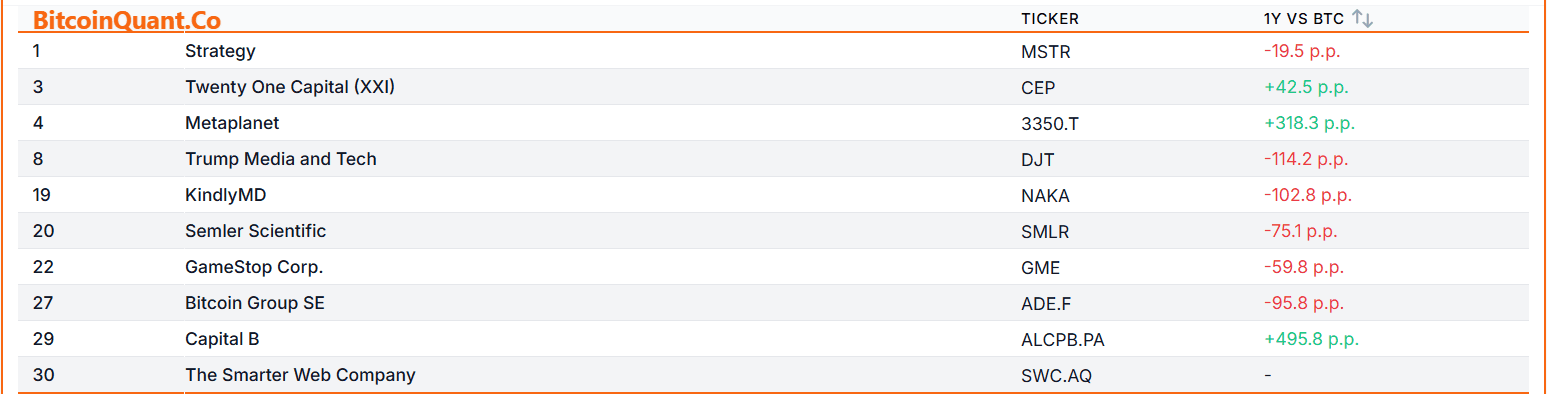
“Just buy an ETF.” Strive Asset Management CEO Matt Cole’s frank advice during a panel discussion at Bitcoin Asia in Hong Kong in August summed up the growing dissatisfaction with digital asset treasury (DAT), a corporate vehicle that promises to outperform Bitcoin. It achieved success through smart fundraising and balance sheet engineering, but so far it has struggled to deliver on its promises.

Bitcoin itself is up about 23% this year. However, most digital assets, including MicroStrategy, Semler Scientific, GameStop, and Trump Media, are lagging far behind both BTC and the ETFs that track it. Only a few outliers have been able to outperform their benchmarks, including Twenty One Capital and volatile Japan’s Metaplanet.
This gap reveals the core weakness of DAT trading. These companies were founded to outperform BTC through leverage, funding, or operational alpha, but most lag behind in the simplest exposures.
The leveraged beta proposition with balance sheet discipline only works if equity premiums, convertibles, and fixed income markets remain in good shape. Consider how detrimental Strategy’s $8 billion in debt would be if there were a rate hike. With average coupons of just 0.42% and maturities spanning four years, these bonds seem manageable today, but that sense of security disappears in a world of higher interest rates.
Despite daily headlines about crypto entrepreneurs taking over shell companies and filling their balance sheets with BTC, the voices of alarm are getting louder.
Galaxy Digital warned that the entire structure relies on a permanent premium to net asset value, a reflexive setting reminiscent of the mutual fund boom of the 1920s. NYDIG was similarly critical, arguing that the industry-favored “mNAV” metric masks debt and inflates per-share exposure by assuming debt conversions that never occur.
This does not mean that corporate Bitcoin adoption is an illusion. We’re growing faster than ever before. According to data compiled by Bitwise, the number of publicly traded companies holding Bitcoin is now nearly 40% higher than it was three months ago.

Some of these companies are genuine companies that carry BTC on their balance sheets due to the nature of their industry, such as Coinbase, Bullish (Bullish is the parent company of CoinDesk) and BTC miners like MARA. Some use it as a hedge against fiat currency volatility.
However, so many of the companies listed on Bitwise are BTC DATs, and it is important to distinguish them from other DATs that list proof-of-stake altcoins such as ETH and Solana. This is a separate product.
These DATs earn revenue from network activity itself rather than leverage by staking native assets and manipulating validators. For example, owning ETH or TRX DAT exposes you to Ethereum or Tron, the networks where the stablecoin revolution is alive. In theory, this exposure turns the Treasury into a miniature ecosystem, increasing in value as the network expands.
Tron’s listco, SRM, now Tron Inc after a rocky start, shows how this is done. Almost half of USDT’s activity relies on Tron, so if investors want a “Visa moment” for USDT, especially in the most exciting markets for stablecoins like Latin America, Tron Inc is a DAT that fits the bill.
Still, this kind of on-chain exposure remains the exception and not the norm. Most DATs do not understand how to translate balance sheet size into operating yield and network participation. They were supposed to be smarter than ETFs, more capital efficient, higher yielding, and tied to real economic flows on the blockchain, but many are still just leveraged proxies for the Bitcoin beta.
Until more financial firms can prove that they can compound capital faster than passive ETFs, the simplest lessons from the Hong Kong phase may remain the best. That means buying ETFs.