

Critics say Cardano is a dead project, while others say it’s only evolving. Charles Hoskinson responded to this criticism. But with TVL shrinking and user growth stagnating, it’s natural to wonder: Has Cardano lost its way?
In this episode, we explore data, decisions, and the deep forces that shape our future. Because what happens next could decide whether Cardano fades into history or not. Or stage one of the biggest comebacks in the crypto industry.
Cardano TVL
Therefore, the immediate issue for Cardano is the criticism regarding DeFi usage and TVL numbers. Frankly speaking, they are not good. Well, Charles Hoskinson came out and defended Cardano. That’s what you expect from CEOs and founders. However, it depends on what he actually said. First, check out my latest Cardano video here.
Therefore, Hoskinson pointed out that Cardano’s low TVL (Total Value Locked) is not primarily a technical limitation. Instead, he points to issues of user behavior and coordination. According to him, many $ADA holders are staking or holding. This is done in lieu of actively using DeFi protocols on Cardano.
For the record, Cardano ranks 26th out of all TVL chains on this DeFiLlama chart. Current TVL is $244 million. When compared to other L1s, it’s unfortunately not that great. Now, Cardano’s TVL was around $653 million in early January. That’s 2.6 times the current amount, but it’s still far from $1 billion. Alternatively, the TVL that Hoskinson believes Cardano could capture is $5 billion to $10 billion. In contrast, Sui’s TVL is $1.6 billion, and Sui is only two years old. Solana’s TVL is worth $10 billion, while Ethereum’s TVL is almost $80 billion.
#Cardano Founder’s Responsibility $ADA User complaining about DeFi’s predicament: “Our TVL will be at least $5 billion to $10 billion.”
Charles Hoskinson, founder of the Cardano network, highlighted this in a recent podcast, suggesting that Cardano users are contributing to the fight in decentralized finance… pic.twitter.com/Cz6ibXqBqt
— TheCryptoBasic (@thecryptabasic) November 3, 2025
$ADA Staking
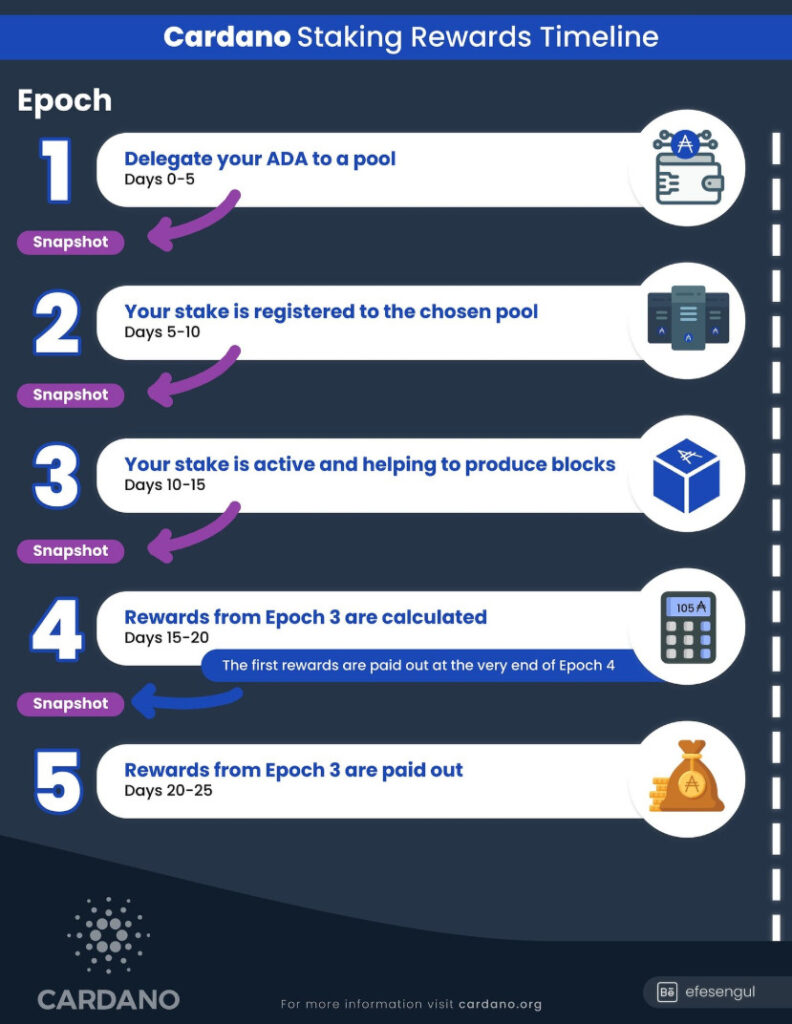
So, before we continue, let’s take a closer look at the $ADA staking numbers. Currently, there is $36.5 billion of ADA in circulation. Of this, Pool Tools claims that 21.78 billion shares are currently invested. This gives a staking rate of 57%, or about $11.5 billion at current $ADA prices. This is a good number. However, to put this into perspective, $SUI currently has a staking rate of 75%, according to Coinbase.
Source: Cardano Forum
However, Hoskinson claims that all staked $ADA is not part of TVL. Unfortunately, that argument doesn’t hold up. In general, native staking tokens do not count toward TVL. The main purpose of TVL is often to measure assets locked within dApps. This includes the broader DeFi ecosystem built on top of the chain. However, this does not include the base layer consensus mechanism itself.
However, assets locked in a Liquid Staking protocol are typically included in that protocol’s TVL. In other words, they contribute to the TVL of the entire DeFi ecosystem on-chain. For example, $stETH’s Lido. Therefore, Ethereum’s DeFi TVL includes Lido’s TVL.
Essentially, staking is a form of “locking” value. However, the type of staking determines its inclusion in the standard “Chain TVL” metric.
- Native consensus staking is typically done separately.
- DeFi protocol staking (including liquid staking) is part of TVL.
So here is evidence that Hoskinson’s statement that staked $ADA is not included in TVL is off the mark. The numbers don’t lie, TVL is low and Cardano’s DeFi is showing little activity. So let’s take a look at what Hoskinson and Cardano plan to solve this problem.
What is Cardano’s plan
So the question is on the table. But what are Cardano and Hoskinson going to do about them? Because it doesn’t end there. For example, Hoskinson admits a few things. One is that low network activity affects partnerships and liquidity. Another issue is that the lack of external integration further limits on-chain adoption. It’s like a catch-22.
Now that governance is going very well, I’m going to focus deeply on three big themes for Cardano this year.
1) Cardano’s Bitcoin DeFi (market size is 4 times that of Ethereum and Solana combined)
2) 24/7 commitment to scalability including Leios
3) Cardano…— Charles Hoskinson (@IOHK_Charles) January 18, 2025
Hoskinson put it another way. He says these issues are creating a “chicken and egg” loop in the ecosystem. So he came up with some solutions. Here are two he has proposed recently.
- Cardano and Bitcoin link. He has already mentioned this on various occasions.
- Unlock liquidity using real-world loans.
Welcome to the era of Bitcoin DeFi brought to you by Cardano
— Charles Hoskinson (@IOHK_Charles) May 27, 2025
Combining these two should improve DeFi TVL on Cardano. Another trump card is the Midnight Network. This is a privacy-focused sidechain. Applications for Midnight Airdrop recently closed.
RealFi is another card that Cardano can use. This is a microfinance platform. Its main initiative is to target the African market. Both Midnight and RealFi can now integrate with BTCFi on Cardano. As a result, you can lend $ADA and $BTC and convert them into stablecoins. Now you can use them in real lending protocols.
Laios upgrade
We are also planning a major network upgrade. That’s the Laios upgrade. This introduces a parallel block structure. This means enabling different transaction streams rather than one linear chain.
Leios has made great strides, evolving from an idea to a comprehensive CIP with a dedicated team committed to delivering it by 2026. Bitcoin DeFi has a dedicated team and GM, and we are already moving assets between chains as a team. In 2026, we will have a complete mainnet…
— Charles Hoskinson (@IOHK_Charles) November 3, 2025
In other words, this should increase transaction speed on the chain. There is talk of 10,000TPS (transactions per second). However, this is a theoretical TPS. Currently, Leios is moving from pure research to active engineering. However, the release schedule has not yet been revealed. Cardano is also well known for its slow but thorough pace. Therefore, this launch could take place in 2026.
Cardano founder: Leios scales 65x in 12-18 months pic.twitter.com/Ng2uzJe3vx
— Cardano Feed ($ADA) (@CardanoFeed) October 11, 2025
However, please note that launching Leios does not guarantee a better user experience. Other factors also influence this. Think about adopting an ecosystem, using DeFi, integrating protocols, or sidechains like Midnight. They all play a role in this story.
Also, don’t expect 10,000 TPS right away. This is an engineering goal and does not guarantee live network performance. The speed benefits are real. However, it may happen gradually. Don’t expect to “flip a switch and instantly get 10,000 TPS” changes overnight.
Current status of Cardano
So, all in all, Cardano’s current DeFi state is not great. But Hoskinson acknowledges this and is working on a solution. Knowing Cardano’s operating style, it can take some time for all the pieces to fall into place. So from that perspective, the current $ADA price of around 53 cents could be a good entry point. The question is, can Hoskinson convert the Cardano crowd into active DeFi users? Will he be able to save Cardano from the chain of death?
So it looks like Cardano is not dead, but in transition. TVL and DeFi activity is definitely low. However, our core infrastructure, user base, and development pipeline remain strong. Hoskinson’s solution requires implementation and coordination as well as technology. Even if liquidity and actual usage return, Cardano still has room to recover and evolve.
What do you think about this? Do you think Cardano has the power to bring about another turnaround? Can Hoskinson pull something out of his hat to reinvigorate the chain? Let us know in the comments section. Join the lively discussion on X and Discord.

Disclaimer
The information discussed on Altcoin Buzz does not constitute financial advice. This is for educational, entertainment, and informational purposes only. Any information or strategies are the thoughts and opinions of the writers and reviewers relative to their acceptable level of risk tolerance, and their risk tolerance may differ from yours.
We are not responsible for any losses you may incur as a result of any investments directly or indirectly related to the information provided. Bitcoin and other virtual currencies are high-risk investments, so please use caution.
Copyright Altcoin Buzz Pte Ltd.
The post Cardano ADA: Dead Chain or Crypto’s Next Big Comeback? appeared first on Altcoin Buzz.