

Important points
-
ChatGPT works best as a risk detection tool, identifying patterns and anomalies that often appear before sharp market declines.
-
In October 2025, tariff-related headlines were followed by a series of liquidations that wiped out billions of dollars of leveraged positions. While AI can flag risk buildup, it cannot precisely time market breaks.
-
Effective workflows integrate on-chain metrics, derivatives data, and community sentiment into a unified, continuously updated risk dashboard.
-
ChatGPT can summarize social and economic stories, but all conclusions must be verified with primary data sources.
-
AI-assisted predictions enhance cognition but do not replace human judgment or execution discipline.
Language models such as ChatGPT are increasingly integrated into analytical workflows in the cryptocurrency industry. Many trading desks, funds, and research teams deploy large-scale language models (LLMs) to process large volumes of headlines, summarize on-chain metrics, and track community sentiment. But when the market starts to bubble, the question keeps coming up: “Can ChatGPT actually predict the next crash?”
The wave of liquidations in October 2025 was a real stress test. More than $19 billion in leveraged positions were wiped out in about 24 hours as global markets reacted to the sudden U.S. tariff announcement. Bitcoin (BTC) plummeted from over $126,000 to around $104,000, one of the steepest single-day declines in recent history. The implied volatility of Bitcoin options has soared and remains high, while the stock market’s CBOE Volatility Index (VIX), also known as Wall Street’s “fear gauge,” has declined in comparison.
This combination of macro shocks, structural leverage, and emotional panic creates an environment where ChatGPT’s analytical power can come in handy. You may not be able to predict the exact day of a meltdown, but with a properly set up workflow, you can assemble early warning signals hiding in plain sight.
Lessons from October 2025
-
Leverage saturation preceded the collapse. Open interest on major exchanges hit record highs, while funding rates turned negative, both signs of overcrowded long positions.
-
Macrocatalysts are important: Increased tariffs and export restrictions on Chinese technology companies acted as an external shock, amplifying systemic vulnerabilities across the crypto derivatives market.
-
Divergence in volatility indicates stress: While Bitcoin’s implied volatility remains high, equity volatility has declined, suggesting that the risks inherent in cryptocurrencies are building independently from traditional markets.
-
Community sentiment suddenly changed. The fear and greed index dropped from “greed” to “extreme fear” in less than two days. Discussions on crypto markets and crypto subreddits have gone from jokes about “Uptober” to warnings of “season of liquidation.”
-
Liquidity has disappeared: As cascading liquidations triggered automatic deleveraging, spreads widened, bid depth thinned and selling increased.
These indicators were not hidden. The real challenge lies in interpreting them together and weighing their significance. This task can be automated by language models much more efficiently than by humans.
What can ChatGPT realistically accomplish?
Integrating stories and emotions
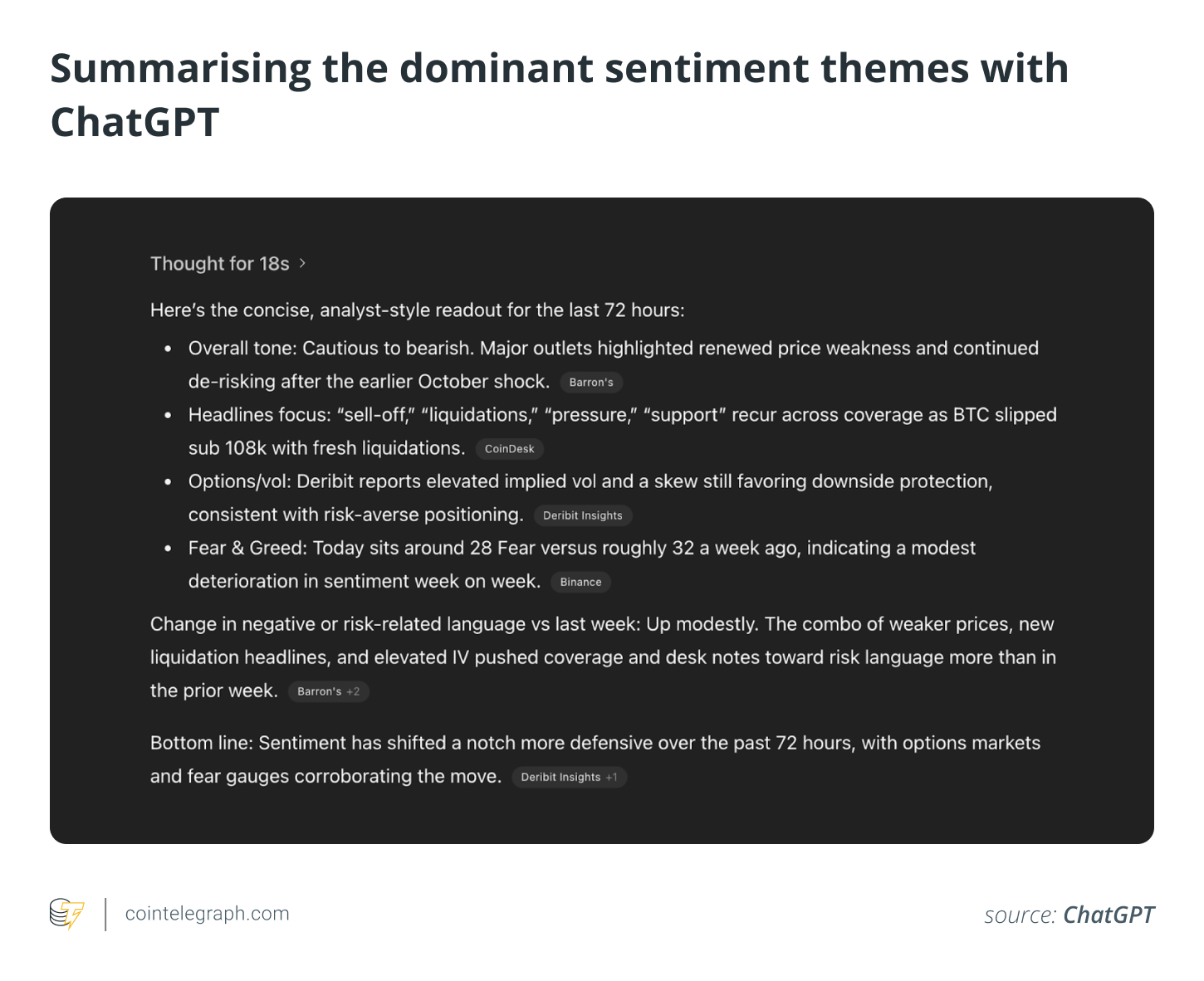
ChatGPT can process thousands of posts and headlines to identify shifts in the market narrative. As optimism fades and fear-mongering terms like “liquidation,” “margin,” and “sale” begin to dominate, the model can quantify that change in tone.
Example prompt:
“Act as a crypto market analyst. Summarize in concise, data-driven terms the sentiment themes that dominate across crypto-related Reddit discussions and major news headlines over the past 72 hours. Quantify changes in negative or risk-related terms (e.g., ‘sell-off’, ‘liquidation’, ‘volatility’, ‘regulation’) compared to the previous week. Highlight changes in trader mood, headline tone, and community attention. It may indicate an increase or decrease in market risk. ”

The resulting summary forms an emotional index that tracks whether fear or greed is increasing.
Associating text data with quantitative data
ChatGPT helps you estimate probability ranges for various market risk conditions by linking text trends with numerical indicators such as funding rates, open interest, and volatility. for example:
“Act as a crypto risk analyst. We correlate sentiment signals from Reddit, X, and headlines with funding rates, open interest, and volatility. If open interest is in the 90th percentile, funding goes negative, and mentions of ‘margin calls’ or ‘liquidations’ increase 200% week over week, we classify market risk as high.”

This contextual inference generates qualitative alerts that closely match market data.
Generating conditional risk scenarios
Instead of trying to make predictions directly, ChatGPT can outline conditional if-then relationships and explain how certain market signals interact under different scenarios.
“Act as a cryptocurrency strategist. Use market and sentiment data to create concise if-then risk scenarios.
Example: If implied volatility exceeds the 180-day average and currency inflows surge amid weak macro sentiment, assign a short-term drawdown probability of 15% to 25%. ”

Scenario language makes analysis grounded and falsifiable.
Post-event analysis
After volatility subsides, ChatGPT can review pre-crash signals to assess which indicators proved to be the most reliable. This type of retrospective insight helps refine analytical workflows rather than repeating past assumptions.
Steps for ChatGPT-based risk monitoring
While conceptual understanding is helpful, applying ChatGPT to risk management requires a structured process. This workflow transforms scattered data points into a clear daily risk assessment.
Step 1: Ingest data
The accuracy of the system depends on the quality, timeliness, and integration of the inputs. Continuously collect and update three major data streams:
-
Market structure data: Open interest, perpetual funding rates, futures basis and implied volatilities (such as DVOL) from major derivatives exchanges.
-
On-chain data: Indicators such as net stablecoin inflows and outflows to exchanges, outflows from exchanges, large “whale” wallet transfers, wallet concentration ratios, and exchange reserve levels.
-
Text (narrative) data: Macroeconomic headlines, regulatory announcements, exchange updates, and highly engaged social media posts that shape sentiment and narrative.
Step 2: Data health and preprocessing
Raw data is inherently noisy. To extract meaningful signals, the signals must be organized and structured. Tag each dataset with metadata such as timestamp, source, topic, and apply a heuristic polarity score (positive, negative, or neutral). Most importantly, we filter out duplicate entries, promotional “shillings” and bot-generated spam to maintain data integrity and reliability.
Step 3: Synthesizing ChatGPT
Feed the aggregated and cleaned data summary to the model using the defined schema. Consistent, well-structured input formats and prompts are essential to producing reliable and useful output.
Example of a synthetic prompt:
“Act as a risk analyst for the crypto market. Using the data provided, create a concise risk bulletin summarizing the current leverage situation, volatility structure, and tone of prevailing sentiment. Finish by assigning a risk rating from 1 to 5 (1=low, 5=severe) with a brief rationale.”

Step 4: Establish operational thresholds
The output of the model must be input into a predefined decision-making framework. A simple, color-coded risk ladder is often most effective.

The system should automatically escalate. For example, if two or more categories, such as Leverage or Sentiment, independently trigger an “Alert”, the overall system rating should move to “Alert” or “Critical”.
Step 5: Verify and ground
All insights generated by AI should be treated as hypotheses rather than facts and verified against primary sources. For example, if your model flags “large currency inflows,” use your trusted on-chain dashboard to review that data. Exchange APIs, regulatory filings, and trusted financial data providers serve as anchors to ground model conclusions in reality.
Step 6: Continuous feedback loop
Conduct a post-mortem analysis every time a major volatility event occurs, whether it’s a crash or a spike. Evaluate which AI-flagged signals are most strongly correlated with actual market results and which signals turn out to be noise. Use these insights to adjust the weighting of input data and adjust prompts for future cycles.
ChatGPT features and limitations
Being aware of what AI can and cannot do helps prevent AI from being misused as a “crystal ball.”
ability:
-
Synthesis: Transform large amounts of fragmented information, including thousands of posts, metrics, and headlines, into a single, consistent overview.
-
Emotion detection: Detect early changes in crowd sentiment and narrative direction before they manifest in lagged price action.
-
Pattern recognition: Identify non-linear combinations of multiple stress signals (e.g. high leverage + negative sentiment + low liquidity) that often precede volatility spikes.
-
Structured output: Provide clear, unambiguous explanations suitable for risk briefings and team updates.
Limitations:
-
Black swan event: ChatGPT cannot reliably predict unprecedented, out-of-sample macroeconomic or political shocks.
-
Data dependencies: It depends entirely on the freshness, accuracy and relevance of the input data. Old or low-quality inputs will skew the results. That means garbage goes in and garbage goes out.
-
Microstructural blindness: LLM does not fully capture the complex mechanics of exchange-specific events (such as automatic leverage cascades and circuit breaker activation).
-
It is probabilistic rather than deterministic: ChatGPT provides risk ratings and probability ranges (e.g. “25% chance of drawdown”) rather than hard predictions (“the market will crash tomorrow”).
Actual crash in October 2025
If this six-step workflow had been active before October 10, 2025, the exact date of the collision likely would not have been predicted. However, risk ratings may have increased systematically as stress signals accumulated. The system may have observed:
-
Accumulation of derivatives: Record-high open interest on Binance and OKX, combined with negative funding rates, indicates that long positions are crowded.
-
Story fatigue: AI sentiment analysis could reveal fewer mentions of the ‘Uptober Rally’ and an increase in discussion of ‘macro risks’ and ‘tariff concerns’ instead.
-
Volatility divergence: This model provides a clear cryptocurrency-specific warning, warning that cryptocurrencies’ implied volatility is spiking even as the traditional stock VIX remains flat.
-
Liquidity vulnerabilities: On-chain data shows that balances on stablecoin exchanges are shrinking, which could indicate a reduction in liquid buffers to meet margin calls.
Combining these factors, the model could have issued a “Level 4 (Alert)” classification. The rationale would be to point out that the market structure is highly fragile and vulnerable to external shocks. When a tariff shock occurred, a cascade of liquidations unfolded in response to clustering of risks rather than precise timing.
This episode highlights the core point. While ChatGPT or similar tools can detect accumulated vulnerabilities, they cannot reliably predict the exact moment of rupture.
This article does not contain investment advice or recommendations. All investment and trading moves involve risk and readers should conduct their own research when making decisions.