

Bitcoin price prediction: weekly and daily analysis
Bitcoin is testing a key weekly moving average near $105,000, but daily momentum indicates that interim buying pressure is returning. Traders are monitoring weekly closing prices to see if prices maintain a bullish trend or fall.
Bitcoin price prediction: weekly trends and major moving averages
The weekly chart shows that Bitcoin is currently trading near its 20-week moving average of $105,000, which is an important level when considering macro trend structure. The 20-week moving average is also an area that traders can use in their analysis to assess medium-term price stability.
Benjamin Cowen tweeted that Bitcoin is back above its 50-week simple moving average as the week approaches its close. A weekly close above $105,000 could be a price to explore higher levels around $115,000 to $120,000, while multiple weekly closes below $105,000 could signal a rebalancing towards the $98,000 to $100,000 support level. The weekly trends in BTC will be very important for positioning in the coming weeks.
After the past few weeks, we have started to see a decline in the highs. This means that the momentum of BTC price movements may weaken in the short term. Focusing on the price’s interaction with the 20-week moving average may provide a better perspective on understanding whether the bullish structure remains intact or if consolidation will occur.
With volume close to the 20-week moving average, we can further understand trader conviction. If traders can remain active in this area for more than 20 weeks, the greater activity will support the continuation of the broader uptrend.
I don’t want to jinx it, but BTC is above the 50W SMA heading into the week’s close. pic.twitter.com/gdHYgEIsg9
— Benjamin Cowen (@intocryptoverse) November 9, 2025
Bitcoin price prediction: daily indicators show stabilization
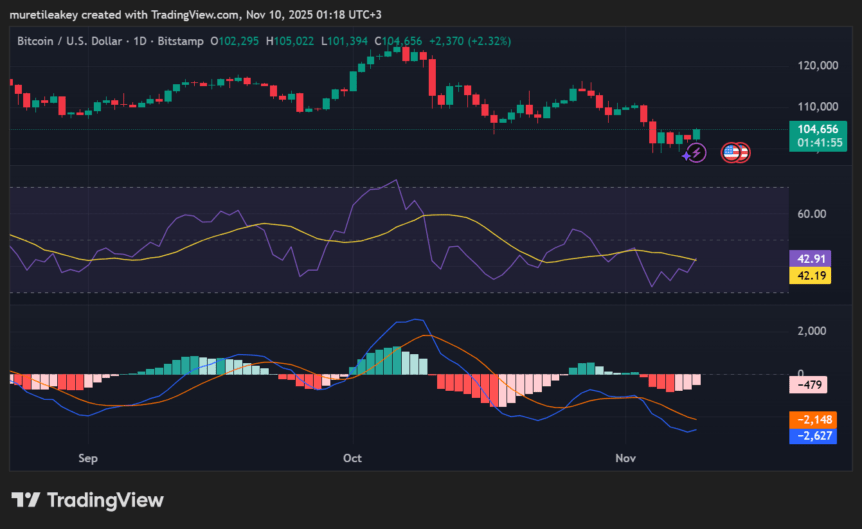
As shown on the daily chart, as of this writing, BTC has clearly recovered from the previous selling pressure and is trading at around $104,655. The RSI is at around 42.91, right at the midpoint of the neutral range, suggesting reasonable momentum and possible buying interest.
The MACD is still in negative territory, but the bar at the bottom of the histogram indicates that the bearish momentum is weakening. If buyers increase their push further, BTC could rise to the $108,000 to $110,000 range. The support zone remains extremely significant between $103,000 and $105,000.
Short-term price trends ultimately depend on daily closing prices and volume trading. A break through the support could reduce price action to a possible retest of the psychological level of $100,000, while holding the zone could allow for further consolidation before the bullish bias resumes.
By default, daily momentum suggests sellers are losing power, but buyers have not fully regained full control, so traders want to monitor these indicators to inform short-term style trading approaches based on current market conditions.
Source: Trading View
Bitcoin Price Prediction: Market Sentiment and Commentary
Market commentary integrates both technical and macroeconomic perspectives. Robert Kiyosaki drew attention to his long-term goals, suggesting that BTC’s value could reach $250,000 in 2026. Kiyosaki’s message is an element of sentiment for crypto traders, and sentiment drives much of their trading behavior.
Merlijn The Trader shared that Corporate Shell plans to accept BTC payments in South Africa, giving an example of the continued acceptance of cryptocurrencies by businesses. Greater financial behavior and social psychology may also continue to stimulate liquidity and short-term trading behavior.
Benjamin Cowen’s understanding of the 50-week SMA is also introduced, which is a way to draw traders’ attention to weekly closing prices. Investors are weighing the latest benefits of technical support and real-world implementation, and weighing expectations for future deals.
It is important to recognize that the market narrative continues to include examination of potential government actions and liquidity events that may impact the market. Such actions, even in the short term, can spur market movements.
Combining technical analysis and sentiment observation for diagnosing entry and exit in the current market helps traders plan future entry/exit levels.