

After Bitcoin price breaks above $100,000, is it likely to fall further, or will institutional buyers step in to support current levels?
summary
- Bitcoin price fell below $100,000 after a prolonged rally, causing renewed selling pressure and investor uncertainty across global markets.
- Large-scale liquidations coupled with high leverage and ETF outflows have led to widespread fear and structural fragility around cryptocurrencies.
- Technical indicators point to sustained weakness with resistance near $106,000 and support near $99,000 as traders remain cautious.
- Analysts have warned of weaker demand, a sell-off by long-term holders and a fragile recovery, while urging investors to manage risk amid continued volatility.
Bitcoin price falls below $100,000
Bitcoin’s drop below $100,000 has reignited concerns across the cryptocurrency market. After reaching an all-time high of $126,080, the world’s largest cryptocurrency has fallen about 21% and is trading at nearly $99,500 as of this writing on November 7th.
The decline follows a sharp selloff on Nov. 4, when Bitcoin (BTC) briefly hit $99,000 after a sudden collapse in U.S. stocks sparked a global risk-off movement. Prices recovered slightly after that, but the rally quickly dissipated as selling pressure returned.
Macroeconomic and geopolitical headwinds continue to dampen sentiment. The US-China trade conflict remains unresolved, further increasing uncertainty.
At the same time, investors are closely tracking the flow of Bitcoin exchange-traded funds, which saw inflows of $240 million on November 6, the first positive number since October 28, according to data from Coinglass.
Confidence is further undermined by concerns about the ongoing U.S. government shutdown. Historically, such conflicts have coincided with declining liquidity and declining risk appetite. For example, the 2018-2019 shutdown occurred near the bottom of Bitcoin’s last major cycle.
Forecasting platform Polymarket currently sees a roughly 50% chance that the current impasse will continue beyond November 16, and market sentiment remains fragile.
Why crypto sentiment has turned bearish
The weakness in cryptocurrency sentiment can be traced back to a series of interconnected events that have compounded over the past month.
The first big blow came with an unprecedented $19 billion liquidation event between October 10 and October 11, when leveraged traders were caught off guard by the sudden market collapse.
Approximately $16.8 billion of this represents long positions, or bullish bets that are forced to close as prices fall. More than 1.6 million traders were liquidated within a day, and in a particularly violent development, approximately $3.2 billion disappeared within a minute.
In the days leading up to the crash, derivatives markets were overleveraged. Before the decline, perpetual futures rates and open interest ratios had risen to near all-time highs.
Bitcoin’s open interest to total market value ratio is unusually high, suggesting that speculative exposure is ahead of organic demand.
Massive deleveraging wiped out weeks of speculative positions, leaving markets structurally weak, reducing liquidity and shaking confidence.
Macroeconomic and geopolitical conditions exacerbated the economic downturn. In early October, the United States imposed 100% tariffs on imports from China and introduced new export controls, reigniting concerns about a protracted trade war between the United States and China. The two countries have since signed agreements to soften the blow, but sentiment remains fragile.
As a result, the global cryptocurrency market capitalization fell to approximately $3.35 trillion as of November 7, a nearly 22% decline from its peak of $4.28 trillion on October 7.
ETF flow patterns confirmed the change in tone. By late October, U.S.-listed Bitcoin ETFs had recorded cumulative outflows of approximately $550 million, marking a sharp reversal from the previous streak of inflows.
The Cryptocurrency Fear and Greed Index, a measure derived from volatility, volume, and market momentum, has fallen to around 21 as of this writing, classifying it as “extreme fear.”
Technical structure suggests growing downside risks
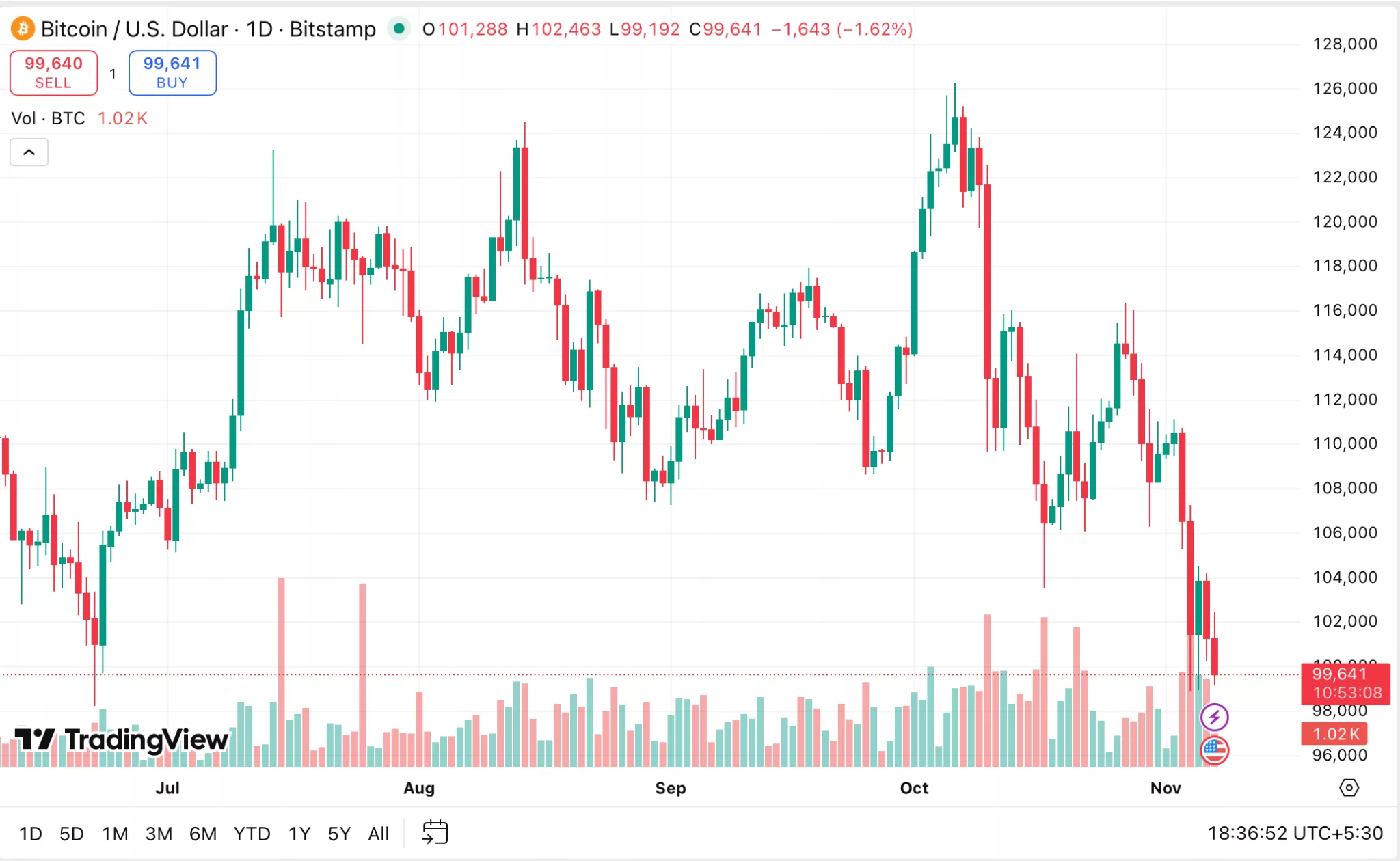
Bitcoin is trading around $99,500, down from its October high. The structure of the chart shows that a descending channel has been forming since mid-October, cutting down the highs on each rebound and breaking the previous support level on each decline.
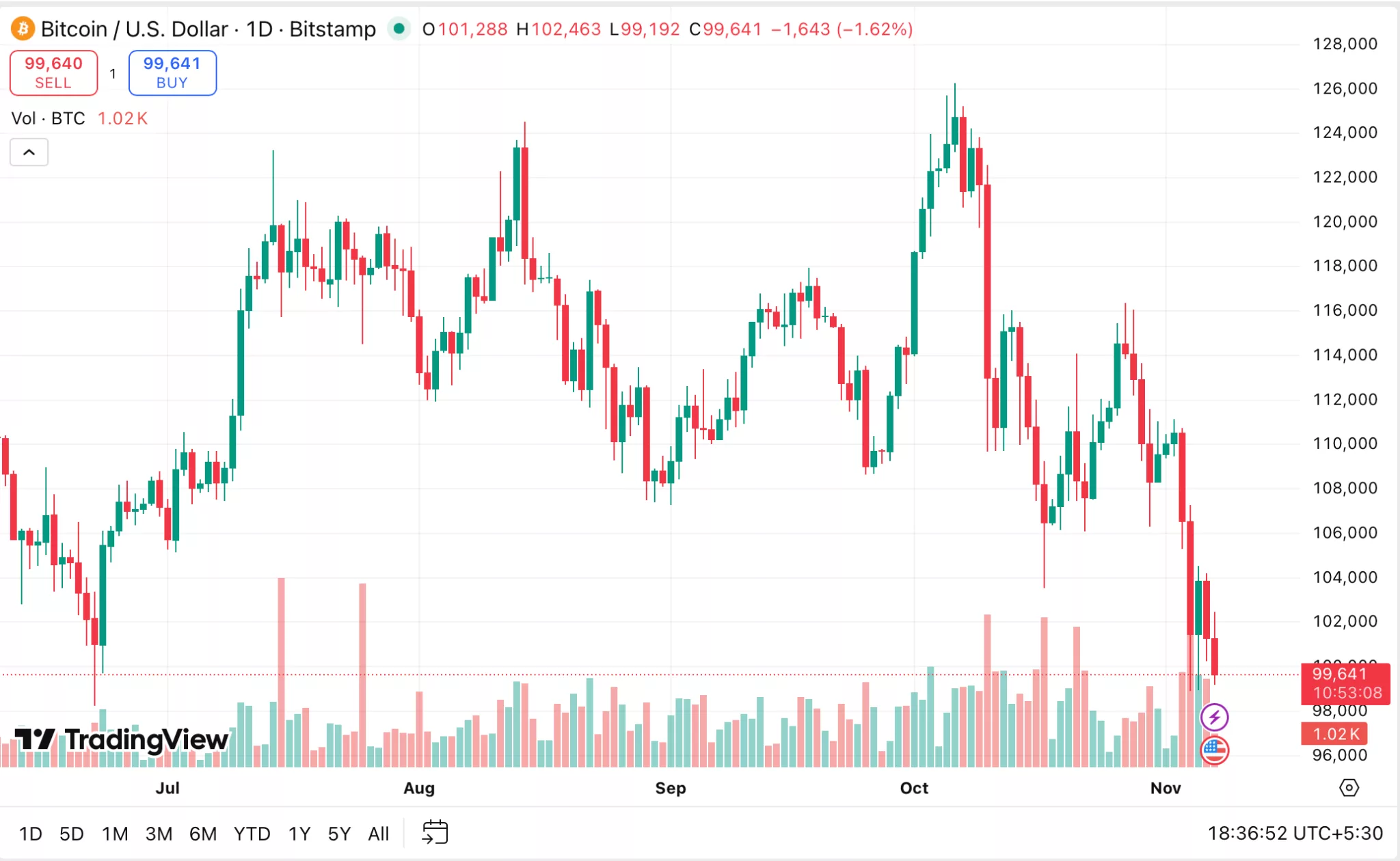
The most recent candlestick shows that the attempt to recover $102,000 has again failed, confirming sustained selling pressure around that level.
The recent selloff has seen a significant spike in volume, indicating that the decline is not simply the result of weak buying interest, but rather the result of aggressive position exits, a typical feature of a capitulation phase where traders lock in profits or cut losses rather than accumulating profits.
In terms of support resistance, Bitcoin currently faces immediate resistance levels at $102,500 and $106,000. The $99,000 level, briefly tested on November 4th, serves as the next important support.
If this level cannot be maintained, the next potential zone is between $95,000 and $92,000, which matches the previous accumulation area from August to early September. A break below that could result in a deeper correction, exposing the $88,000 to $90,000 range, where strong buying interest could emerge once again.
Based on moving average data, the short-term trend remains significantly negative. The 5-day average is around $102,472 and the 20-day average is around $108,674, both of which are above the current price, indicating a decisive decline in momentum.
Even the 200-day average, located near $103,917, is above the spot price, suggesting that the broader trend is also weakening.
Overall, the technical situation remains bearish, but increasingly oversold. Bitcoin is hovering around $100,000 psychological support with significant resistance overhead. A sustained close below $99,000 could lead to a retest of the mid-$90,000s, but a clean break above $106,000 would be needed to signal a recovery.
Analysts warn of declining demand and resurgence of whales
Analysts believe the current price trend reflects weakening momentum as Bitcoin struggles to maintain stability above $100,000.
Cryptocurrency market analyst Ted Pillows said Bitcoin’s ability to stay above $100,000 is temporary unless it falls below $106,000 and continues to stay above $106,000 at the end of the day.
He also pointed out that the Coinbase Bitcoin Premium, which measures the difference between Bitcoin prices on Coinbase and global exchanges, remains significantly negative.
Historically, negative premiums indicate less buying interest among U.S. institutional and retail investors, suggesting that confidence remains weak.
Charles Edwards, founder of Capriol Investments, shared data showing that long-term Bitcoin holders, also known as “OG whales,” are selling in large numbers.
His analysis, based on Glassnode’s on-chain metrics, shows multiple $100 million and $500 million sell events from inactive wallets from before 2018. Such activity typically reflects distributions from early investors who took profits or exited amid market uncertainty.
If long-term holders start selling en masse, this often creates downward price pressure as new market participants tend to absorb these coins only at lower valuations.
Another concerning indicator comes from CryptoQuant’s Bull Score Index. The index recently fell to zero for the first time since January 2022, the same signal that preceded the start of the last bear market.
A reading of zero means that most of the key market indicators such as funding rates, stablecoin inflows, and foreign exchange reserves have turned bearish.
The overall sentiment is that the market remains fragile and driven more by fear than fundamentals. Investors should remain vigilant, manage their risks carefully, and remember that cryptocurrencies remain one of the world’s most volatile asset classes. Trade wisely and never invest more than you can afford to lose.
Disclosure: This article does not represent investment advice. The content and materials published on this page are for educational purposes only.