

Important points
What has the U.S. Treasury’s new guidance changed?
This will officially allow US-listed crypto ETFs to stake proof-of-stake assets such as Ethereum and Solana and distribute staking rewards to investors.
Why is this important to investors and the industry?
This levels the playing field between ETFs and direct crypto holders, allowing investors to earn passive yield within a regulated product.
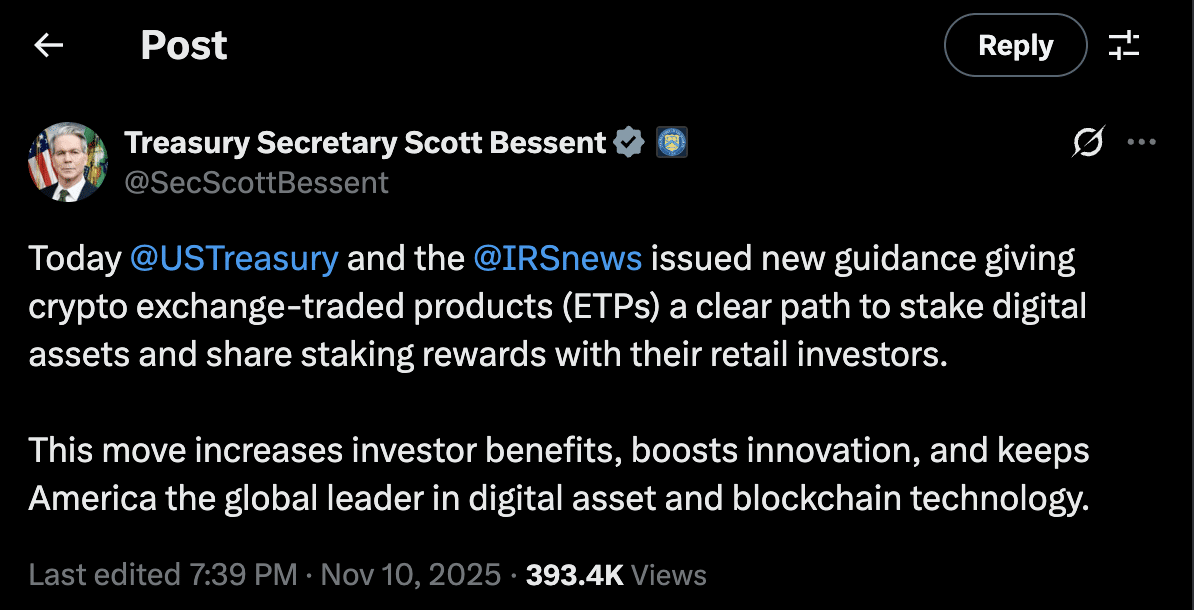
The U.S. Treasury Department and IRS released landmark guidance on November 10th that allows for virtual currency exchange-traded products. [ETP] Stake your digital assets and share the rewards with retail investors.
The safe harbor rule is Revenue Procedures 2025-31 Major asset managers are waiting to add yield-generating features to Ethereum and Solana ETFs, following months of regulatory uncertainty.
Treasury Secretary Scott Bessent announced The guidelines aim to “increase investor returns, foster innovation, and ensure the United States remains a global leader in digital assets and blockchain technology.”

Source: X
What staking means for ETF investors
Staking allows you to verify network transactions with proof-of-stake cryptocurrencies such as Ethereum and Solana.
Validators earn rewards by securing the blockchain. To date, U.S. crypto ETFs have not been able to participate in staking, even though direct holders of cryptocurrencies earn these yields.
The new guidance changes that completely. ETFs can now stake their holdings through eligible custodians such as Coinbase Custody, BitGo, and Gemini, who work with validator operators and earn rewards.
ETFs are required to distribute these fees to investors at least quarterly.
This provides significant benefits for regulated products. Ethereum ETF holders can now earn staking yield through a traditional brokerage account without having to manage validators or private keys themselves.
The 8 month wait is finally over
Major issuers have been anticipating this moment since February.
The SEC repeatedly postponed its decision, pushing the deadline from April to June and then October.
Asset managers have been anxiously waiting while non-staking ETFs have been underperforming their direct Ethereum holdings relative to expected staking yields.
Grayscale shareholders approved staking amendments in September, demonstrating investor demand for high-yielding crypto products.
BlackRock held a private meeting with the SEC earlier this year, fueling speculation that it would ultimately be approved.
Requirements and schedule
Safe harbors include strict requirements. ETFs are traded on national stock exchanges, must remain 85% liquid for redemption, and are only funded through unaffiliated third-party providers on arm’s length terms.
This guidance protects trusts from significant penalties if a validator loses staking assets due to fraudulent activity.
Existing ETFs have a nine-month grace period starting today to amend their trust agreements. This means the Ethereum ETF could start staking by mid-2026.
You can now add staking on Solana ETFs
The Solana ETF is the latest one, launched on October 28th. However, these funds were launched without staking functionality due to regulatory uncertainty.
Today’s guidance provides the clear framework these issuers need.
The Solana ETF will be able to amend its trust agreement to add staking within nine months, allowing investors to enjoy high SOL yields of around 5-7% per year, alongside existing Ethereum funds.
This guidance marks a major change in U.S. cryptocurrency regulation. Asset managers will finally be able to compete with direct ownership of cryptocurrencies by offering institutional-level staking through traditional investment vehicles.