

Main highlights
- Spanish authorities arrest Álvaro Romillo Castillo, the ringleader known as CryptoSpain, on suspicion of running a 260 million euro pyramid scheme
- The scheme, known as Madeira Invest Club, promised high guaranteed returns from crypto assets and luxury assets.
- The investigation revealed that the 260 million euros stolen was laundered through a complex network of offshore shell companies in Madeira and Cyprus.
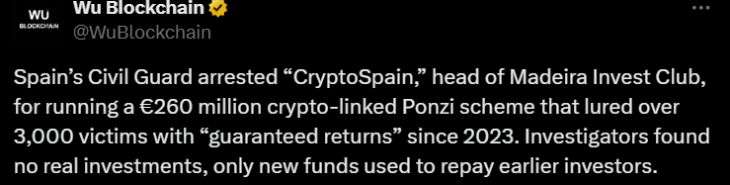
Spanish law enforcement has dismantled a cryptocurrency Ponzi scheme known as Madeira Invest Club. The operation resulted in the arrest of the alleged ringleader, Álvaro Romillo Castillo, a 42-year-old man from Madrid.
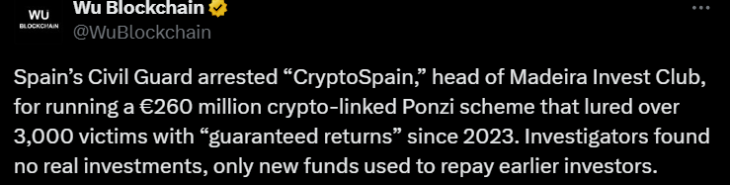 (Source: Wu Blockchain on X)
Who is Alvaro Romillo Castillo?
Castillo, who was widely known online under the alias “CryptoSpain,” was taken into custody on November 7. He currently faces felony charges including fraud, money laundering and membership in a criminal organization.
Authorities believe his scheme defrauded more than 3,000 investors in Europe and other parts of the world. This allowed him to steal around 260 million euros.
Madeira Invest Club has established itself as an exclusive private investment group. They used deceptive marketing techniques to attract people with promises of high profits. Potential investors were told they could earn up to 20% a year by putting their money into a mix of trendy and traditional assets. These included cryptocurrencies, gold, luxury yachts, expensive whiskey, real estate, and luxury cars.
The system was reportedly expected to provide a kind of safety net called a “buyback guarantee.” This promises to buy back your investment at a higher price. The operator, known as “CryptoSpain”, has gained a large following on social media. He hosted webinars promoting risk-free ways to profit from digital currencies using targeted advertising.
Spanish authorities crack down on fraud
The investigation began in mid-2024 after victims came forward. We concluded that this operation was a classic pyramid scheme. A financial audit confirmed the hard fact that Madeira Investment Club was not making any real investments.
Instead, the funds from new investors were simply used to pay fake “profits” to previous investors. This created the illusion that the business was successful and profitable. A spokesperson for Spain’s Interior Ministry said the scheme exploited the popularity of cryptocurrencies and luxury goods to prey on people’s get-rich-quick desires. When the flow of new capital slowed, the entire business collapsed, leaving most investors with nothing.
Fraud connections spread around the world
Most were middle-class citizens of Spain, but the scheme also ensnared people from Portugal, Italy, Germany, and as far away as the United States and Latin America. Many were retirees or small business owners who had lost their savings.
One retiree from Madrid said he had lost 50,000 euros. She said she saw compelling charts and data that made her believe the investment was justified.
On average, each victim lost around 80,000 euros, with some losing more than 1 million euros. The criminals moved the stolen funds through a complex network of shell companies based in overseas locations such as Madeira and Cyprus. They used crypto-mixing services and converted funds into cash to cover their tracks.
The arrest was the result of an 18-month international investigation. Police searched several properties and seized luxury goods, including a Ferrari and a yacht, believed to have been purchased with stolen funds.
With the help of Europol, researchers traced the connections of digital money to cryptocurrency exchanges in Estonia and Panama. The suspect has been denied bail due to the possibility of him fleeing the country. His trial date is set for November 15th, and prosecutors are seeking a 15-year prison sentence. The case serves as a stark warning about the risks in the lightly regulated world of cryptocurrencies, where promises of guaranteed returns often result in total losses.
According to a mid-year report from blockchain analysis firm Chainalysis, criminals stole more than $2.17 billion in the first half of 2025 alone. This number already beats the total for all of 2023. If this trend continues, the total annual theft could reach a staggering $4 billion.