

Important points
What do recent on-chain metrics suggest about Bitcoin’s near-term outlook?
Indicators such as a rising bid-to-ask ratio and a low bubble index suggest that Bitcoin may be poised for a bullish move.
How is Bitcoin’s market power impacting investor sentiment?
As its dominance rises to 59.1%, Bitcoin attracts more liquidity and strengthens its role as a market anchor.
Bitcoin [BTC] We may see new demand in the coming weeks as key on-chain indicators signal potential market changes.
The asset has consolidated over the past three days, trading between $101,000 and $103,000.
At the time of writing, the asset was trading at $102,289. This consolidation reflects a temporary balance between buyers and sellers and suppresses price fluctuations.
Long-term holders put pressure on Bitcoin
Market dynamics usually depend on the balance between buyers and sellers. However, this equilibrium has recently changed.
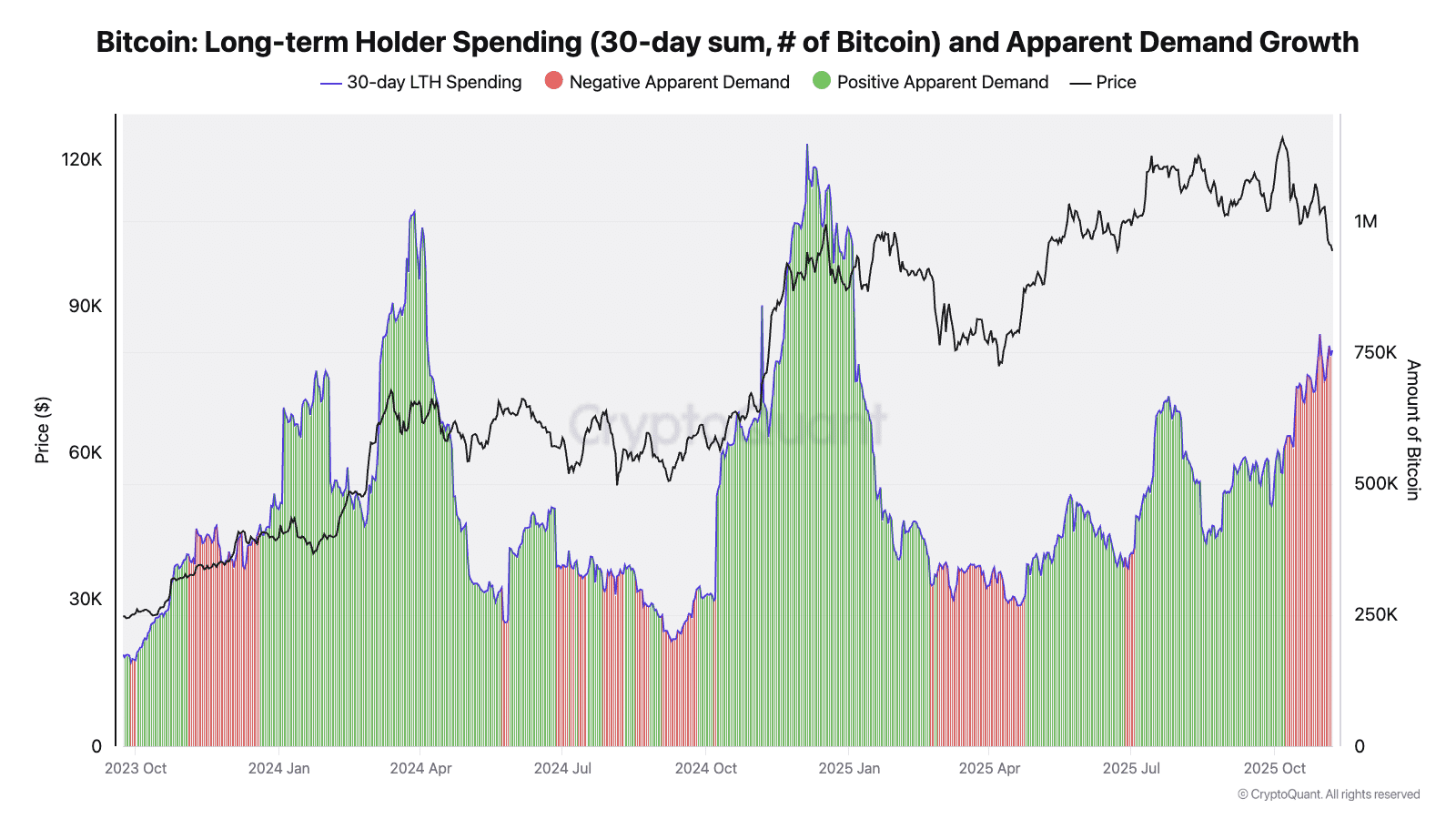
Long-term holders (LTH), who control the majority of Bitcoin’s supply, have begun selling off their assets due to weak demand.
From November to December 2024 and from January to March 2025, these holders sold some of their holdings, but strong demand at the time offset the impact.

Source: CryptoQuant
That trend has now changed. Looking at the chart, we can see that apparent demand has decreased over the past 30 days as LTH continues to sell, putting downward pressure on its price.
Meanwhile, the liquidation heatmap shows that Bitcoin is trapped between two major liquidity clusters. Price movement towards either cluster could define the next major trend for that asset.
Liquidity zones often cause price fluctuations, with current levels at $105,000 on the bullish side and $98,000 on the bearish side.
A decisive move beyond either boundary could indicate where Bitcoin’s next leg is headed.
Where could Bitcoin tilt?
Market fundamentals suggest the bulls could make a move soon. The buy-to-sell ratio, which measures liquidity on the buyer and seller sides, turned positive for the first time in several months and was hovering at 0.2 at the time of writing.
This number indicates that buyer liquidity is increasing as investors begin to accumulate Bitcoin.

Source: CryptoQuant
Historically, large increases in Bitcoin prices have been preceded by similar changes between March and April.
Further supporting this view is the Bitcoin Bubble Index, which determines whether Bitcoin is in a bullish or bearish phase and identifies potential market tops or bottoms.
A number near 139 typically indicates a market ceiling. Currently, the index is at 13.46, indicating that the market is still far from its peak and Bitcoin still has room to rise.
Advantage is built gradually
Bitcoin’s market power has remained relatively stable over the past 30 days, reflecting the balance of liquidity inflows and outflows.
In the past 24 hours alone, Bitcoin’s dominance has increased by 0.71% at the time of writing, bringing Bitcoin’s share of the total cryptocurrency market capitalization to 59.1%.

Source: CoinMarketCap
The market capitalization of virtual currencies currently stands at $3.45 trillion. The continued rise in dominance suggests that more liquidity is flowing into Bitcoin, strengthening its position as the center of the market.
For now, long-term holders continue to sell while new demand begins to emerge, likely setting the stage for Bitcoin’s next bullish phase.