

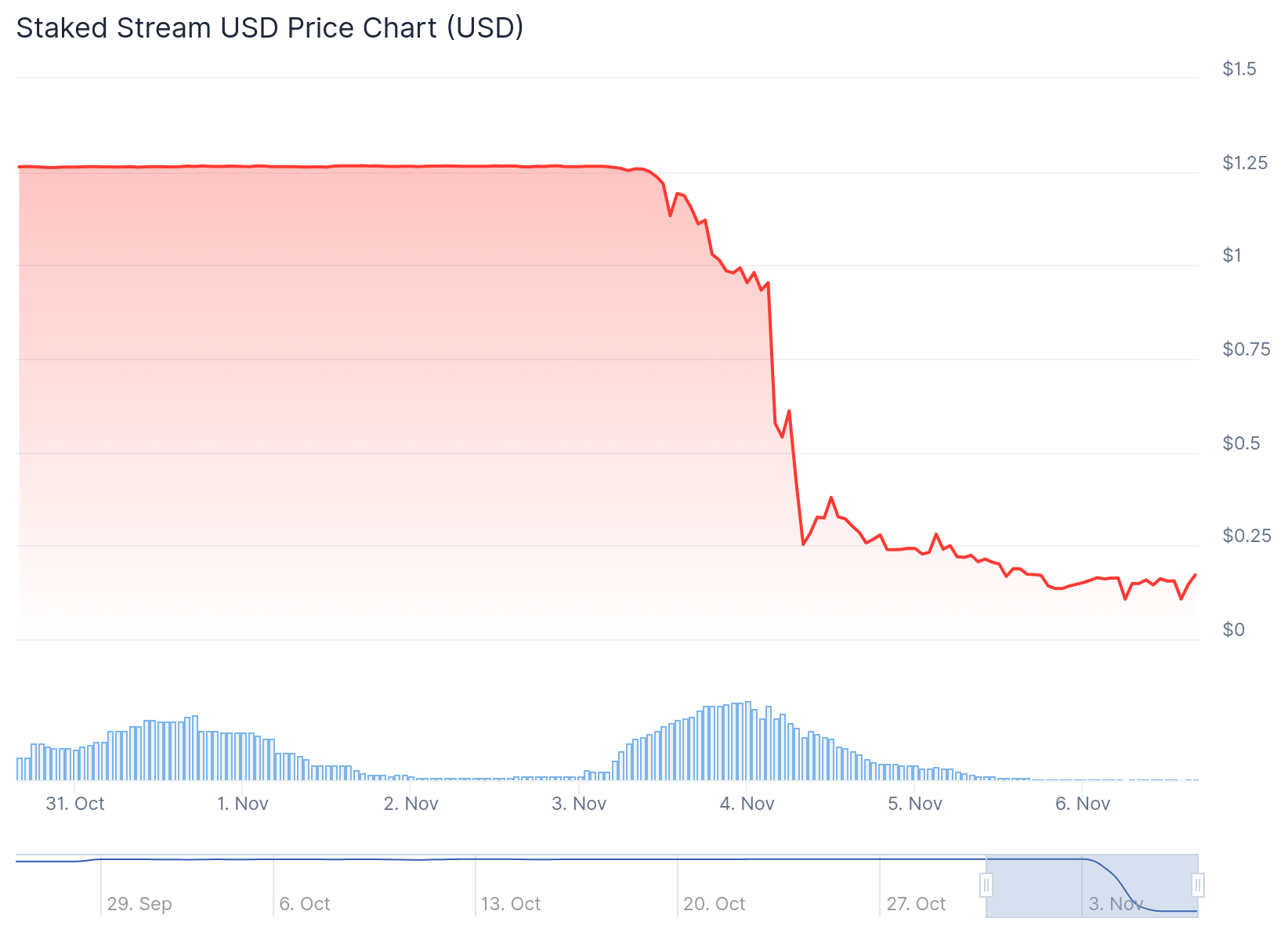
Stream Finance exploded just weeks after some DeFi insiders discovered its sketchy “trust me” strategy.
Stream Finance, a DeFi project that issues a synthetic dollar token called xUSD and focuses on yield optimization, told users on November 4 that an “external fund manager” had lost approximately $93 million in assets associated with the project.

Within a day, xUSD lost more than 85% of its value, plummeting from $1.26 to $0.16 by the time this article was published. Withdrawals from the platform were frozen and the dense web of interconnected yield vaults began to unravel, raising questions about how much of DeFi’s apparent growth was built on so-called circular lending loops.
This disclosure comes shortly after reports surfaced that the established DeFi protocol Balancer had been abused for more than $100 million, further shaking confidence in the sector.
As the issue subsides, reports continue to emerge showing the scale of the impact on DeFi as a whole.
What is Stream Finance?
Stream Finance describes itself as a “tokenized market-neutral fund.” The project’s main slogan, “The SuperApp DeFi Deserves,” is still prominently featured on the website at press time, along with the promise to simplify on-chain revenue generation.
However, Stream’s mechanism was largely a black box. Users will deposit their supported assets (USDC, ETH, BTC, or EURC) into a vault that promises double-digit APYs. The Stream Finance team then reallocates these funds to other protocols based on various strategies that are opaque and not fully disclosed in order to provide higher returns to depositors. According to Stream’s platform, these strategies included “loan arbitrage, incentive farming, dynamic hedging HFT, and market making.”
Stream Finance issued corresponding yield tokens, such as xUSD for USDC deposits, in exchange for deposited assets. According to Stream’s official platform, at the time of writing, the total amount on the platform was over $382 million, with an APY of 18%.

For comparison, as of this writing, Aave, DeFi’s largest lending protocol, currently offers 4.8% APY on USDC deposits, while Compound offers just over 3%.
While Stream Finance’s value proposition (much higher yields on stablecoin deposits) was clear, the “yield optimization” corner of DeFi is also clearly high risk. As the platform itself notes, risks include “failure to execute, smart contract risks, and custody risks.”
To offer higher-than-normal yields, players like Stream are building on-chain positions that include self-circulating lending markets, risk curators, and automated strategies, all of which are hidden from users lending or depositing assets, making understanding the full scope of risk complex, if not impossible.
How it all started: Recursive mint
Even before the stream revealed losses and xUSD collapsed, some in the crypto community already knew something was wrong. After the largest liquidation event in crypto history on October 10, when around $20 billion disappeared from the market, Stream Finance and several other companies have been acting suspiciously as if nothing had happened.
This raised eyebrows among on-chain analysts, who increasingly began flagging a pattern of Stream Finance lending and borrowing its own assets, recycling the borrowed tokens into partner vaults, and minting new yield tokens on top of them, effectively creating circulating liquidity and inflating the total amount locked up.
And for a while, this tactic worked, with loop liquidity pushing Stream Finance’s self-reported total value locked (TVL) to over $200 million. However, many are now questioning this tactic, claiming that tracking sites are likely double-counting bridge tokens and artificially inflating TVL.

As warning signs emerged, DefiLlama updated its indicators and wiped out millions of dollars from Stream Finance’s TVL page. After news of Stream’s collapse broke, 0xngmi, the pseudonymous founder of DefiLlama, posted on X that protocols that are funded on centralized exchanges may be asked to share data, as “currently all protocols that are funded on CEX are black boxes in terms of verification.”
DeFi yield aggregator Yearns Read, known as Schrag on X, posted yesterday evening that “nothing that happened suddenly happened out of nowhere,” adding, “Like any good bubble or explosion, it was slowly building and it was just a matter of time before it burst.” Schlag also added that “Stream Finance is not the only company hiding bodies.”
On October 28, days before Stream reported the $93 million hole, Schlag sounded the alarm on X in a detailed article reporting that Stream Finance and Elixir, DeFi protocols focused on liquidity provisioning, were exploiting hidden markets in lending protocol Morpho.
According to Schlag’s report, Elixir was supplying USDC through Morpho’s private vault, with Stream Finance being the sole borrower and using its own xUSD as collateral. “It’s hard to know exactly how much actual collateral is going to back this complete system, but it’s likely to be less than $0.10 on the dollar,” Schlag concluded at the time.
Schlag also explained how Stream and Elixir implemented a so-called loop mechanism, “recursively minting each other’s tokens in order to inflate their own TVL and create a ponzu of a kind not seen in cryptocurrencies in a while.” As Yearn’s lead explained, Stream Finance’s xUSD wallet received millions of dollars in USDC, circulated the funds through multiple addresses, exchanged them for USDT, minted Elixir’s proprietary synthetic dollar token, deUSD, and then used the borrowed assets to mint more xUSD.
“[…] Using the same $1.9 million USDC, I minted approximately 14.5 million x USD. […]” Schlag wrote.
On November 3, Elixir responded to concerns about xUSD circulating on social media, claiming that it has “full redemption rights at $1 with Stream” and is “the only creditor with these one-to-one rights.”
fall out
The breaking point came on November 3rd, the same day that Balancer V2, one of the largest automated market makers, was hacked for $128 million. The exploit caused confusion about the potential for infection, triggered a classic run on Stream Finance as liquidity providers rushed to withdraw from pools that appeared to be connected, and users rushed to withdraw their funds.
On November 4, Stream disclosed $93 million in losses, but gave few details other than that it had hired US law firm Perkins Coie LLP to investigate the incident. Later, the project informed users that it had stopped both withdrawals and deposits.
By that time, the value of xUSD was already well below $1, and the web of Vault integration was beginning to crumble. When the collapse finally occurred, the extent of these hidden loops became at least somewhat visible.
Several major DeFi protocols, including Morpho, Euler, Silo, and Gearbox, were found to have accepted Stream Finance’s xUSD as collateral despite clearly being aware of the asset’s recursive minting structure. This interconnected setup spread xUSD-backed positions across multiple lending markets, amplifying risk across the ecosystem.
As this scheme unraveled, reports emerged that risk curators and vault managers such as Beefy, Silo, and Valarmore were reallocating user funds to xUSD without transparent disclosure, leaving depositors unknowingly exposed to Stream’s tokens.
“There are too many entities. We can’t monitor them,” Johnny Time, founder of Web3 security company Ginger Security, wrote on the X thread on November 4th.
In an interview with The Defiant, Dries Benamour, co-founder and CEO of YO Labs, the company behind multi-chain yield optimizer YO, called the strategy behind xUSD a “decadent practice in DeFi” and clarified that “YO’s vaults had no exposure to xUSD and no meaningful exposure to yUSD.”
Silo Labs, the company behind the Silo protocol, said in a press release shared with The Defiant on November 5 that it is preparing to file a lawsuit against the Stream team, while the Silo DAO is also preparing to take legal action, as the incident “resulted in lenders being unable to access their funds or redeem their xUSD and xBTC.”
Silo Labs said in a release that the Silo DAO is working closely with attorneys to prepare and coordinate the lawsuit and seek “the maximum pro rata repayment to all affected lenders.”
stream response
Before Stream Finance revealed its massive losses, the platform’s founder, known by the pseudonym 0xlaw, sought to reassure users in a now-deleted October 29 post on X that Stream maintains an “insurance fund of over $10 million” and that all positions other than the main wallet are “immediately and fully liquid.” The founder also promised a transparent report on Stream’s strategy.
0xlaw initially agreed to an interview with The Defiant on October 28, but did not respond to additional questions regarding the transparency report or details of the announced insurance funds.
After the meltdown, the founders of Stream Finance wrote in an X post, which has since been made private, that they held “no outside fund managers” to blame for the millions of dollars in losses, claiming: “None of the strategies I was running suffered any drawdowns. We are pursuing aggressive legal pursuit against the responsible asset managers. For various reasons, I had no knowledge of this matter until shortly before it became public.”
But with approximately $285 million in debt entwined with risk curators, vaults, and lending markets, and multiple yield tokens collapsing between 30% and 99% as of November 5, the fallout has exposed how fragile DeFi’s stacked yield economy has become, and how badly the so-called risk curators have failed.