

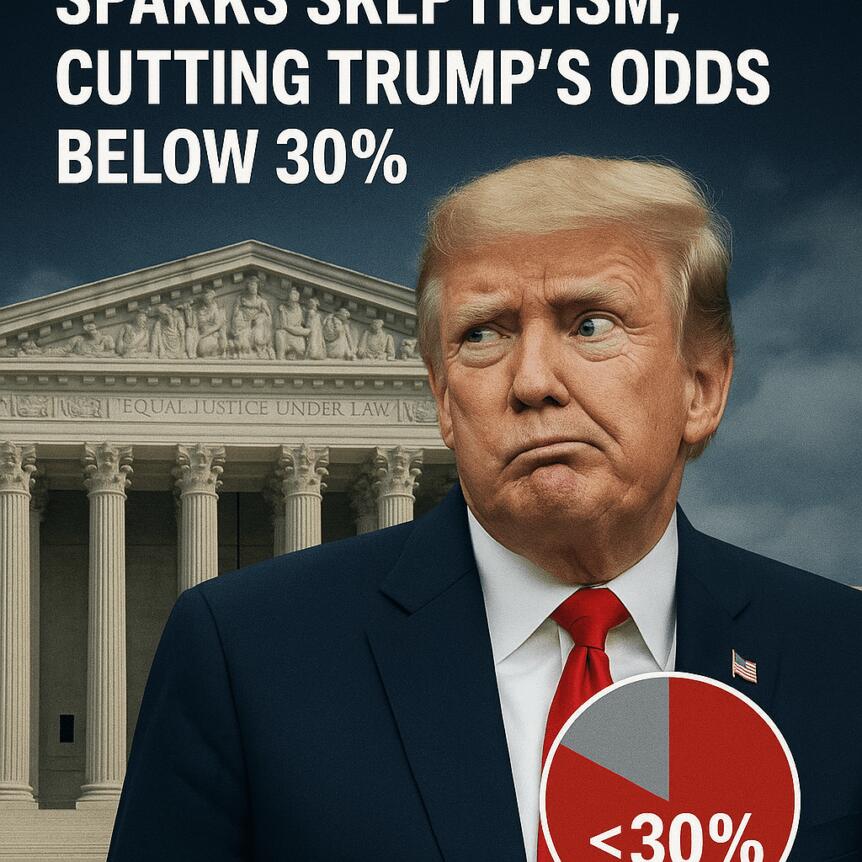
Recent changes in prediction market sentiment suggest growing skepticism among traders about the U.S. Supreme Court’s tendency to uphold President Trump’s broad authority to impose tariffs using emergency powers. As the legal debate unfolds, markets are adjusting their odds, reflecting concerns about potential limits on presidential power that could have a significant impact on how crypto markets react to future U.S. trade policy and political developments.
- Market forecasts indicate a significant decline in confidence that the Supreme Court will side with Mr. Trump on tariff authority.
- Both traditional and blockchain-based platforms anticipate that the president’s tariff powers may be limited.
- Recent market developments reflect ongoing legal debate and judicial skepticism regarding the executive branch’s trade powers.
- Cryptocurrency prediction market volume exceeds $1.3 million, showing early signs of political and legal sentiment.
Prediction markets, including regulated exchanges like Karshi and blockchain-powered platforms like Polymarket, are showing a sharp decline in confidence in President Donald Trump’s ability to unilaterally impose tariffs through emergency powers. On Thursday, Carsi traders gave just a 29% chance that the Supreme Court would back Trump, a one-day drop of 28 points. Meanwhile, polymarket odds have fallen to 25%, highlighting a similar shift in sentiment among crypto-native traders.
The combined trading volume of these platforms exceeds $1.3 million, demonstrating how prediction markets serve as an early indicator of political and judicial risk sentiment related to crypto markets. The divergence in market trends coincides with increased volatility since the Supreme Court agreed to reconsider the case in September, particularly on Wednesday, when the market decline reached its biggest one-day drop since it began.
General market sentiment suggests that expectations are rising that the court will limit the scope of the president’s authority to impose tariffs under the International Emergency Economic Powers Act of 1977. A decision to reduce this power could reshape future US administrations’ approaches to fiscal leverage and trade diplomacy. The alignment of traditional and decentralized markets highlights the convergence of how traders interpret political and legal risk through both fiat and blockchain platforms.
Traders expect President Trump’s tariff powers to be limited
The prediction market’s odds drop comes after several conservative judges reportedly expressed skepticism about President Trump’s claims to impose broad import tariffs on his own. In oral arguments Wednesday, the Supreme Court considered whether the president can rely on a 1977 law to unilaterally impose tariffs without Congressional approval.
An Associated Press analysis also found concerns about separation of powers and centralization of fiscal authority among Trump appointees. Chief Justice John Roberts, Justice Neil Gorsuch, and Justice Amy Coney Barrett questioned the scope of the executive branch’s authority under the law, with Barrett criticizing the targeting of specific countries and Roberts stressing that tariffs are essentially Congressional taxes. Gorsuch warned that expanding executive power could lead to an unchecked expansion of presidential power.
President Trump’s trade policies have historically impacted the crypto market, with tariffs raising inflation concerns and encouraging Bitcoin (BTC) to act as a hedge against fiscal instability. However, periods of uncertainty can also trigger risk-off behavior and short-term declines as traders pivot to safer assets amid economic concerns.
Related: From Taylor Swift to interest rate cuts, Redstone integrates real-world bets with Calsi on-chain