

WazirX Hack Aftermath: User Disputes $9,400 XRP Account Freeze
This incident is based on XRP (XRP) filed a petition against WazirX after the exchange froze her account containing 3,532.30 XRP worth approximately $9,400. The dispute stemmed from WazirX’s response to a July 2024 hack that led to the theft of approximately $235 million in assets.
To manage losses, WazirX proposed a controversial “socialization of losses” plan. This spreads the financial impact evenly across all user accounts. Ruthikumari objected to the plan, claiming it infringed on her property rights.
In its defense, WazirX argued that the dispute was governed by a restructuring plan approved by the Singapore High Court, which outlined a three-step process to provide proportionate compensation to all users. The exchange argued that it did not directly own users’ wallets and argued that the Madras High Court lacked jurisdiction as the arbitration was based in Singapore. It added that trading and withdrawals for all users have been temporarily suspended during the restructuring process.
This situation led the Madras High Court to rule not only on Ruthikmari’s account, but also on whether cryptocurrencies like XRP qualify as personal property under Indian law.
Did you know? XRP can settle cross-border transactions in just 3-5 seconds, making it one of the fastest digital assets for settlement.
Court sets legal precedent in India
In a significant interim judgment, the Madras High Court formally recognized virtual currencies under Indian law, declaring them to be “property that can be owned and held in trust.”
Justice N. Anand Venkatesh opined that digital assets such as XRP are not mere speculative vehicles, but constitute a type of property that, while intangible, can be owned, enjoyed, and held in trust. In reaching this conclusion, he referred to section 2(47A) of the Income Tax Act and drew on both Indian case law and international case law, including the New Zealand case of Ruscoe v. Cryptopia Ltd.
WazirX argued that the restructuring plan approved by the Singapore court governs the dispute, but the Madras High Court disagreed. The court held that the petitioner Ruthikmari had transferred the funds from an Indian bank account and therefore the court had jurisdiction. It also pointed out that she accessed the WazirX platform from within India, giving rise to a cause of action in the country.
As interim relief, the court prohibited Zanmai Labs, the Indian company that operates WazirX, from reallocating Rhutikumari’s 3,532.30 XRP and ordered the exchange to provide a bank guarantee of approximately $11,500 until the matter is resolved. This judgment established virtual currency ownership as a legally protected property right in India.
Did you know? Many people confuse Ripple and XRP, but they are not the same. Ripple is a company that builds blockchain-based payment solutions, while XRP is a decentralized digital asset that powers transactions on the XRP Ledger, a blockchain network.
Why this ruling matters for crypto holders in India
The Madras High Court judgment marks a turning point for India’s crypto market, bringing much-needed legal clarity. For the first time, the High Court formally recognized digital assets like XRP as “property” under Indian law, giving investors clear ownership rights.
The Madras High Court’s interim order protects holders by restraining Zanmai Labs from reallocating or liquidating investors’ XRP to offset losses from hacking or restructuring. This could set a precedent where courts could treat virtual currency holdings as property owned by customers rather than unsecured claims of exchanges.
The ruling is widely expected to increase investor confidence in XRP in India as it brings new legal clarity.
The ruling could prompt lawmakers to introduce clearer and stronger rules regarding the ownership and rights of virtual digital asset holders. Although it may take some time, this ruling could be an important first step.
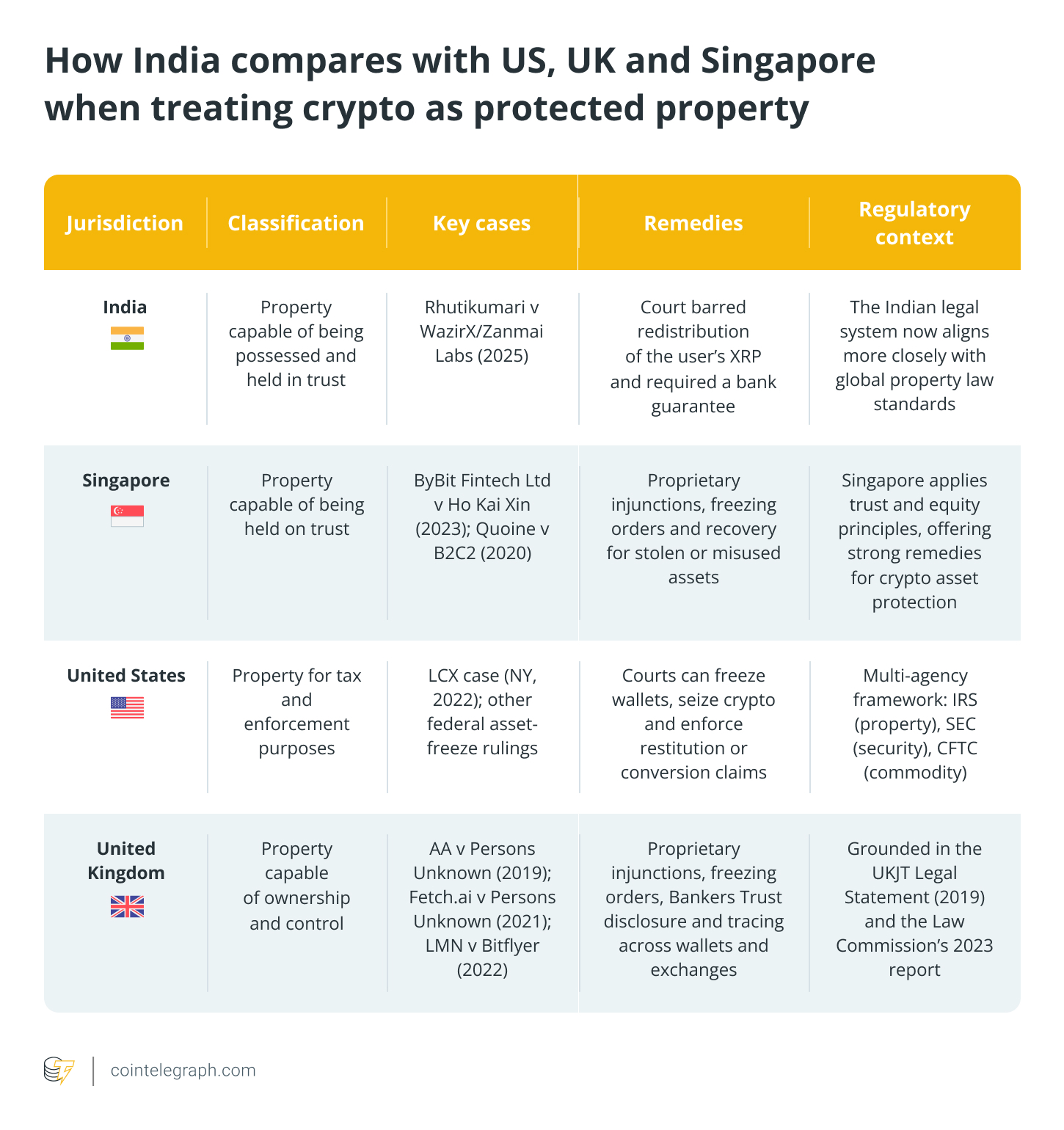
Joins India, US, UK, and Singapore in treating virtual currencies as protected property
The Madras High Court judgment recognizes that virtual currencies constitute property under Indian law, providing legal protection to Indian holders. This decision brings India into line with other jurisdictions, including Singapore and the United States, which have similarly treated crypto assets as property in certain legal contexts.
In the United States, the Internal Revenue Service (IRS) classifies virtual currencies as assets for federal tax purposes. Courts can freeze wallets, issue injunctions, and seize cryptocurrencies based on property law and civil forfeiture rules. This property classification may help victims of hacks and fraud by providing a legal basis for recovery strategies, but actual recovery will depend on traceability, jurisdiction, and exchange cooperation.
British courts have recognized crypto assets as property, allowing for injunctive relief, tracing and disclosure orders. The landmark decision was AA v. Parsons Unknown [2019] In EWHC 3556 (Comm), the court held that cryptoassets such as Bitcoin (BTC) can be treated as property because they are definable, identifiable, transferable, and meet the criteria for property rights.
British law traditionally divides property into “things in possession” and “things in operation,” but the court acknowledged that new assets such as crypto assets could fall into the third category of personal property.
High Court of Singapore, ByBit Fintech Ltd v. Ho Kai Xin & Ors [2023] SGHC 199 determined that crypto assets are “property held in trust” and accordingly declared a constructive trust in misappropriated digital assets. The court’s decision enables ownership and equitable remedies (such as freezing orders and tracing) with respect to these assets, reinforcing that ownership of cryptocurrencies can attract the same protections as traditional property.

Impact of virtual currency asset status in India on XRP
The Madras High Court’s recognition of XRP as property could have a major impact on the Indian cryptocurrency market and boost investor confidence.
As for XRP, stronger legal protection could increase domestic demand in India and boost investor confidence. As of November 3, 2025, XRP was trading around $2.3 with technical resistance at around $2.80. If demand in India increases as a result of this ruling, XRP could surpass its resistance level.
For exchanges, this ruling may require them to reorganize their terms of service. As the law currently treats user tokens as protected property rather than shared assets, management agreements and restructuring plans may need to be reconsidered.
It is very important for investors to understand their legal rights. They are now gaining greater ownership recognition for the crypto assets they store on exchanges. India is currently in a position close to jurisdictions such as the US, UK and Singapore. This collaboration has the potential to accelerate regulatory progress in India and promote transparency, accountability, and trust in the digital asset ecosystem.
Did you know? Unlike Bitcoin, XRP uses a consensus protocol that consumes very little energy. Some estimates put it at around 0.0079 kilowatt-hours (kWh) per transaction, compared to Bitcoin’s estimated hundreds of kWh.
Limitations of India’s landmark crypto asset ruling
Although the Madras High Court’s judgment is an important step forward, it also has certain limitations. As a crypto trader, it is important to clearly understand these constraints.
-
ball: The Madras High Court’s decision is an interim order specific to 3,532 XRP of a single holder, so it may not automatically apply to all wallets, tokens, or exchanges.
-
Token type: The court clarified that XRP and similar assets are intangible assets rather than “currency,” leaving uncertainty as to how other types of virtual digital assets would be classified.
-
Force and recovery: While property status provides potential protection, actual enforcement and recovery will depend on each exchange’s custody practices and transparency.
-
Regulatory evolution: India does not yet have a comprehensive regulatory framework. The ruling is judicial, not legislative, and future legislation could override the court’s decision.
-
Interjurisdictional issues: Cross-border cryptocurrency transactions can be further complicated because protections granted in one jurisdiction may not apply in another.