

Important points
Why is the Fusaka upgrade important for Ethereum?
Fusaka introduced PeerDAS and a 5x increase in block gas limits to improve scalability and data throughput.
How is the Ethereum market reacting to the Fusaka upgrade announcement?
Despite the upgrade news, ETH remains under bearish influence and is trading below the key EMA with bearish momentum.
Since its inception, Ethereum has [ETH] A series of upgrades have been made to improve security, scalability, and sustainability.
Since 2020, Ethereum has undergone five major upgrades towards proof-of-stake, including Merge, Shapella, and EIP-1559.
In the latest development, network developers have set their sights on upgrading Fusaka Mainet.
Fusaka mainnet launch is scheduled for December
In an important and decisive move, Etherem developers decided to launch the mainnet of the Fusaka upgrade in December.
Following the All Core Developers Consensus (ACDC) call on October 30th and Fusaka’s success on the Hoodi testnet on October 28th, the team finalized the date.
In early October, the long-awaited Fusaka upgrade was successfully deployed to the Holesky and Sepolia testnets. Each rollout was closely monitored to assess validator stability, synchronization, and overall performance, paving the way for a full mainnet launch.
Following its release, Fusaka will introduce 12 Ethereum Improvement Proposals (EIPs) aimed at enhancing the efficiency, speed, and security of the network.
This will be Ethereum’s most significant upgrade since the Pectra update in May 2025 and will prepare it for the next stage of Layer 2 integration.
Main features and expected deployment
Importantly, the Fusaka upgrade includes several new features that are different from previous versions.
First, the core feature is Peer Data Availability Sampling (PeerDAS), which helps validators effectively access and verify data. PeerDAS was scheduled for a Pectra upgrade, but was postponed to allow for further testing.
Another important improvement for Fusaka is the increase in the block gas limit from 30 million units to 150 million units. This addition increases Ethereum’s transaction capacity and doubles the throughput of BLOB data.
With these upgrades, the core development team hopes to bring Ethereum closer to its main goals of low-cost scalability and high throughput.
How is the ETH market doing?
Strangely, even after announcing the much-awaited upgrade, Ethereum’s market structure remains weak and bears have the upper hand.
After breaking the support at $3.8,000, ETH fell to a low of $3.6,000 before rebounding to a high of $3,873. At the time of writing, Ethereum was trading at $3,842, down 1.72% on the daily chart.
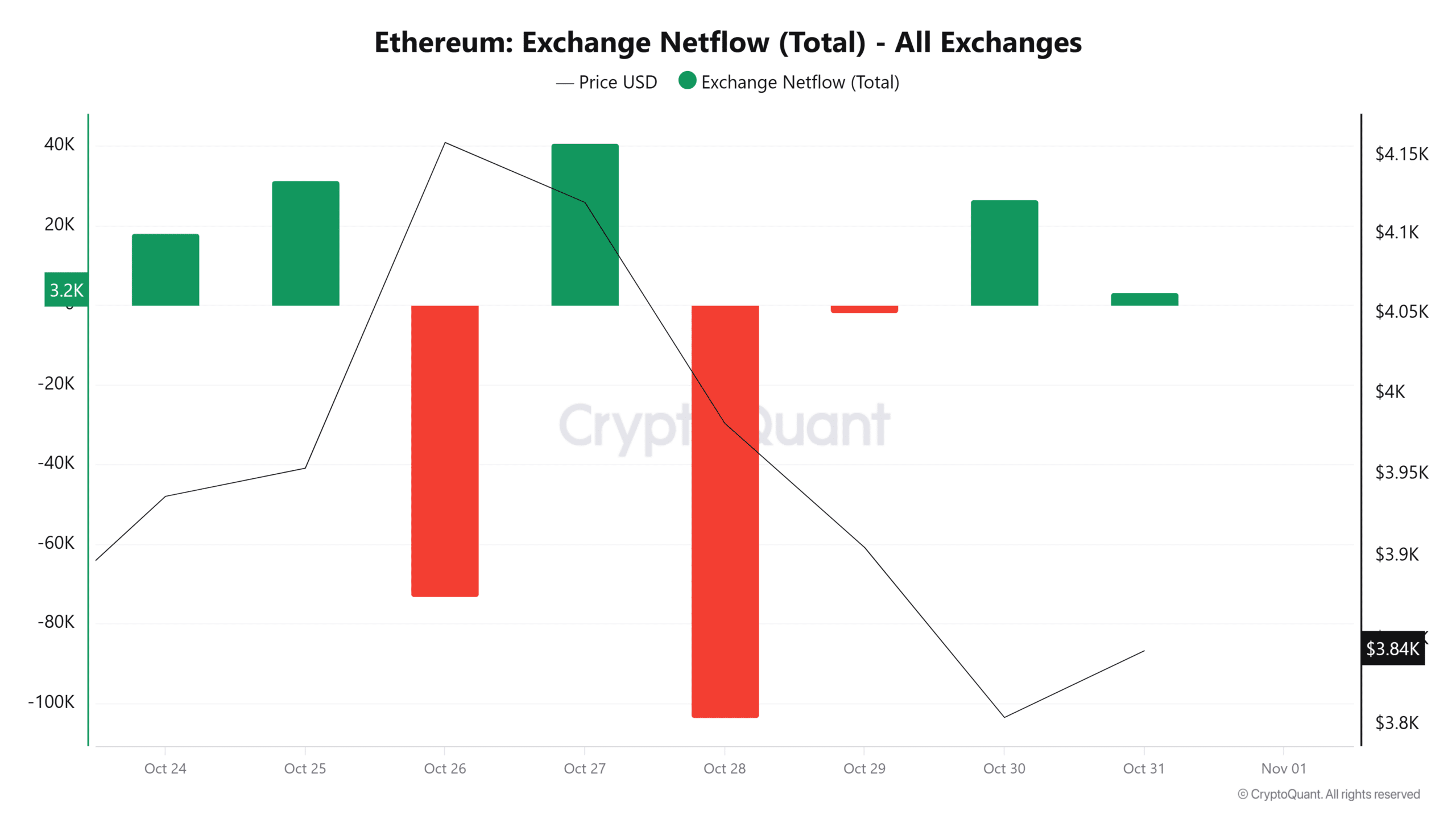
Notably, this decline was primarily driven by increased selling pressure. According to CryptoQuant data, net flows on Ethereum exchanges have remained positive for the past two days.

Source: CryptoQuant
Increased sales activity typically creates strong downward pressure and often signals the possibility of price declines.
As a result, the altcoin fell below its short-term exponential moving average (EMA). At the same time, its continuous pattern strength decreased to -9.33, suggesting the emergence of a pattern characterized by gradually decreasing highs.

Source: TradingView
These market conditions indicate that the uptrend has dried up and a short-term decline is possible. Therefore, if the prevailing situation continues, ETH will break above $3.8,000 and find support near the 200 EMA at $3601.
Conversely, if the recent decline creates a buying window, bulls would target the 50EMA and 100EMA at $3,988 and $4,089, respectively.