

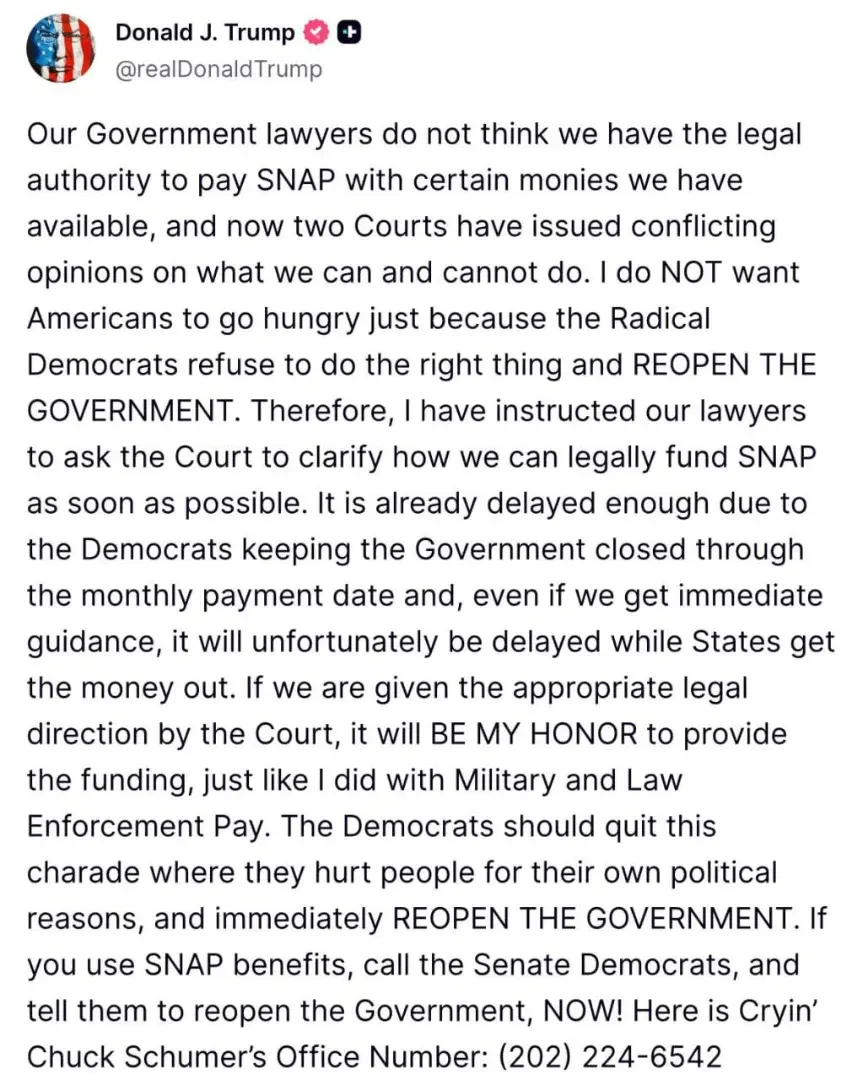
US President Donald Trump recently posted on social media calling for an end to the ongoing government shutdown in the United States.
In the post, the president called for urgent legal clarity on SNAP funds, a critical government program that distributes food stamps and other nutritional assistance to more than 42 million Americans. He cited conflicting court rulings and is unsure whether the federal government can legally use available funds to continue supporting programs during the shutdown.

President Trump also publicly criticized Democrats, particularly Senate Majority Leader Chuck Schumer, for “keeping the government shut down,” arguing that political gridlock is preventing critical services from being provided to vulnerable Americans.
Schumer Strikes Back
Two federal judges have ruled that the government must continue funding SNAP during the shutdown. Judges in Rhode Island and Massachusetts have directed that SNAP payments must be maintained, at least in part, using emergency reserve funds. This decision comes amid a complete freeze on SNAP funding that was effective Nov. 1. The Department of Agriculture recently announced that it will not be able to maintain SNAP costs during the shutdown.
With this in mind, Senator Schumer: Twitterattacked the president for “manufacturing a hunger crisis” to force a resolution in Congress.
“No president in American history has cut off SNAP during a government shutdown, including President Trump’s first term,” Schumer wrote.
Both parties are aiming to end the government shutdown, but it remains unclear if and when Republicans and Democrats will reach an agreement on the next federal budget.
Outage period approaches longest in history
The shutdown, which began Oct. 1, is already approaching the longest in U.S. history. The closures have affected millions of people. More than 900,000 federal employees have been furloughed, and services such as student loans, tax refunds and infrastructure permits have been or are about to be stopped. In just five days, we will enter the longest shutdown in history, highlighting the deep dysfunction plaguing Washington.
Republicans are pushing for deep cuts to foreign aid and health care subsidies, while also eliminating the Senate filibuster rule. Democrats, on the other hand, insist on resisting these demands, arguing that the filibuster ensures a more democratic process in the Senate. They are also fighting to maintain funding for key social programs, especially health subsidies.
Time is certainly moving forward for these subsidies. If the government doesn’t reach a deal soon, the current American Care Act subsidies will expire by the end of the year, significantly increasing out-of-pocket insurance premiums for millions of American households.
How the shutdown will affect cryptocurrencies
As a decentralized asset, cryptocurrencies have no direct correlation to the political affairs of the U.S. government. But in the end, this is just a theory. Washington has had and continues to have a significant influence on financial markets, as many of its macroeconomic and geopolitical decisions generally shape investor sentiment around the world.
The impact on the cryptocurrency market was not immediate. Digital assets have only declined by about 5% since their inception. However, lingering uncertainty is impacting overall risk tolerance across cryptocurrencies and stocks.

Perhaps the most impactful result is the growing blind spot in economic indicators. As the shutdown continues, federal agencies such as the BLS and BEA are unable to report key employment and inflation indicators, leaving the Fed with less of its usual decision-making accuracy and with investors flying blind in an uncertain market.
Federal Reserve Chairman Jerome Powell said last Wednesday that due to the Federal Reserve’s shutdown, The Fed does not guarantee future rate cuts In December. Ultimately, this will have an even bigger impact on financial markets, as investors rely heavily on the Fed’s signals on price risk.