

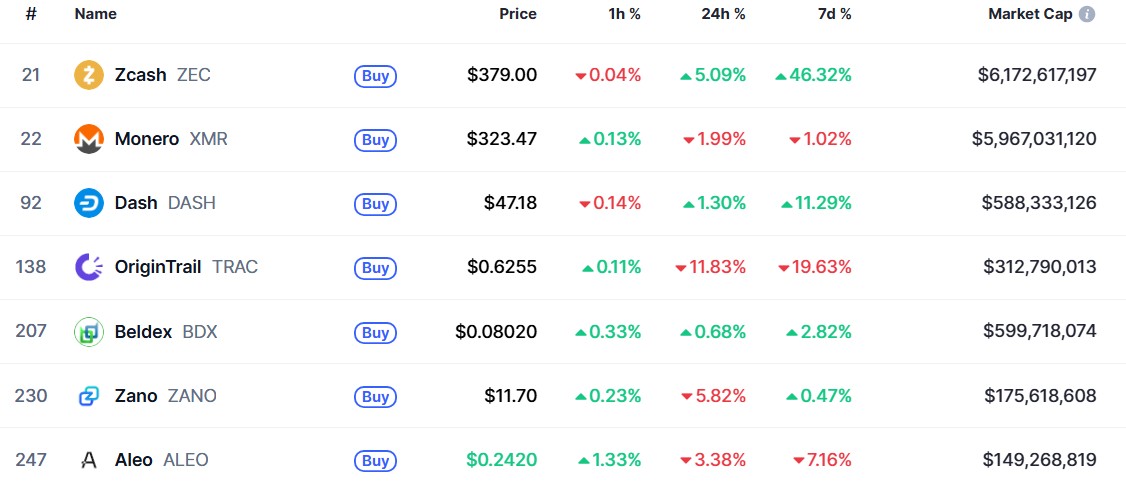
Recently, privacy-focused cryptocurrencies have attracted the attention of investors, ranking among the most popular token categories.
According to CoinGecko, the overall market capitalization of privacy coins has reached approximately $22 billion, and its value has increased by 52.2% in the past 24 hours. Rival data aggregator CoinMarketCap values the category at nearly $55 billion, with Zcash (ZEC) currently leading the way.
One of the first privacy-focused cryptocurrencies, Zcash was launched in October 2016. Trading at less than $80 at the beginning of October this year, it soared 375% in a month, reaching $380 by Halloween and overtaking Monero (XMR) to become the largest privacy token by market capitalization.
As governments consider measures like the European Union’s “chat control” proposals that could force the scanning of encrypted messages, Meta has resumed training its AI models on European user data. Privacy technology is once again in the spotlight as concerns about data surveillance grow.

Zcash’s big month and shielded supply increase
Zcash and other privacy tokens have soared even as the broader crypto market struggles to recover from U.S. President Donald Trump’s tariff threats against China and a $19 billion liquidation event in early October.
But privacy trends aren’t just based on speculation. This coincides with an increase in Zcash’s “shielded supply” and a wave of adoption with new wallet technologies that have made personal transactions more accessible.
“Instead of issuing tokens just for the sake of it, the focus is shifting to projects that build privacy technologies, such as zero-knowledge systems that leverage real-world incentives. These systems can provide privacy by default without requiring users to explicitly choose about anonymity,” Carter Feldman, founder and CEO of the ZK proof-based blockchain Psy Protocol, told Cointelegraph.
At the heart of Zcash’s privacy model are shielded addresses, which use zero-knowledge proofs (specifically zk-SNARKs) to hide senders, recipients, and transaction amounts. Transactions sent between shielded addresses enter a pool of privately traded coins. As that pool grows, the network’s anonymity set expands and the privacy guarantees for everyone using the network are strengthened.
Its shield pool is now the largest ever, approaching 4.9 million ZEC.

Zcash developer Electric Coin Company introduced new features to its Zashi wallet in October, allowing users to perform cross-chain swaps and private payments through integration with Nеаr’s Intents system. This means users can easily move value to and from Zcash’s privacy layer without going through a centralized exchange or complex bridging interface.
Related: What if quantum computers have already beaten Bitcoin?
This new ease of use facilitated the expansion of shielded pools throughout October. Zcash activity on Near Intents exploded in early October, reaching over $17 million on October 16th alone.

However, there are also caveats to the boom. Researcher ZachXBT notes that Zashi’s integration with Near Intents may not have completely obscured the transaction path, suggesting there are still traceable links to cross-chain privacy.
“We reached out to the Zashi team and were told that they plan to soon resolve this privacy issue by adding temporary addresses and ultimately protect near-intent refunds,” ZachXBT said.
Zcash is rapidly increasing due to global privacy trends
Globally, privacy is at the center of policy and technology debates, as governments introduce controversial surveillance proposals and companies deepen their data-intensive AI models.
“Regulatory oversight has paradoxically clarified the value proposition of compliant privacy solutions,” Marko Stokic, head of AI at Oasis Protocol, told Cointelegraph.
“The industry is grappling with how to implement privacy in a way that is responsible and responsive to the needs of legitimate users. This is driving demand for programmable privacy, where information is protected by default and disclosed when legally required or contextually appropriate,” he added.
Related: EU chat regulation depends on Germany’s decision
In Europe, EU lawmakers have backed away from a controversial “chat control” proposal that would have forced messaging services to scan encrypted chats for illegal content, at least for now. Meanwhile, Meta has started training a generative AI model using European users’ Facebook and Instagram data, but promised that private messages will not be included.

Across the Atlantic, U.S. privacy rules remain patchy. States such as California, Colorado and Virginia have strengthened protections, but efforts in Congress to pass nationwide legislation remain stalled.
These global trends are increasing both fear and fascination with digital privacy. Privacy technology is being reimagined as a market opportunity as governments consider intrusive tools to monitor online behavior and companies collect more data.
“The biggest misconception is to confuse privacy with crime or to assume that compliance and privacy are mutually exclusive. A well-designed system can protect sensitive information during normal operations while maintaining auditability when necessary,” Stokic said.
Why privacy is more important than ever for cryptocurrency users
Anonymity used to belong to cypherpunks and traders who didn’t trust regulators.
“Privacy is not a niche feature for people who want to hide something,” Feldman said.
“The real misconception is that you have to choose between privacy and ease of use or privacy and scale. Technology has advanced to the point where you can have both.”
Currently, cryptocurrencies operate under continuous monitoring through know-your-customer checks, transaction monitoring, and advanced blockchain analytics.
Blockchain forensics experts use machine learning to track wallets and build behavioral profiles. Their system can link identities, map connections between wallets, and predict when assets will move to exchanges.
The government is also tightening controls. On August 18, the U.S. Treasury Department solicited public input on “privacy-enhancing tools” to detect illegal activity involving AI, blockchain surveillance, digital identity credentials, and digital assets. The agency said the feedback will inform new guidance and potential rulemaking under the GENIUS Act.
In the EU, crypto exchanges must treat transfers to and from self-hosted wallets as high risk and apply enhanced due diligence, including verification of wallet controls. These obligations become effective on December 30, 2024.
For many users, this combination of surveillance and scrutiny is a signal to turn to privacy-focused cryptocurrencies.
magazine: Glocipedia: A “far-right talking point” or the long-awaited antidote to Wikipedia?