

If the upgrade is adopted by a super majority of validators, although it was not passed in the previous community vote, there will be nearly 60 million fewer NEAR tokens minted this year.
NEAR Protocol has upgraded its network with a new update that reduces the annual token inflation rate from 5% to approximately 2.4%, even though the community vote intended to approve the change did not reach the required threshold.
The NEAR Protocol team announced today, October 30, that the upgrade has been completed. The so-called halving upgrade will limit the token dilution caused by approximately 60 million new NEAR tokens being minted annually with minimal fee burn, while rebalancing the incentives for on-chain participation, reducing staking yields from approximately 9% to 4.5%, assuming half of the total supply remains staked.

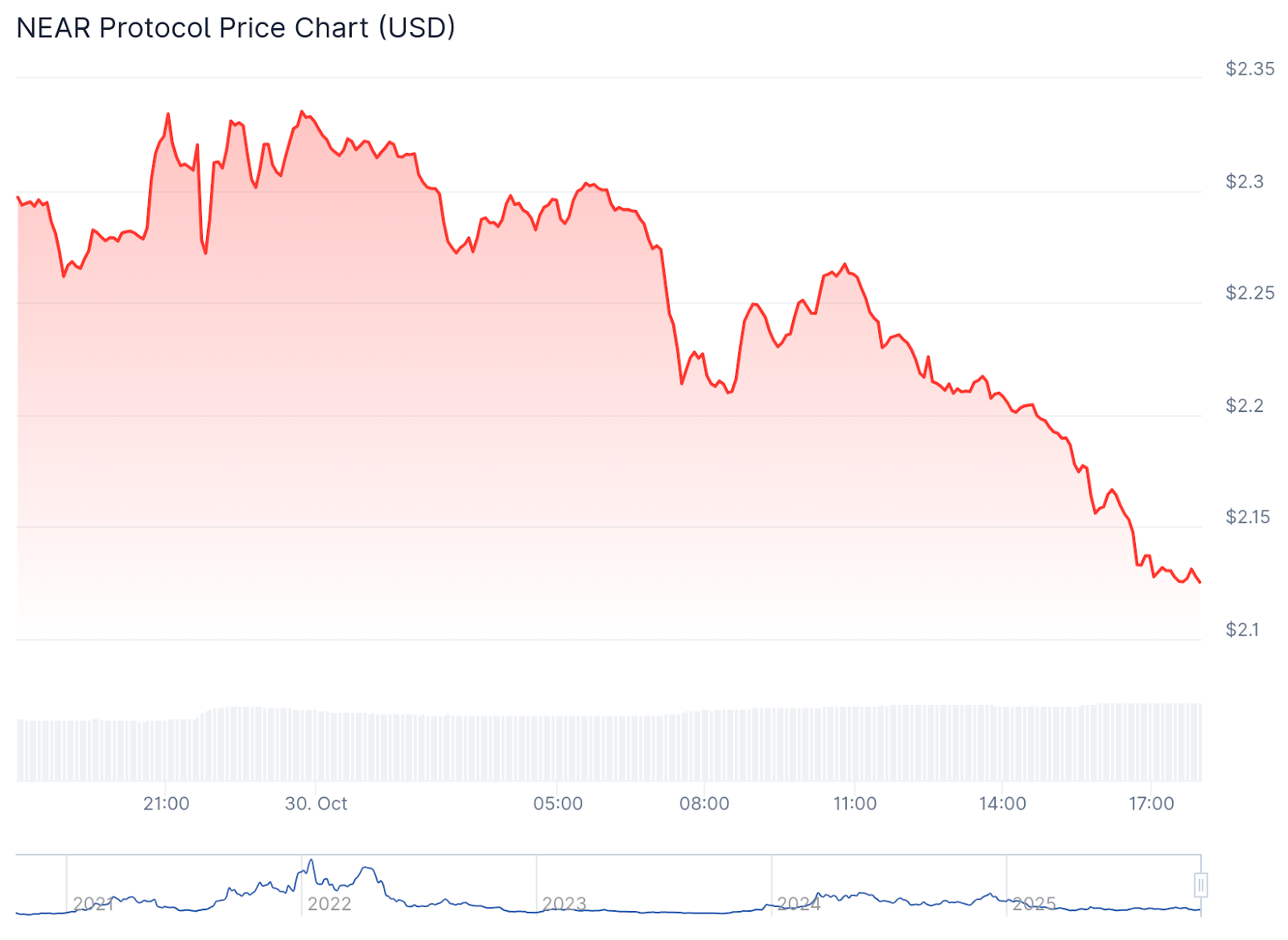
Following this news, NEAR’s price fell by nearly 8% on the day, falling to $2.10 at the time of writing, amid a broader downturn in the crypto market.
The first community vote on the inflation reduction proposal ended on August 1st, with 89 validators, representing 45.06% of participants, voting in favor of reducing the token’s inflation rate. However, the proposal technically failed as the total number of votes in favor fell below the required threshold of 66.67% for approval.

Despite the results, the NEAR core team included inflation reduction in the protocol upgrade on Github, sparking public criticism from some validators even before today’s announcement.
“Dangerous precedent”
Chorus One, a staking provider that manages more than $2.3 billion in assets across its various networks, said in an October 22 X thread that moving forward with the inflation reduction despite the failed vote “sets a dangerous precedent and undermines the integrity of NEAR,” adding that it creates “the impression that decisions can be unilaterally forced by the core team if validators do not pay attention to the changes implemented during upgrades.”
The staking provider added that it would not be upgrading its nodes and encouraged other validators to follow suit, making clear that its stance is more focused on the governance presence set up by this move than on the eventual inflation rate.
“While we did not support the inflation control proposal, our position this time is not to oppose inflation control per se, but rather the idea that the core team can force changes through upgrades even if the governance vote has already been rejected.”
In a comment to The Defiant before the upgrade was completed, NEAR Protocol Chief Technology Officer Bowen Wang said the proposed upgrade still “requires a supermajority of 80% of block-producing validators’ shares to adopt it, and will not be implemented unless a threshold is reached.”
Wang added, “Verifiers must vote within 30 days. This is how NEAR protocol upgrades have worked since mainnet launch over five years ago.” NEAR reiterated this sentiment in the official X thread announcing the upgrade today.
As NEAR’s CTO explained to The Defiant, the vote to halve NEAR’s inflation rate starting this summer was a community-driven joint proposal by HOT DAO and LiNEAR. According to Wang, this explicit voting by validators at the consensus layer “requires a higher threshold to ensure network-wide coordination.”
He added that going forward, NEAR’s recently launched governance system, the House of Stake, will determine “the specific economic parameters of the NEAR ecosystem that core developers can propose in their code.”