
The decentralized AI network is gearing up for its first halving event on December 10th.
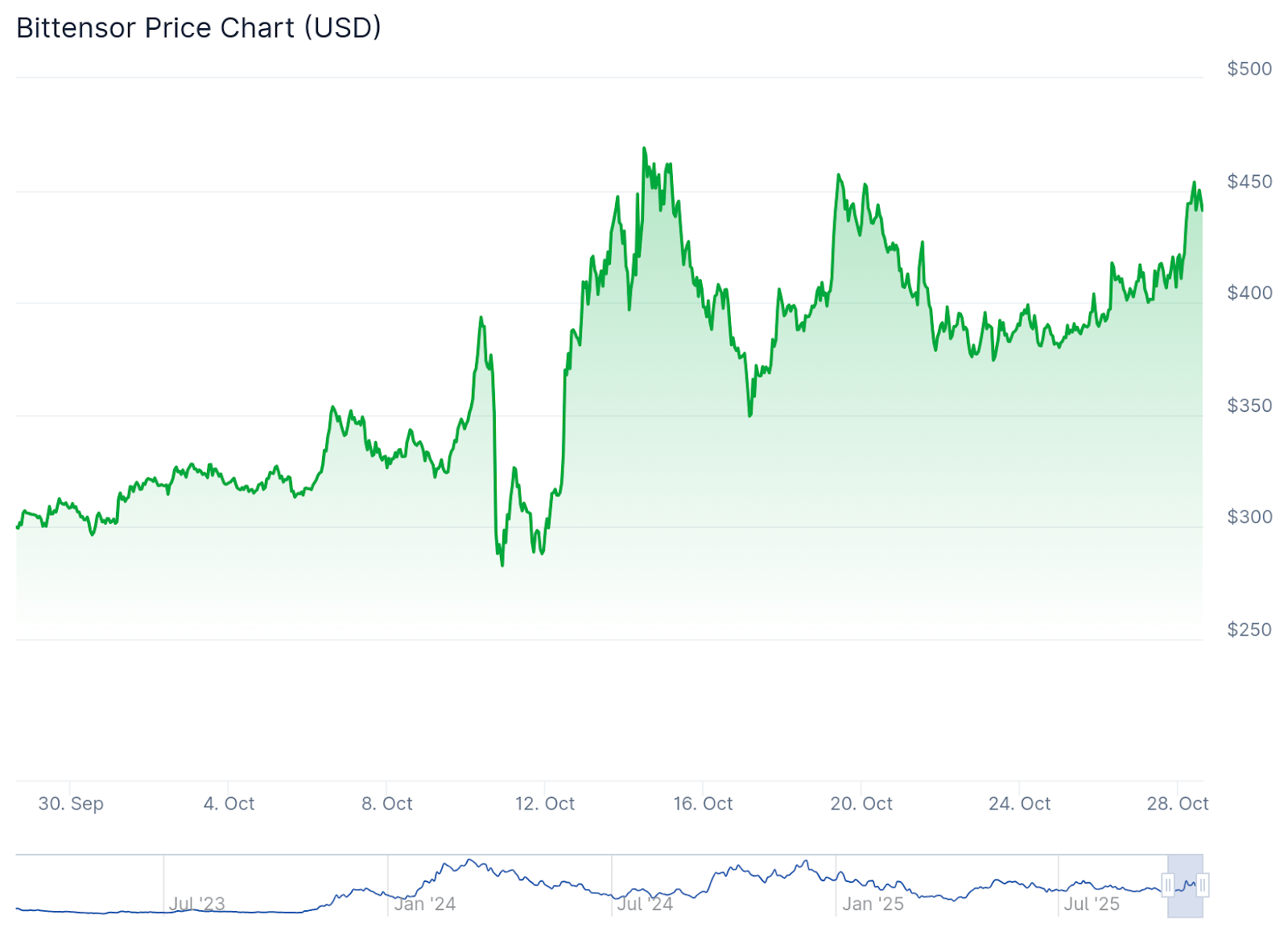
Decentralized AI network Bittensor is set to have its first halving event in December, and TAO is outperforming other altcoin markets in anticipation.
TAO tokenomics is modeled after Bitcoin, so TAO tokens undergo a halving approximately every four years depending on the mining rate. The network’s first halving is scheduled for December 10th.
Until 2024, BTC typically followed a pattern of a halving, where the block reward was cut in half, followed by a one- to two-year period in which the asset trended upward toward all-time highs. However, 2024 marked the first time that BTC reached an all-time high before the halving, rather than after.
That said, the market seems to be expecting a bullish move for TAO ahead of the first halving, as TAO is up 50% in the past 30 days and is also one of the strongest altcoins since its October 10 liquidation low.

TAO is the second best-performing altcoin among the top 100 altcoins in the past 30 days, behind Zcash, which soared 400% in the same period.
Impact on the Bitensor ecosystem
Sami Kassab, managing partner of Bittensar investment fund Unsupervised Capital, announced his theory of Bittensar halving on October 14th, and expects TAO’s strong price movement to continue.
“When we dig into the legend of Bitcoin’s first halving, the atmosphere feels eerily nostalgic. Pessimists are convinced Bitcoin will go into a death spiral, while optimists believe the system will adapt because incentives demand it,” Kassab said.
However, the Bittensor halving will have potential ripple effects on subnets that Bitcoin has not had to deal with before.
Bittensor subnetworks earn TAO emissions based on their contribution to the overall network. On the surface, the halving means less circulating supply for miners and validators to sell, but it also means less liquidity flowing through each subnet.
According to Kassab, this liquidity constraint amplifies volatility, and the direction of net flows can have a significant impact on the subnet’s price, both positively and negatively.
“Thus, our view is: We believe Subnet flows will turn positive soon, and that will be a tailwind for Subnet tokens in a post-halving world of increased volatility and tight liquidity,” he concluded.
Subnet proliferation
According to TaoStats, the Bittensor subnet now has a cumulative market cap of $1.28 billion, which is just over 30% of TAO’s market cap of $4.26 billion, led by Shoots in subnet 64 and Ridges in subnet 62.

Total subnet valuations have increased nearly 100% since August as more subnets continue to come online.
Yuma Group, one of the notable subnet and Bittensor infrastructure companies, is led by Barry Silbert, founder and CEO of Digital Currency Group. Yuma currently powers 14 different subnets and accounts for $71 million in subnet valuation in circulation.
“Agencies are beginning to realize how quickly Bittensor is evolving into a critical component of the global AI infrastructure,” Yuma COO Greg Schvey told The Defiant.
“Yuma Asset Management’s goal is to bridge capital to the network in a way that supports the Bittensor ecosystem. By offering traditional financial products like this, we are able to provide investors with access that requires unique technical expertise,” added Shubei.