

Important points:
-
Since 2024, spot ETF inflows and outflows have been the most powerful driver of Bitcoin’s green and red eras.
-
With foreign exchange balances near multi-year lows, the large orders will be even more widespread.
-
Large holders often split their trades or use OTC desks to cushion the visible “wallet movement” shock.
-
Funding rates, open interest, dollars, and yields often dictate the direction of the day more than any single wallet.
Everyone “knows” that whales move Bitcoin (BTC), but they can still shake up the price.
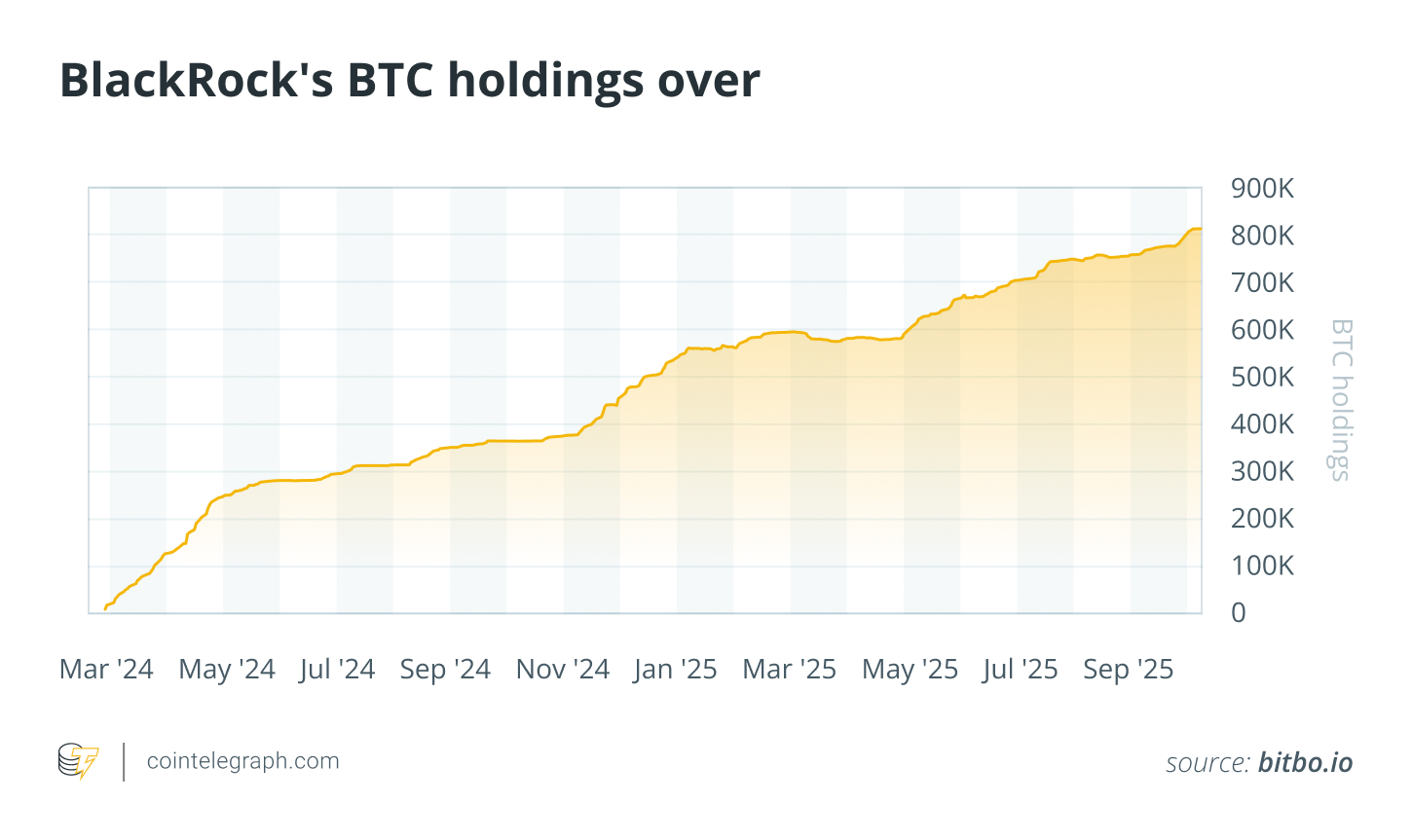
Since the introduction of spot exchange-traded funds (ETFs), the direction of Bitcoin has often been determined by ETF inflows and outflows. It also depends on how much tradable supply the exchange actually has, rather than the whims of a single wallet. For example, BlackRock’s iShares Bitcoin Trust ETF (IBIT) currently holds over 800,000 BTC on behalf of thousands of investors. The flow through that pipe is comparable to any holder.
The true picture emerges when you layer derivatives positioning with the broader risk-on/risk-off mood.
This guide delves into the whale legend, explains the market mechanics that really matter, and provides a simple data checklist to read the tape without having to chase every viral “whale just moved” alert.

What qualifies as a “whale”?
In cryptocurrency, a whale refers to an on-chain entity that holds at least 1,000 BTC. Many dashboards specifically track the 1,000 BTC to 5,000 BTC range.
An entity is a cluster of addresses managed by the same owner, rather than a single wallet. Analytics companies use heuristics such as joint spending and change detection to group addresses to ensure that a single holder is not counted multiple times in separate deposits.
This distinction is important because raw “rich list” address counts can overstate concentration. Large services such as exchanges, ETF custodians, and payment processors operate thousands of wallets, and labeled clusters help separate them from end investors. Both academic and industry research have long warned against drawing conclusions from address data alone.
The methodology is different. Some whale indicators include exchanges, ETFs, and service entities such as storage pools and companies. Others exclude known exchanges and clusters of miners to focus on true investor whales.
This guide uses entity-based rules for 1,000 BTC and above to clearly indicate where service wallets are included or excluded so you know exactly what each metric represents.
Did you know? The number of entities holding at least 1,000 BTC recently exceeded 1,670, the highest level since early 2021.
How concentrated is BTC right now and who owns it?
Since the launch of the US Spot ETF, a large portion of the visible Bitcoin supply has moved into custodial pools. BlackRock’s IBIT alone holds approximately 800,000 BTC, making it the largest known holder. However, it is not held as a single balance, but on behalf of many investors.
Across issuers, US spot ETFs hold a total of approximately 1.66 million BTC, representing approximately 6.4% of the total supply of 21 million BTC. This centralizes execution even though the underlying ownership remains widely distributed.
Businesses are another major group. MicroStrategy recently revealed holdings of approximately 640,000 BTC. Miners, exchanges, and unlabeled long-term holders make up the remaining largest clusters.
Meanwhile, the tradable float on centralized exchanges continues to shrink. Glassnode’s tracking balance decreased to about 2.83 million BTC in early October 2025, the lowest level in about six years. With fewer coins on the exchange, large orders tend to move the price significantly.
Keep in mind that major services operate thousands of wallets, so rich lists of “top addresses” often overstate their concentration. Entity-level clustering and labeled wallets, such as wallets belonging to ETFs, exchanges, and companies, give you a clearer picture of who actually controls your coins.

Did you know? US spot ETFs currently hold over 1.6 million BTC, representing just over 6% of the total supply held by institutions and funds.
Could the whale turn the market upside down during the day?
Large, aggressive orders can cause prices to fluctuate rapidly, especially if the order book becomes thinner. In volatile times, liquidity is often eroded, and large short blocks can have an outsized impact and blow through the books. That is the basic market microstructure.
For this reason, many large holders avoid “hitting the books.” They split orders or use over-the-counter (OTC) desks to quietly execute blocks, reducing both footprint and information leakage. In reality, the majority of whale activity occurs outside of exchanges, reducing the visible impact of a single wallet on the public sphere.
Throughout the cycle, the whale does not constantly “pump”. Research combining exchange and on-chain data shows that large holders are often bullish sellers, especially when smaller traders are buying. Their flow could dampen the rally rather than guide it.
The 2025 snapshot fits this pattern. When the price rose above $120,000 with strong inflows and widespread accumulation in the ETF, the “big whale” booked profits on margin. Intraday direction often tracks ETF flows and available liquidity better than any whale wallet.
Did you know? One famous “OG” whale recently sold thousands of BTC to buy nearly $4 billion in Ether (Ethereum).
What is the real thing that turns the market blue or red most days?
Since January 2024, Spot ETF flows have been one of Bitcoin’s most reliable daily signals. Strong weekly inflows often coincide with a rally to new highs, while weak or negative numbers tend to coincide with decline days. Combine this with the Live Flow Dashboard to track how US ETFs are leaning each session.
Exchange liquidity is equally important. Balances on centralized exchanges have fallen to around 2.83 million BTC, a six-year low, and there is now less supply available for easy trading. Thin liquidity means that even routine buying and selling programs go deeper into the order book, amplifying price movements across all participant types.
Positioning and leverage often cause intraday fluctuations. The path of least resistance can quickly change as money becomes plentiful or significantly negative and open interest (OI) rebuilds after a wipeout.
Continue to monitor funding and OI to understand crowding. With about 97% of supply recently in profits and a slight loosening of the distribution of long-term holders, the market has become more sensitive to new trends and headlines.
Finally, Macro is still pushing the crypto beta. Dollar trends, US yields, and broader risk appetite often move in lockstep with Bitcoin’s daily direction. On days with less data, the range tends to be compressed. When macros heat up, cryptocurrencies usually follow.
quick checklist
-
ETF flow: Track yesterday’s net inflows/net outflows and total sales.
-
Liquidity: Monitor exchange balance trends and order book depth across major exchanges.
-
positioning: Check funding rate heatmaps and rebuild OI after liquidation.
-
Macro tape: Monitor the dollar index, 10-year yield, and stock market breadth.
Will whales still set the tone for Bitcoin for the day?
Whales can move prices, but they rarely decide how the day ends. When liquidity is thin, a single large order can cause more trading than usual. Many large holders are now mitigating the impact seen on their public books by splitting their trades into smaller clips or routing them through OTC desks.
Since 2024, spot ETF flows have been the primary driver of daily direction, along with the large volumes passing through those funds. If you look at the previous day’s net flow and trading volume, you can feel the bias more clearly.
With tradable supply on exchanges near multi-year lows, even marginal buyers or sellers, whether whales, market makers, or retail waves, can move prices more than usual. Large holders often sell strength rather than “pump,” and this pattern tends to dampen rallies rather than stimulate them.
Much of the action is still driven by macro factors. Changes in dollar and US yields affect risk appetite and pull Bitcoin in the same direction.
This article does not contain investment advice or recommendations. All investment and trading moves involve risk and readers should conduct their own research when making decisions.