

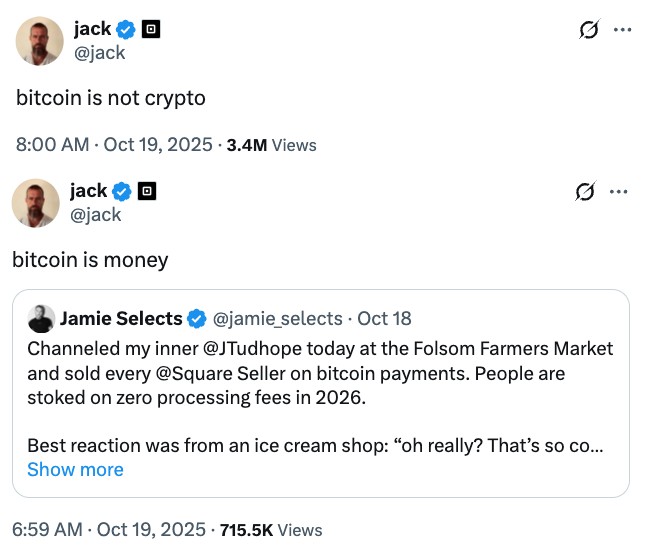
Bitcoin is not a “cryptocurrency”
Jack Dorsey’s X post revived the old question of whether Bitcoin is part of “cryptocurrency” or its own category.
On October 19, 2025, Jack Dorsey posted three words on X: “Bitcoin is not a cryptocurrency.” The post quickly gained attention across platforms and in media coverage. This reflects his long-held view that Bitcoin should be considered a currency with its own rules and history, not part of a broader token market.

Dorsey argues that Bitcoin (BTC) belongs to a different category. Started without foundation or premine and managed conservatively. The network is designed for payments and savings, unlike smart contract platforms and app tokens that evolve rapidly to support multiple use cases.
Let’s unpack the discussion.
To understand why, it helps to consider how Bitcoin’s design, governance, and regulation differ from the rest of the crypto world.
Did you know? El Salvador became the first country to adopt Bitcoin as legal tender. This law was passed on June 9, 2021 and came into effect on September 7, 2021.
Monetary policy and issuance: fixed rules and flexible policies
Bitcoin issuance begins with supply and follows a fixed schedule, whereas most other networks treat supply as an adjustable function.
New coins will be issued as block rewards and will be halved approximately every 210,000 blocks until the total supply reaches 21 million BTC. The fourth halving occurred on block 840,000 in April 2024, reducing the reward from 6.25 BTC to 3.125 BTC. Each reduction makes miners more reliant on transaction fees rather than new issuance.
Changing the amount of Bitcoin issued would require overwhelming social consensus among users running nodes, allowing investors to model supply years in advance. This predictability remains a core part of its “store of value” appeal.
Most other networks approach monetary policy as a design choice. Take Ethereum as an example. Ethereum Improvement Proposal (EIP) 1559 introduced base fee burn to reduce net issuance when demand is high, and a merge update moved the network to proof-of-stake (PoS), reducing total issuance. These changes create a supply model that dynamically adjusts to network activity.
Its flexibility improves the user experience and enables new functionality. Bitcoin’s rigor, on the other hand, is aimed at maintaining financial trust.
Consensus and security budgets: PoW minimalism and PoS upgrade speed
How the blockchain itself is secured will shape everything that follows. Bitcoin pays for security in work, whereas proof-of-stake (PoS) systems pay in stake.
In Bitcoin, miners use energy to add blocks, and full nodes apply a small, conservative set of rules. Its scripting language is intentionally simple and not Turing complete. Fewer moving parts means things are less likely to break. As such, changes to the base layer are rare and carefully limited.
As block rewards continue to halve, miners’ revenue will gradually shift from new coins to transaction fees, or Bitcoin’s long-term “security budget.” This raises important questions for the future, including how incentives will be maintained during low-fee periods. You can also see why the surge in activity that drives up fees, along with steady usage on layers like the Lightning Network, is important to miners’ economics.
Many crypto platforms, especially Ethereum, use PoS. Validators lock up Ether (ETH), earn rewards for proposing and proving blocks, and can be penalized for cheating. This model allows for faster upgrades. Merge in 2022 switched to PoS, Shapella (2023) enabled withdrawals, and EIP-4844 (2024) reduced data costs for rollups.
Bitcoin prioritizes security, stability, and minimal changes at the base layer, while most PoS networks value faster upgrades and higher throughput.
Did you know? A bug in 2010 briefly created 184 billion BTC before the chain was rolled back with a 53-block reorganization. The “value overflow” incident remains Bitcoin’s biggest reorganization. The second largest one occurred in 2013 when there was a software incompatibility between versions 0.7 and 0.8, which spanned 24 blocks.
Governance and Culture: Strengthen vs. Optimize
Who changes the rules, how quickly, and how secure? Bitcoin evolves slowly by design, but app-centric chains prioritize speed and flexibility.
By design, Bitcoin changes slowly. The proposal begins as a Bitcoin improvement proposal and will only be advanced after public discussion and widespread support from developers, miners, and node operators. There are no on-chain votes or decisions made by the Foundation. Upgrades are typically shipped as soft forks to maintain compatibility with older nodes.
The Taproot upgrade used the “Speedy Trial” signaling mechanism in 2021, achieved lock-in in June, and was activated on November 14, 2021 on block 709,632. The lengthy process gave developers, miners, and node operators time to adjust and mitigate activation risks. This rhythm (less change, more reflection) is what people mean by Bitcoin’s “ossification.”
Smart contract platforms take the opposite approach. Ethereum introduces changes through an EIP process, following a stable release cycle (such as post-merge withdrawals and proto-dunksharding to reduce data costs).
Different purpose, different tempo: Bitcoin protects financial trust through conservative editing, while app-centric chains are focused on delivering new features and keeping developers active.
Did you know? A significant portion of your BTC may be lost forever. Estimates based on Chainalysis suggest that approximately 2.3 to 3.7 million BTC are permanently lost, which corresponds to a double-digit percentage of the supply cap of 21 million.
What runs at the top level: Payment apps vs. general purpose apps
Bitcoin keeps its base layer small. That means unused transaction output (UTXO) accounting, limited stack-based scripting (intentionally not Turing-complete), and relatively modest logic beyond that.
Much of Bitcoin’s payment activity has moved to second-tier networks, such as the Lightning Network. Use bidirectional channels and hashed time lock contracts (HTLC) to route low-cost, instant payments without changing the base layer rules. Day-to-day transactions occur off-chain, but payments remain locked to the main network.
Smart contract platforms take the opposite approach. Ethereum supports rich, stateful contracts at Layer 1, facilitating composability such as decentralized finance (DeFi), non-fungible tokens (NFTs), and on-chain games that build on each other. This approach allows for faster experimentation, but relies on a flexible and regularly upgraded base layer.
Bitcoin is still experimenting at the edge. The launch of Ordinals and Runes around the 2024 halving caused fees to rise to all-time highs, increasing miner revenue and providing a real-world test of fee-driven security. Importantly, none of this changes Bitcoin’s monetary rules or its minimalist Layer 1 design. This pattern is: Stabilize your base and grow new activity on or beside it.
Market Structure and Its Implications: Separate Buckets for BTC
Exchange-traded funds (ETFs), options, and flow data suggest that financial institutions are treating Bitcoin differently than other crypto markets.
On January 10, 2024, the U.S. Securities and Exchange Commission approved rule changes that will allow exchanges to list and trade Spot Bitcoin Exchange Traded Products (ETPs). This decision introduced BTC to mainstream markets such as New York Stock Exchange (NYSE) Arca, Nasdaq, and Chicago Board Options Exchange (Cboe).
These are the same platforms used by brokerages, registered investment advisors (RIAs), and pension funds. Whatever the asset class is called, retirement and wealth platforms have dedicated lanes for Bitcoin.
From there, the market infrastructure expanded. By late 2024, U.S. regulators approved options for spot Bitcoin ETFs, and Cboe launched index options tied to a basket of those funds. In a nutshell, it’s risk transfer and price discovery using tools that financial institutions already understand, something that most tokens still lack.
Flow data revealed that change. From 2024 to 2025, new fund creation and redemptions became routine, with assets and net flows tracked on a dashboard. Investors were gaining exposure to Bitcoin through traditional wrappers rather than through crypto-native venues.
Policy signals point in the same direction. U.S. derivatives regulators have long classified Bitcoin as a commodity. In 2025, the staff of the US SEC and Commodity Futures Trading Commission indicated that registered exchanges may facilitate trading of certain spot commodity crypto products.
Distribution channels, hedging tools, flow reports, and regulatory labels all add up to strongly support Jack’s claim that Bitcoin is not a cryptocurrency. The market has already put it in another bucket.