

On Friday, a perfect storm of factors converged to create the largest liquidation event in crypto industry history, sending Bitcoin (BTC) briefly below $110,000.
The $19 billion liquidation does not mean investors lost that amount, but rather that leveraged positions were forced to close.
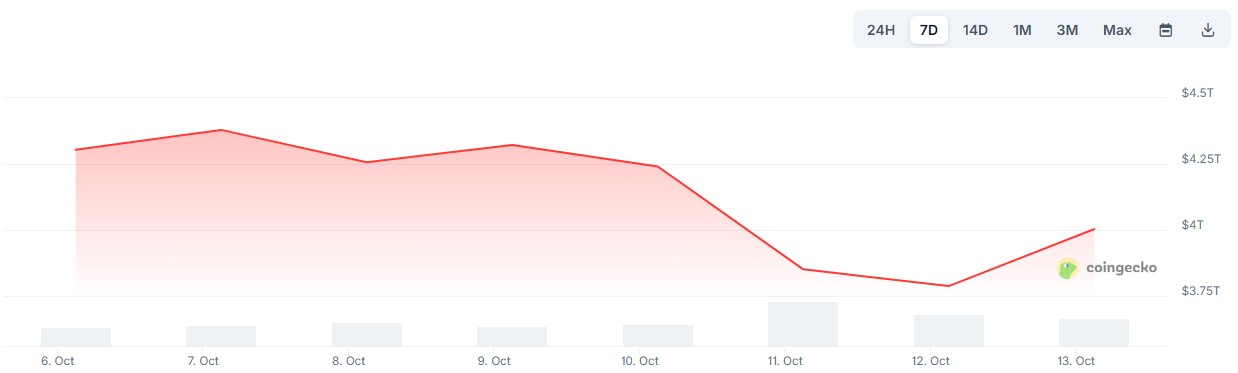
The unrealized losses are more observable through the reduction in market capitalization, which shows the disappearance of $450 billion. From Friday to Sunday, the market capitalization of cryptocurrencies decreased from $4.24 trillion to $3.79 trillion. As of this writing, the market has already recovered over $4 trillion.

Experts are still figuring out how macro shocks, currency mispricing and overleveraged positions converged to cause the industry’s largest single-day liquidation. Here’s what we know so far:
Tariff shock spreads to global and virtual currency markets
US President Donald Trump on Friday escalated the ongoing trade war that has defined much of his term, threatening to impose 100% tariffs on imports from China starting November 1, and potentially sooner “depending on further actions and changes by China.”
In cryptocurrencies, some analysts believe that the same day’s market slump was caused not by President Trump’s tariff threat, but by industry-specific price oracle malfunctions. However, a comparison with traditional financial indices reveals that the decline was not limited to cryptocurrencies.

The Nasdaq 100 index, which tracks the top 100 non-financial companies, was down 3.49% by Friday’s close, leading the decline among major U.S. indexes. The S&P 500 fell 2.71%, and the Dow Jones Industrial Average, made up of 30 blue-chip companies, fell 1.9%.
Bitcoin outperformed them on the downside, falling 3.93% during regular trading hours and continuing to decline after US markets closed.
Binance’s oracle glitch is said to be the cause of cryptocurrency meltdown
President Trump’s tariff announcement triggered a broad market selloff and Bitcoin’s decline over the weekend, but industry-specific factors compounded the damage as traditional markets shut down.
One key flashpoint was USDe, Ethena’s synthetic dollar, which remains pegged to the US dollar through a delta-neutral strategy in the perpetual futures market. On Friday, USDe appeared to lose parity and fall to $0.65, which was mainly seen on Binance. On other exchanges, USDe traded with mild volatility typical of dollar-pegged tokens during market turmoil.

According to analysis by X User YQ, this crash was caused by the drop in USDe that exposed flaws in Binance’s unified margin oracle. The system used Binance’s proprietary spot order book to significantly lower the prices of collateralized assets such as USDe, wBETH, and BNSOL in real time. This triggered a series of liquidations and dried up liquidity across interconnected venues. Other platforms that reference Binance prices followed suit, even though USDe and related assets were trading normally elsewhere. YQ described the incident as an oracle failure rather than a traditional market crash.
In a separate analysis, Haseeb Qureshi, managing partner at crypto investment fund Dragonfly, said USDe has never actually depegged, noting that its deepest liquidity is in curves where the price divergence is less than 0.3%. On Binance, market makers were unable to recover their peg due to API failures and lack of a direct mint and redemption channel with Ethena.

It is too early to blame Binance for the recent cryptocurrency crash.
Delphi Digital analyst Trevor King said Binance made a first-principle error in valuing wrapped assets such as wBETH, BNSOL, and USDe based on their own spot prices rather than their underlying redemption values, thereby causing the collateral to appear much weaker than it actually was, leading to mass liquidations.
Related: “Uptober” records 21 crypto ETF applications as Bitcoin rises
As the Binance oracle became the de facto “price of record” across the leveraged trading ecosystem, these mispricing feeds spread to other exchanges and decentralized exchanges (DEXs). However, analysts said they are still cautious about pointing the finger at Binance for the root cause, as the timing of the initial cascade requires further attention.

That’s also part of Binance’s defense. In a statement, the exchange claimed that “core futures, spot matching engine and API trading remained operational” during the event, and that the volatility was “primarily caused by overall market conditions.”
However, the exchange admitted that not all modules worked as expected.
At the same time, this review confirmed that some platform modules experienced a temporary technical glitch starting at 21:18 UTC on October 10, 2025, causing depegging issues with certain assets due to rapid market fluctuations. ”
Binance also announced that it has distributed $283 million in two installments to compensate affected customers. Binance’s token BNB (BNB) hit a new all-time high on Monday.
Binance updated its margin price feeds for wBETH and BNSOL on Saturday, switching the valuation from Binance’s own spot price to the official staking conversion rate. The change was originally scheduled for Tuesday, October 14, but was brought into effect earlier due to market turmoil.
Hyperliquid defends role in $19 billion crypto liquidation
According to data provider DefiLlama, Hyperliquid is a rising star in cryptocurrencies and the top DEX by perpetual volume. We recently removed Aster’s data due to integrity concerns. HyperLiquid rival Aster is backed by YZi Labs, the investment arm of Binance.
Related: Aster delisting reveals DeFi’s growing integrity crisis
HyperLiquid was also listed as the main venue where most liquidations took place during the $19 billion cascade, prompting Crypto.com CEO Chris Marszalek to call for an investigation into the top derivatives platform.

HyperLiquid founder Jeff Yang defended the exchange, saying it worked as designed throughout the turmoil, maintaining 100% uptime and zero bad debts.
He explained that the liquidation was not due to a system failure, but was caused by excessive leverage during a rapid market downturn that saw many altcoins fall by more than 50% in a matter of minutes. Hyperliquid’s liquidation process first attempts to close undercollateralized positions through the order book and then relies on the Hyperliquid liquidity provider’s custodian as a backstop liquidator. If both fail, the exchange will trigger automatic deleveraging. This is a mechanism for closing profitable positions on the winning side to maintain solvency.

Yang also hit back at his critics, accusing his rival’s exchanges of deflecting blame.
“Solvency and uptime are the two most important characteristics of a financial system,” he said, calling any attempt to “gaslight users” about HyperLiquid’s performance unethical. He contrasted Hyperliquid’s on-chain transparency with the opaque clearing practices of centralized exchanges, arguing that this episode shows the resilience of the margin system rather than a flaw.
Short bet by a super liquid whale just before the virtual currency crash disaster
More than 250 wallets have lost their millionaire status on Hyperliquid since Friday’s collapse, according to HyperTracker. Since then, several wallets have been dubbed “hyperliquidity whales,” but one wallet in particular has received new attention due to its extraordinary timing and insane profits.
A whale trader in a derivatives DEX made headlines by opening a short position minutes before President Trump’s tariff announcement on Friday, netting him $192 million in profit.

On Sunday, the same wallet initiated another huge bet. Using 10x leverage, we went short $163 million against Bitcoin and have already shown a profit of about $3.5 million. If Bitcoin rises to $125,500, the position will be liquidated.
The timing of these trades has led many in the crypto community to refer to the traders as “insider whales,” with some speculating that their positions may have contributed to the $19 billion liquidation chain over the weekend.
magazine: EU’s privacy-destroying chat control bill postponed, but the fight isn’t over