

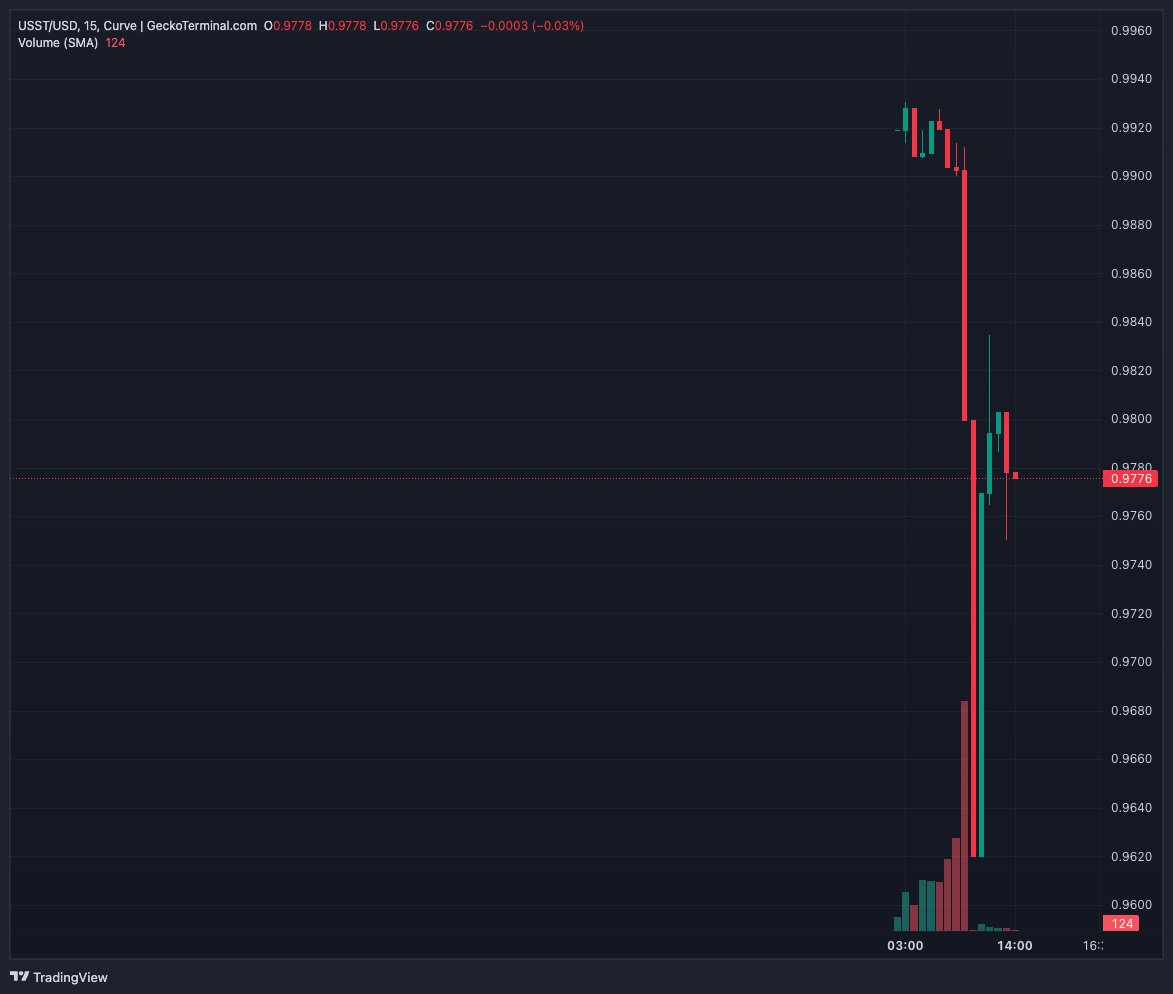
STBL Protocol’s new stablecoin fell below the $1 peg shortly after its launch, highlighting liquidity challenges.
USST, a new stablecoin launched on Friday, October 10th by stablecoin platform STBL, co-founded by one of Tether’s founders, fell below the $1 peg to $0.96 within hours of its debut on Curve, raising concerns about the project’s credibility.
At the time of writing, USST is trading at around $0.9776, down 1.5% in 24 hours, with a market cap of around $967,000 and just 52 holders, according to Geckoterminal data.

Curb pool liquidity was approximately $965,000, 24-hour trading volume was $484,000, and net outflows were approximately $466,000. So far, 50 transactions have been recorded in the last 24 hours.
Earlier today, STBL announced a new USST-related partnership with Ondo Finance. The partnership has a total value of $1.76 billion, with Ondo’s USDY pegged and tokenized yield asset USDY serving as the primary collateral for USST. According to a press release shared with The Defiant, up to $50 million in the USST stablecoin mint will be backed by USDY. USDY, on the other hand, is backed by US Treasuries and cash deposits.
STBL is a decentralized protocol that offers both the stablecoin USST and another yielded NFT YLD that users receive when they mint USST. The project was co-founded by Reeve Collins, one of Tether’s co-founders, who was also the CEO of the USDT issuer from 2013 to 2015. According to DefiLlama, Tether’s USDT dominates the global stablecoin market, with a current market capitalization of $177 billion and accounting for more than 58% of the sector.
The initial depegging event highlights how difficult it is for new stablecoins to establish trust when liquidity depth, transparency, and reliable collateral are critical to maintaining a dollar peg.
what it means
Katie Romero, CEO and co-founder of crypto growth and advisory firm BABs, told The Defiant that initial wobble on the peg is common for stable new launches. Depeg “looks more like a liquidity adjustment issue than a structural flaw,” Romero said, adding:
“Shallow pool depth, incentives still rising, and uneven mint/redemption flows may exaggerate small sales.”
Kadan Stadelmann, CTO of Komodo Platform, echoed Romero’s position, noting that while USST is not yet structurally bankrupt, there is some risk.
“Small deviations in pegs are common in the early days of stablecoins, but if unresolved they can undermine the entire STBL ecosystem and could lead to spillovers from STBL to other stablecoin ecosystems,” Stadelman said. “Historically, stablecoin projects have managed such pegs through yield enhancements, reserve injections, and buybacks.”
Romero added that if the buying and selling channels work smoothly, market makers typically step in to stabilize prices once the profits start to generate value.
STBL token drop
Meanwhile, STBL, the ecosystem’s governance token that was just launched on the BNB Chain ecosystem last month, has plummeted over the past 24 hours amid widespread declines, likely reflecting a loss of confidence following USST’s shaky debut. STBL is currently trading around $0.17, down 18% on the day and over 36% for the week.

“It’s not an autopsy here, it’s a reliability test. STBL is under a lot of pressure,” Romero told The Defiant. He added that today’s token decline “suggests a reflexive loop between the credibility of governance tokens and the perceived resilience of stablecoins (something we’ve seen in earlier early-stage ecosystems to date, such as the UST prepeg recovery),” referring to one of the biggest collapses in crypto involving Terra’s algorithmic stablecoin UST.
She added that while today’s USST Depeg is not substantial from a cryptocurrency perspective, it is enough to shake investor confidence, at least temporarily.
“Social data shows that negative sentiment spiked 3.2x after the peg fell, amplifying that narrative faster than liquidity rebalanced,” Romero continued. Meanwhile, Mr. Stadelman also expressed a similar opinion, saying that STBL tokens are suffering due to USST depegging.
“The overall viability of the project is now in question,” he said. “Users are looking to see how the project responds and whether they can nip problems in the bud and restore confidence.”